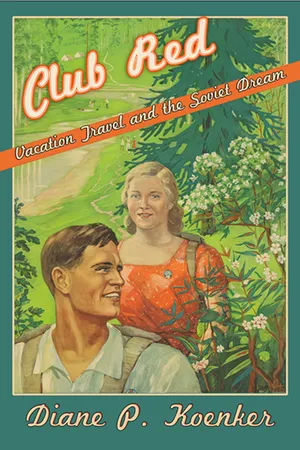
The Bolsheviks took power in Russia 1917 armed with an ideology centered on the power of the worker. From the beginning, however, Soviet leaders also realized the need for rest and leisure within the new proletarian society and over subsequent decades struggled to reconcile the concept of leisure with the doctrine of communism, addressing such fundamental concerns as what the purpose of leisure should be in a workers' state and how socialist vacations should differ from those enjoyed by the capitalist bourgeoisie.In Club Red, Diane P. Koenker offers a sweeping and insightful history of Soviet vacationing and tourism from the Revolution through perestroika. She shows that from the outset, the regime insisted that the value of tourism and vacation time was strictly utilitarian. Throughout the 1920s and '30s, the emphasis was on providing the workers access to the "repair shops" of the nation's sanatoria or to the invigorating journeys by foot, bicycle, skis, or horseback that were the stuff of "proletarian tourism." Both the sedentary vacation and tourism were part of the regime's effort to transform the poor and often illiterate citizenry into new Soviet men and women.Koenker emphasizes a distinctive blend of purpose and pleasure in Soviet vacation policy and practice and explores a fundamental paradox: a state committed to the idea of the collective found itself promoting a vacation policy that increasingly encouraged and then had to respond to individual autonomy and selfhood. The history of Soviet tourism and vacations tells a story of freely chosen mobility that was enabled and subsidized by the state. While Koenker focuses primarily on Soviet domestic vacation travel, she also notes the decisive impact of travel abroad (mostly to other socialist countries), which shaped new worldviews, created new consumer desires, and transformed Soviet vacation practices.
- 328 pages
- English
- ePUB (mobile friendly)
- Available on iOS & Android
eBook - ePub
About this book
Information
chapter one
Mending the Human Motor
Materialist and Marxist, the Soviet Union subscribed to the labor theory of value, privileging work as the foundation of personal worth and as the path toward a society of abundance for all. Work—physical or mental—was the obligation of all citizens. Work ennobled; it was mankind’s highest calling. But work took its toll on the human organism, and along with creating the necessary conditions for productive labor, a socialist system would also include productive rest as an integral element of its economy. The eight-hour workday, a weekly day off from work, and an annual vacation constituted the trinity of restorative and healthful rest in the emerging Soviet system.
Of these three, the annual vacation was the most original contribution of Soviet socialism to promoting the welfare of its workforce. Its labor code of 1922, the first in the world to do so, stipulated that all workers with at least five and a half months of work tenure were entitled to an annual two-week vacation. And as early as 1919, Soviet leaders had begun to create a network of vacation institutions that would maximize the benefit of workers’ annual breaks from production and labor.1 Rest homes and health resorts would become “workshops for the repair of toilers,” offering structured rest and medical therapies that would allow workers to recover their strength and energy for the work year to come. French workers, wrote the health commissar Nikolai Semashko, had only one rest home, the cemetery.2 Soviet workers, by contrast, enjoyed an absolute right to rest, one that would later be enshrined in the 1936 constitution of the Soviet Union.
This chapter explores the practice of Soviet vacationing in rest homes and health spas (kurorty, or cure places) in the 1920s and the 1930s and the evolution of specific doctrines of socialist rest. The question of whether vacation was a recuperative necessity or a socialist entitlement shaped planners’ debates about building vacation institutions and allocating access to them. Alongside these debates, the beneficiaries of the annual socialist vacation asserted their own preferences for fun and merrymaking as well as medicine and therapy. By the late 1930s, a Soviet resort vacation had emerged that featured pleasure as much as medical purpose and attracted more of the Soviet elite than deserving factory toilers in need of bodily repair.
Socialist Rest
Early discussions of production, leisure, consumption, and health in the Soviet Union emphasized the utilitarian element of leisure in the socialist system. New forms of recuperation could provide an antidote to the intensity of socialist forms of production such as shock work (individuals seeking to surpass set norms) and socialist competition (work groups challenging other work units to compete in fulfilling and overfulfilling the plan). The scientific organization of labor required a scientific organization of rest.3 Proletarian leisure had nothing in common with “cinema, skittles, beer, or dancing,” argued officials.4 Rather, it belonged to the serious realms of production and public health. In this context, medicalization emerged as an integral characteristic of Soviet annual leisure. All rational leisure pursuits began with a visit to the doctor, and leisure activists encouraged participants to monitor their own medical conditions to ensure that they were fulfilling their responsibilities to rational recuperation.5 Like a machine, a person needed repair and recuperation: socialist leisure restored the proletarian machine-body.6
The English word “vacation” derives from the Latin stem vacare, to be empty, free. In the context of twentieth-century leisure, vacation is the absence of work. Similarly, the British term “holiday” conveys something sacred and exceptional. The Russian terms for vacation convey a different meaning. The annual leave, otpusk, connotes release, being set free. But the proper purpose of otpusk, for a Soviet worker, was otdykh, from the verb otdyshat′sia, or to recover one’s breath. While the term is conventionally rendered in English as “rest,” its meaning for Soviet culture is a much more active one. Under socialism, wrote one authority on socialist leisure, we challenge the conception that otdykh means “peace [pokoi], inactivity, idleness…A system of correctly organized rest ought to activate the worker or collective farmer, strengthen their will to labor and properly combine amusements, games, and fascinating activities with expanding their political, productive, technical, and general cultural horizons.”7 The annual leave was an empty vessel to be filled with socially, culturally, and economically meaningful activity: otdykh. Another term that often replaced otdykh in practical discussions—ozdorovlenie, or making healthy—reinforced the physiological value of vacation.8 In the Soviet Union, the annual vacation was purposeful, a joint investment by the state and the individual to restore socially useful labor power and to improve the self.
A few experts believed that the need for vacations would wither away in a socialist state. “Normal” socialist labor would not overtire a worker, and life itself would provide sufficiently varied experiences and impressions. “The need for an annual vacation will disappear,” said one social insurance expert. Others argued that since work was a matter of “honor, courage, and valor,” the idea of a vacation devalued the very notion of socialist labor. It was a Menshevik point of view, argued health experts in 1932, to say that labor itself was “harmful.”9
Most Soviet experts embraced the ideal of a socialist system of rest that would employ the discipline of science to determine the optimal organization of vacation time. In this regard, the Soviet Union situated itself squarely in a European Enlightenment tradition that had already fostered a scientific approach to issues of health and the human organism. Nineteenth-century French spa culture had begun to apply science and reason to its therapeutic regimen as early as the 1830s, including a strict use of time marked by the same bells that had begun to rule the capitalist factory. The Russian elite, like Leo Tolstoy’s Alexei Karenin, had a long tradition of seeking their cures in establishments in France, Germany, and Switzerland, and they were well familiar with these practices: “As in previous years, with the coming of spring he went to a spa abroad to restore his health, upset each year by his strenuous winter labours. Returning in July, as usual, he at once sat down with increased energy to his customary work.”10 By the end of the imperial regime, the rise of professions and a growing demand by a middle class for the consumption of good health had produced an explosion of medical remedies, including health spas, that would bring the benefits of modern science to the everyday consumer.11 Soviet medicine built on these traditions, but it added three particularly socialist principles: centralized unity of health care providers, free medical care, and an emphasis on prevention, hygiene, and public health.12
Soviet public health officials who gathered to consider “worker leisure” in 1933 fluently spoke this language of modern science, and medicine constituted the central axis of Soviet vacation practices.13 Climate therapy (sun, sea, and fresh air), physical culture therapy (morning exercises, volleyball, and bracing hikes), and nutritional therapy guaranteed that all Soviet vacationers would spend their annual leaves in scientifically planned and purposeful activities. One’s own physical constitution, as certified by a medical specialist, would determine the best form of rest: whether a six-week recuperation in a tuberculosis sanatorium, a month-long stay at a “climate” rest home, or a long-distance backpacking trip for the physically healthy but emotionally drained urban dweller. Doctors signed the certificates that entitled vacationers to receive a pass to a resort or rest home; they checked the patients in when they arrived, and they sent them home again with a detailed bill of health. The line between treatment and ordinary rest was blurred: indeed, the terms for “patients” (bol′nye—from the word for illness) and “resters” (otdykhaiushchie) were generally interchangeable. In the early years of the Soviet regime, scarce places in health resorts and rest homes were meant to be used by the most medically needy—particularly those suffering from tuberculosis but also those afflicted with neurasthenia. Very soon, however, such restrictions were swamped by the broader social need to provide all working people with the opportunity to recover their strength. Newly nationalized health resorts proved too attractive to be reserved only for the very ill. Vacations at one of the “health places” (zdravnitsy) came to be considered attractive incentives for exemplary work performance. In time, medical rationing of scarce vacation places became supplemented by rationing based on social status, as we shall see.
Sites of Leisure and Restoration: Kurort and Rest Home
Serious socialist vacationing in the Soviet Union built on the nineteenth- and twentieth-century culture of science, and it depended on expert professionals for its implementation. Soviet vacations also relied upon a built environment inherited by the revolution. Before the regime began to construct its own health facilities, it first utilized the nationalized properties of the aristocracy and merchant princes, including the sanatoria and pansions of the prerevolutionary health spas and villas and country estates that would be converted into rest homes.
Russia’s spa culture had first emerged in the service of empire. Mineral spring towns in the Caucasus welcomed recuperating military officers in the early nineteenth century, followed by royal family members who established estates in the area, who in turn attracted a growing population of middle-class consumers of vacations and leisure. Crimea began to host imperial visitors in the second half of the nineteenth century, and by the end of the century a bustling resort culture had developed not only in imperial Yalta but along the Black Sea coast and in the North Caucasus. Medical and commercial interests worked together to attract visitors in search of therapeutic leisure, part of a larger commerce in health remedies that would counter the mounting stresses of urban life.14 The history of the spas of the Black Sea shore in Abkhaziia illustrates this pattern of commercial development. Medical professionals had determined at an international congress in 1898 that the Abkhazian coastal town of Sukhum (population three thousand) possessed ideal climate conditions for the treatment of lung diseases, particularly tuberculosis. Naturalists had already discovered the remarkable botanical variety of the region, and in 1895 a factory owner-philanthropist, Smetskoi, purchased land on which to develop a botanical garden. Shortly after the turn of the century, he added several sanatorium buildings for the treatment of patients on his property, modeling them after the German spas he knew. Growing demand by family members accompanying the patients and by completely healthy individuals led to the further construction of hotels and pansions to accommodate the visitors, served by the farm and vineyards that Smetskoi had also established on his property. Further up the coast, in the small town of Sochi, the Moscow businessman Tarnopol′skii built an expansive spa, soon to be incorporated as the Caucasian Riviera.15
The Black Sea coast remained less popular before the revolution than the four towns clustered in the North Caucasus mineral springs area: Essentuki, Piatigorsk, Kislovodsk, and Zheleznovodsk. It was here that Russian military officers, including the poet Mikhail Lermontov, had sought respite and cures in the nineteenth century. The opening of a railway link from Rostov to the Mineral Waters station in 1875 assured a permanent flow of patients and vacationers. In addition to bath works, sipping stations, and medical facilities, the towns’ commercial developers constructed parks, theaters, and music halls, drawing patrons from Russia’s aristocratic, moneyed, and professional strata.16 Yet by and large, Russians preferred to take their cures abroad. In 1912, German spas counted more than a million visitors; Russian spas attracted only 110,000 cure seekers. The most visited Russian spa, Essentuki, attracted only 13,000 visitors in 1912, while Bohemia’s Karlsbad drew 70,000, including 20,000 Russians. Local pub...
Table of contents
- Acknowledgments
- Abbreviations
- Introduction
- 1. Mending the Human Motor
- 2. Proletarian Tourism
- 3. The Proletarian Tourist in the 1930s
- 4. Restoring Vacations after the War
- 5. From Treatment to Vacation
- 6. Post-proletarian Tourism
- 7. The Modernization of Soviet Tourism
- Conclusion
- Bibliography
Trusted by 375,005 students
Access to over 1.5 million titles for a fair monthly price.
Study more efficiently using our study tools.
Frequently asked questions
Yes, you can cancel anytime from the Subscription tab in your account settings on the Perlego website. Your subscription will stay active until the end of your current billing period. Learn how to cancel your subscription
No, books cannot be downloaded as external files, such as PDFs, for use outside of Perlego. However, you can download books within the Perlego app for offline reading on mobile or tablet. Learn how to download books offline
We are an online textbook subscription service, where you can get access to an entire online library for less than the price of a single book per month. With over 1.5 million books across 990+ topics, we’ve got you covered! Learn about our mission
Look out for the read-aloud symbol on your next book to see if you can listen to it. The read-aloud tool reads text aloud for you, highlighting the text as it is being read. You can pause it, speed it up and slow it down. Learn more about Read Aloud
Yes! You can use the Perlego app on both iOS and Android devices to read anytime, anywhere — even offline. Perfect for commutes or when you’re on the go.
Please note we cannot support devices running on iOS 13 and Android 7 or earlier. Learn more about using the app
Please note we cannot support devices running on iOS 13 and Android 7 or earlier. Learn more about using the app
Yes, you can access Club Red by Diane P. Koenker in PDF and/or ePUB format, as well as other popular books in History & Russian History. We have over 1.5 million books available in our catalogue for you to explore.