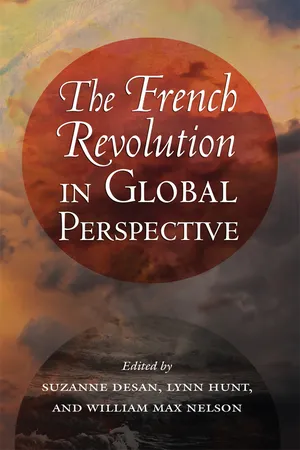
Situating the French Revolution in the context of early modern globalization for the first time, this book offers a new approach to understanding its international origins and worldwide effects. A distinguished group of contributors shows that the political culture of the Revolution emerged out of a long history of global commerce, imperial competition, and the movement of people and ideas in places as far flung as India, Egypt, Guiana, and the Caribbean. This international approach helps to explain how the Revolution fused immense idealism with territorial ambition and combined the drive for human rights with various forms of exclusion. The essays examine topics including the role of smuggling and free trade in the origins of the French Revolution, the entwined nature of feminism and abolitionism, and the influence of the French revolutionary wars on the shape of American empire.The French Revolution in Global Perspective illuminates the dense connections among the cultural, social, and economic aspects of the French Revolution, revealing how new political forms—at once democratic and imperial, anticolonial and centralizing—were generated in and through continual transnational exchanges and dialogues.Contributors: Rafe Blaufarb, Florida State University; Ian Coller, La Trobe University; Denise Z. Davidson, Georgia State University; Suzanne Desan, University of Wisconsin–Madison; Lynn Hunt, University of California, Los Angeles; Andrew Jainchill, Queen's University; Michael Kwass, The Johns Hopkins University; William Max Nelson, University of Toronto; Pierre Serna, Université Paris I Panthéon-Sorbonne; Miranda Spieler, University of Arizona; Charles Walton, Yale University
eBook - ePub
The French Revolution in Global Perspective
- 240 pages
- English
- ePUB (mobile friendly)
- Available on iOS & Android
eBook - ePub
The French Revolution in Global Perspective
About this book
Information
PART I
Origins
1 The Global Underground
SMUGGLING, REBELLION, AND THE ORIGINS OF THE FRENCH REVOLUTION
MICHAEL KWASS
In recent years, historians have globalized the origins of the Industrial Revolution. It is no longer possible to explain how a new system of production emerged in Britain at the end of the eighteenth century without discussing that nation’s prior expansion into the New World, Africa, and Asia.1 Can a similar case be made for that other monumental turning point in modern history, the French Revolution? Did globalization cause the French Revolution? It is a difficult question, not least because globalization is often understood to be an economic phenomenon, while the French Revolution was above all a political event. Any satisfying answer would have to show how the effects of economic globalization penetrated the metropolitan political sphere to generate prerevolutionary tensions, ideas, and debates. However daunting, such a project is of utmost importance, for it holds the promise not only of globalizing the origins of the French Revolution but of integrating a field marked by ever-widening divisions between economic and political-cultural history.2 Introducing globalization into revolutionary studies may help to reverse this process of historiographical fragmentation by drawing together various strands of economic, political, and cultural history. The stakes could not be higher.
The most serious obstacle to globalizing the origins of the Revolution is, ironically, the term “globalization” itself. In common parlance, globalization alludes to an ill-defined, self-propelling process by which world markets inexorably integrate and nation-states inevitably decline as goods, people, and information zip across once-formidable borders. Not surprisingly, historians are skeptical of applying such a simplistic and inherently neoliberal conception of globalization to the past. Dissatisfied with vernacular uses of the term, scholars are formulating more sophisticated theories that take into account the “specificity, contingency, and contestation” at work in long-term historical processes.3
A more rigorously historical understanding of globalization is particularly important for the study of the early modern period. In the seventeenth and eighteenth centuries, when oceanic trade linkages between Asia, Africa, Europe, and the Americas proliferated to create worldwide commercial circuits, government policies were anything but liberal, and trade was anything but free. Indeed, the growth of early modern world trade was bound up inextricably with the rise of powerful European states. As rival European rulers competed for military, diplomatic, and economic hegemony, they intervened in a fast-rising global economy to gain access to, and control over, transcontinental flows of goods. Projecting their dynastic and national rivalries onto the wider world, they built formidable navies, chartered overseas trading companies, founded and fought over colonies, subsidized the transatlantic slave trade and the New World plantation complex, instituted all manner of national prohibitions, monopolies, tariffs, and navigation laws, ran up enormous public debts, and taxed just about anything that moved. It was this bewildering jumble of state policies that Adam Smith rejected as the “mercantile system.”4 Yet, contrary to Smith’s claim that mercantilism was less productive than free trade, recent research suggests that aggressive and exploitative imperial policies deeply enriched early modern metropolitan Europe.5
To acknowledge that world trade emerged in a profoundly illiberal environment is to begin to construct a useful theory of globalization. It may also help us to rethink the origins of the French Revolution, as is underscored by recent studies on the destabilizing effects of global military conflict and rising tensions between colonists and metropolitans.6 Building on such work, this chapter contends that the monarchical state’s engagement with world trade helped to undermine the legitimacy of key institutions, opening the way to revolution. In particular, I will argue that the crown’s interventions in expanding global markets for New World tobacco and Asian cloth inadvertently stimulated the growth of a rebellious underground economy. Not only did the illicit economy give rise to new forms of popular revolt, as legions of smugglers clashed with customs agents while whisking contraband into France, but it provoked an outpouring of politically charged discourse on the need to reform fundamental state institutions.
Among the myriad policies by which Louis XIV engaged world trade, two particularly bold interventions inflamed French politics down to the Revolution. First, in 1674, seeking to harness the fiscal power of domestic consumption, the Sun King turned west to the Atlantic world and established a state tobacco monopoly.7 One of a handful of tropical psychoactive products to inundate Europe in the seventeenth century, tobacco was widely regarded as a potent medicinal remedy and miraculous catalyst of social interaction. It was also addictive. Capitalizing on soaring home demand—and exploiting a new system of slave labor in the New World—the French monarchy banned all private trade in the leaf and marketed millions of pounds of slave-produced American tobacco to its subjects. The tobacco monopoly went well beyond the geographic confines of its elder sibling, the salt monopoly, drawing the French monarchy into a sprawling Atlantic economy that connected peoples from four continents and several empires.
To manage such a large-scale operation and to police the domestic ban on nonstate tobacco, the crown leased the monopoly to the General Farm, a private financial company that contracted the right to collect indirect taxes while advancing enormous loans to the king. Initially adhering to the basic mercantilist principle that mother countries should, whenever possible, import raw goods from their own colonies, the Farm procured tobacco from the French Caribbean colony of Saint-Domingue and from Louisiana. But the Farmers General, the wealthy financiers who ran the Farm, soon spurned the French colonies and turned to British merchants, who could deliver cheaper, better-quality leaf from Chesapeake Bay in North America.8 By the middle of the eighteenth century, the Farm was purchasing millions of pounds of Virginian tobacco a year, processing it in colossal manufactories, and shipping the final product to some ten thousand tobacconists across France. State tobacconists peddled the herb to local consumers, who smoked, chewed, and, above all, snorted it at their leisure, filling the royal coffers annually to the tune of 30 million livres (henceforth l.).
Next, to protect French textile producers from global competition, Louis XIV turned east to erect a shield against the influx of inexpensive, high-quality cloth from Asia, in particular Indian calico.9 Long before and well after the arrival of the first European vessels, India was the greatest textile producer in the world, its renowned cloth gracing markets from the islands of Southeast Asia to Islamic Persia to the Swahili ports of East Africa. When European traders first approached Indian textile merchants in the early seventeenth century, they did not dream of reorganizing the region’s system of labor and production, as their counterparts would do in the New World. Rather, they established fortified trading settlements on the coast and, with an occasional military assist, tapped into existing commercial structures. In 1664, jealous of the commercial success of his rivals, especially the Dutch Republic, Jean-Baptiste Colbert established the French East India Company.10 With a large injection of state funds, this “Versailles of commerce” joined the fray in the Indian Ocean, shipping cloth from the subcontinent around the Cape of Good Hope to Lorient, in Brittany. Printed with vivid designs whose colorfast brilliance far surpassed anything European producers could fabricate, Indian calico became so popular among French consumers that traditional textile manufacturers, panicked by the overseas competition, vigorously lobbied the government for protection. In 1686, the monarchy responded by banning all importation of the cloth. Policed by the guards of the General Farm—and hence intertwined with the monarchy’s fiscal apparatus—the prohibition lasted seventy-three years, only to be replaced with a heavy tariff in 1759.
The tobacco monopoly and the calico ban met with resounding success. The monopoly gave a much-needed boost to royal finances, while the ban helped protect a critical sector of the domestic industrial economy. But the two interventions in world trade had the unintended consequence of spawning a massive underground economy. Although the principal commodity of the French black market had long been salt, a local French product whose sale in many parts of the kingdom had for centuries been monopolized by the monarchy, the tobacco monopoly and calico prohibition provoked a surge in contraband, in effect globalizing the metropolitan parallel economy in the final century of the Old Regime.11
The scale of this illicit trade was immense. Easier to transport and, pound for pound, far more valuable than salt, contraband tobacco flooded all quarters of the French monopoly zone, from the coast of Languedoc in the south to the littoral of Brittany and Normandy in the west. Supply ships hovered off the mainland as small craft ran tobacco ashore, where locals picked it up and hauled it inland for distribution. The most heavily trafficked routes into the territory of the monopoly, however, lay to the north and east, where precious Virginian tobacco entered the Continent by way of Dunkirk and the ports of the Netherlands to pool just beyond the French fiscal border. From there, the leaf flowed in an arc that stretched across Alsace (a privileged French province not subject to the monopoly) down through the Swiss pays de Vaud to Savoy. All along this trajectory, the Virginian was mixed with cheap, homegrown European weed to create an inexpensive yet good-quality blend that was perfect for smuggling. Traffickers purchased blends for as little as 12 sols a pound and sold them in the monopoly zone for as much as 36 sols in the provinces and up to 50 sols in Paris, tripling their money and helping to put tobacco within reach of poor consumers, who could ill afford the 62 sols charged by the Farm.12 By the middle of the eighteenth century, an estimated one-third of the tobacco consumed in France was illicit.13
Just as the tobacco monopoly failed to prevent contraband leaf from entering France, the 1686 calico ban did not stop the influx of calicos from India. Smugglers secreted the cloth into France from the Netherlands, which had not banned its import, while employees of the French East India Company slipped what they could through customs. Permitted to import the fabric for the exclusive purpose of reexportation, company officials and sailors nonetheless siphoned off portions of their cargo into the domestic shadow economy. Most of the “Indian” cloth that was smuggled into France, however, was not produced in India at all. Whereas today we associate Asia with the mass production of counterfeit Western goods (think Nike sneakers), in the eighteenth century it was the Europeans who manufactured imitations of high-quality Asian products. Producers in free ports like Marseille and enclaves like the Comtat Venaisson joined counterparts east of the French customs border in Switzerland and Alsace to manufacture prodigious supplies of low-quality knockoffs. Between genuine Indian calico that seeped in from the reexport market and European-produced facsimiles that were smuggled into France, there was plenty of cloth to be had on the black market. One contemporary economist estimated that 16 million l. of calico was illegally consumed in France every year during the ban.14 After the prohibition was lifted in 1759, the domestic calico industry boomed as Swiss firms transplanted themselves onto French soil, but the 25 percent tariff still made it worthwhile for foreign producers to circumvent customs.15
Countless men, women, and children trafficked in tobacco and calico to supplement their household income. While the underground salt trade remained a largely artisanal affair in which indigent laborers eked out an existence in a punishing economy, the extraordinarily high profits to be had in tobacco and calico trafficking attracted professional types as well.16 Noble and merchant investors wheeled and dealed behind the scenes; mobile professionals (peddlers, coachmen, cart drivers, soldiers, and bargemen) built false compartments in their vehicles or buried contraband beneath heaps of legitimate cargo; innkeepers offered weary smugglers everything from credit and storage space to food and shelter; and domestic servants stored wholesale supplies in their masters’ residences, passing them on to dense networks of urban retailers, the capillaries of the distribution system. Paris was positively crawling with petty tobacco dealers who, operating out of cramped apartments, neighborhood bars and cafés, and secluded cemeteries, hawked half ounces of snuff wrapped in paper cones.17
One measure of the increasingly organized underground market was the rise of gangs. Salt gangs had existed since the chaotic final years of Louis XIV’s reign. They were soon joined by sophisticated tobacco and calico bands that plied a high-volume trade along the eastern border. In northeastern France, authorities were aware of at least thirty-eight large bands operating in the second half of t...
Table of contents
- Acknowledgments
- Introduction
- Part I. Origins
- Part II. “Internal” Dynamics
- Part III. Consequences
- Part IV. Coda
- Notes
- List of Contributors
Trusted by 375,005 students
Access to over 1.5 million titles for a fair monthly price.
Study more efficiently using our study tools.
Frequently asked questions
Yes, you can cancel anytime from the Subscription tab in your account settings on the Perlego website. Your subscription will stay active until the end of your current billing period. Learn how to cancel your subscription
No, books cannot be downloaded as external files, such as PDFs, for use outside of Perlego. However, you can download books within the Perlego app for offline reading on mobile or tablet. Learn how to download books offline
Perlego offers two plans: Essential and Complete
- Essential is ideal for learners and professionals who enjoy exploring a wide range of subjects. Access the Essential Library with 800,000+ trusted titles and best-sellers across business, personal growth, and the humanities. Includes unlimited reading time and Standard Read Aloud voice.
- Complete: Perfect for advanced learners and researchers needing full, unrestricted access. Unlock 1.5M+ books across hundreds of subjects, including academic and specialized titles. The Complete Plan also includes advanced features like Premium Read Aloud and Research Assistant.
We are an online textbook subscription service, where you can get access to an entire online library for less than the price of a single book per month. With over 1.5 million books across 990+ topics, we’ve got you covered! Learn about our mission
Look out for the read-aloud symbol on your next book to see if you can listen to it. The read-aloud tool reads text aloud for you, highlighting the text as it is being read. You can pause it, speed it up and slow it down. Learn more about Read Aloud
Yes! You can use the Perlego app on both iOS and Android devices to read anytime, anywhere — even offline. Perfect for commutes or when you’re on the go.
Please note we cannot support devices running on iOS 13 and Android 7 or earlier. Learn more about using the app
Please note we cannot support devices running on iOS 13 and Android 7 or earlier. Learn more about using the app
Yes, you can access The French Revolution in Global Perspective by Suzanne Desan, Lynn Hunt, William Max Nelson, Suzanne Desan,Lynn Hunt,William Max Nelson in PDF and/or ePUB format, as well as other popular books in History & French History. We have over 1.5 million books available in our catalogue for you to explore.