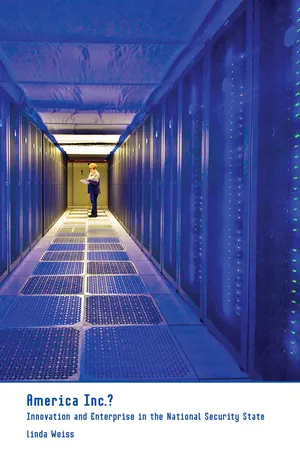
For more than half a century, the United States has led the world in developing major technologies that drive the modern economy and underpin its prosperity. In America, Inc., Linda Weiss attributes the U.S. capacity for transformative innovation to the strength of its national security state, a complex of agencies, programs, and hybrid arrangements that has developed around the institution of permanent defense preparedness and the pursuit of technological supremacy. She examines how that complex emerged and how it has evolved in response to changing geopolitical threats and domestic political constraints, from the Cold War period to the post-9/11 era.Weiss focuses on state-funded venture capital funds, new forms of technology procurement by defense and security-related agencies, and innovation in robotics, nanotechnology, and renewable energy since the 1980s. Weiss argues that the national security state has been the crucible for breakthrough innovations, a catalyst for entrepreneurship and the formation of new firms, and a collaborative network coordinator for private-sector initiatives. Her book appraises persistent myths about the military-commercial relationship at the core of the National Security State. Weiss also discusses the implications for understanding U.S. capitalism, the American state, and the future of American primacy as financialized corporations curtail investment in manufacturing and innovation.
- 264 pages
- English
- ePUB (mobile friendly)
- Available on iOS & Android
eBook - ePub
About this book
Information
1
The National Security State and Technology Leadership
The PC industry is leading our nation’s economy into the 21st century…There isn’t an industry in America that is more creative, more alive and more competitive. And the amazing thing is all this happened without any government involvement.
Bill Gates, 1998
There is no getting around the governmental role in innovation. Even cowboy innovators usually have government technology supporters in their rearview mirror…The reality is that government support necessarily must pervade the market for radical technology advances.
William B. Bonvillian, 2009
But what, apart from the roads, the sewers, the medicine, the Forum, the theater, education, public order, irrigation, the fresh-water system and public baths…what have the Romans done for us? (And the wine, don’t forget the wine…).
Monty Python’s Life of Brian, 1979
Bill Gates’s “state-less” depiction of America’s high-tech economy perfectly captures the prevailing understanding of U.S. techno-industrial preeminence. Both at home and abroad, the United States is widely portrayed as the quintessential free-market economy. In this reputedly freewheeling entrepreneurial setting, robust antistatism combines with weak state capacity to ensure that the U.S. government contributes little more to America’s global technology leadership than a business-friendly environment.
This book tells a different story, one that links high technology with national security and (antistatist) political norms.1 It proposes that there is more to American capitalism and the American state than meets the free-market eye. In getting to this “something more,” we start from the substantive observation that the U.S. has an unmatched capacity for transformative innovation.2 For half a century and more, the United States has been the uncontested high-technology hegemon, leading the world in virtually all the major technologies that drive the modern economy and underpin its prosperity. Think of innovations such as communications satellites, microelectronics, computers, software, biotechnology, the internet—the list goes on. More striking still is that every one of these breakthrough innovations emanated from the United States precisely in the period since World War II, giving rise to entirely new industries.
My main argument focuses on the role of what I call the national security state or NSS (though I use the term in an unusual sense; more on this shortly). Since World War II, the NSS has dominated in high-risk, breakthrough technologies and emerging industries; this pursuit has established, and continues to secure, the foundations for a high-technology commercial sector. Nevertheless, the NSS pursues technology leadership in order to sustain U.S. military-political primacy, not to achieve commercial advantage. To do so it has to rely on the private sector to advance its technology goals. After all, the days when the military could source all it needed from its arsenals are long gone. But as leading-edge capabilities came to reside less and less within the pool of large defense contractors (core of what is traditionally described as the military-industrial complex), and more and more within high-tech firms reluctant to work on security-related projects, the NSS was compelled to retool its incentive system. As I explain in more detail below, increasingly since the 1980s the NSS has had to reach outside the traditional pool of large contractors to attract the most innovative companies, by building commercial goals into its programs. By placing greater emphasis on commercialization opportunities, some of these incentives seek to sweeten collaboration with the Department of Defense (DoD) and other security-related agencies, and thus to increase NSS influence over the direction of technology. In this manner, commercialization becomes the sine qua non of technological-cum-military primacy. Far from being mutually exclusive, security and commerce have become closely entwined in NSS policy and practice.
At one level then, this is a story about how the geopolitics of threat perception has generated a vast state machinery geared to perpetual innovation in the quest for technological superiority. At another level, it is a story about the domestic challenges and political obstacles that have reshaped the NSS and its relationship with the private sector, not only by integrating the goals of security with those of commerce but also by merging public and private resources in distinctive ways.
Although focused on innovation, this is not a study of the nature or process of innovation. I am interested in the sources of U.S. technological dominance because this issue opens a window onto larger concerns at the center of contemporary political science debates. Two in particular motivate the research for this book. One turns analytical attention inward and invites analysis of the U.S. model of capitalism—in particular, the question of the American state’s transformative capacity in the techno-industrial realm. Here, the standard view is of a weak, limited, even dysfunctional state (aka governing apparatus) in which numerous veto points work against—and undermine—coherent problem solving and policymaking. To this conception must be added a strong dose of antistatism which—institutionally, politically, and ideologically—has regularly thwarted efforts to normalize the state’s active role in promoting commercial activities.
A second debate turns attention outward and concerns U.S. primacy (or, if one prefers, preeminence) in the world of international relations. It asks: Whither U.S. power in the context of a rising China and financially weakened public and private sectors? Here, so-called American declinists have regularly painted a grim picture of the American future. Most often implicated in this declinist perspective is the role of the defense sector as an unmitigated burden on the U.S. economy. In speaking to both concerns, I bring to bear a fresh perspective that revises both the “weak state” view of U.S. economic dynamism and the “defense-burdened” view of U.S. economic decline.3
The U.S. Puzzle
The fact that all the major advanced industries of the past sixty years have been pioneered in the United States raises an obvious question: Where does this capacity for transformative innovation come from? Why the United States? In a quasi-foundational narrative, this uncommon (exceptional?) capacity is attributed to a culture of risk-taking and entrepreneurship in which creative individuals, working on their own initiative, push out new ideas and new widgets based on their own ingenuity and derring-do. The adulation accorded the late Steve Jobs for all the wonderful Apple gadgetry is merely the latest example of this influential story. Of course this view of the role of entrepreneurs is well founded, both in American economic history and in today’s economy. But it is also extremely one-sided—and therefore false, since it leaves out what is equally important.
Looking with two eyes rather than one, we see another side to the innovativeness of such celebrated U.S. creations as Apple and Google namely, a medley of technologies that have emerged from costly and sustained state sponsorship. From the GPS to the cell phone, from the mouse to the Siri voice-activated personal assistant application on the new iPhone, or to Google Earth, Google Translate, and indeed Google’s search engine—all have one thing in common. They, like the internet and the IT revolution that preceded it, emerged from patient federal investment in high-risk innovation, focused in the main on national security objectives. It is of course often recognized that the American state has played a catalytic role in nurturing technological innovation and founding new industry sectors. Nevertheless, explaining this uncommon capacity for transformative innovation requires less conventional thinking than either of the binary categories “state” or “market” allows. It also requires a less conventional focus than simply on R&D spending or defense spending or even the military.
The Argument
So what accounts for America’s transformative capacity? Where do its breakthrough innovations come from? My answer traces the relationship between high technology, national security, and political culture. It advances three interlinked propositions regarding the role of the NSS as technology enterprise and commercialization engine; its geopolitical drivers; and the institutional consequences of an antistatist constraint.
The national security state as technology enterprise. First, America’s capacity for transformative innovation derives not merely from the entrepreneurship of its private sector, or simply from the state as such, but from the national security state—a particular cluster of federal agencies that collaborate closely with private actors in pursuit of security-related objectives. The NSS is a wholly new postwar creation that is geared to the permanent mobilization of the nation’s science and technology resources for military primacy, and here I document and explain why it has had to become increasingly involved in commercial undertakings. Although centered on defense preparedness, the NSS is a good deal broader than the military, yet narrower than the state as a whole. In addition to its defense core in the Department of Defense, the NSS comprises several other components created at the height of the Cold War to pursue, deliver, or underwrite innovation in the service of securing technological supremacy. Although some are designated as “civilian” in their origins, evolution, and current mix of activities, these NSS components remain deeply enmeshed in national security or dual-use functions (as we shall see in chapter 2).4 Acting as commander in chief, the president sits at the peak of this complex, supported by the Oval Office and, in particular, the Office of Science and Technology Policy. In sum, I discuss NSS activities not in the more popular sense of a surveillance state, but as a national “technology enterprise” in which the military is the central, but far from exclusive, actor.
In telling this story, I demonstrate and account for a major shift in NSS innovation programs and policies that involved the national security agencies in cultivating and undertaking commercialization ventures. At first (c. 1945 up to the 1970s), this process of fostering commercially relevant (general-purpose or dual-use) technologies took both direct and indirect forms. Then (especially from the 1980s onward) it also took a more proactive form, via patenting and licensing reforms and cooperative agreements to transfer technology from the federal labs to the private sector, via the launching of new procurement and joint innovation initiatives, and via the creation of new venture capital (VC) schemes. By placing greater emphasis on commercialization opportunities, some of these incentives sought to sweeten collaboration with the DoD and other security-related agencies, and thus to increase NSS influence over the direction of technology. A significant problem for the NSS has been that since the late 1970s, it has become progressively more challenging to enlist innovative companies in the private sector to work on security-related projects. While traditional defense suppliers grew increasingly large and specialized in systems integration, by the 1970s the more innovative producer companies—above all, critical suppliers of integrated circuits—had begun to pull away from the federal market. Attracting nondefense firms to do defense work was at one time easy because the government market (in semiconductors and computers, for instance) was so much larger than the private market, and healthy profits could be made. But by the mid-1970s commercial markets had come into their own, leading firms to reorient production to suit the more standardized demand. One consequence of lacking the earlier pull power of massive demand is that NSS agencies have had to create new incentives to foster private-sector collaboration. One of the major incentives intended to reattract the private sector is the inclusion of commercial goals in NSS technology policies. Commercial viability therefore has to stand alongside security and technological supremacy in NSS policy. For instance, if a firm works with an agency to create a technology, service, or prototype for use by the U.S. Army, it will also be encouraged from the outset of the project to create a similar product for the commercial market. In this way, and many more, the NSS has progressively been drawn into promoting commercial innovation for security reasons. One implication, demonstrated in some detail, is that the NSS has achieved a much broader reach than commonly implied by the notion of a military-industrial complex.
Geopolitical drivers. What are the drivers of the NSS technology enterprise? Geopolitics and related threat perceptions have been the original catalyst for NSS formation and its evolution as an innovation engine. This state- (and technology-) building dynamic has occurred in three broad phases: the Cold War, the rise of Japan as techno-security challenge, and the post-9/11 era of asymmetric threats. The NSS emerged and expanded in fits and starts after World War II in response to a perceived international threat, emanating from the Soviet Union, that proved both enduring and persistent. It is instructive to note that in this phase the NSS bears at least some comparison with the erstwhile “developmental states” of Northeast Asia. They too emerged in response to an intensely perceived security threat, from neighboring China and North Korea, but instead sought national security more broadly via economic improvement, or industrial catch-up.5 Living on the fault lines of the Cold War in the presence of a credible and unyielding security threat exerted an unusual pressure on the East Asian states to pursue security by building economic strength. More distinctively in the case of Japan, Peter Katzenstein has developed the argument that, against the backdrop of terrible defeat, domestic power struggles succeeded in reorienting Japan’s conception of security in favor of economic rather than military strength. Thus the Japanese state practices a form of “technological national security” in order to ensure against its resource dependence and reduce its exposure to international supply disruptions (Katzenstein 1996, 2005; also Samuels 1994).
Fundamental motivations drawn from different historical experiences thus serve to underline a unique feature of the NSS. In contrast to Japan (and the East Asian developmental states more generally), America’s national security state has been geared to the pursuit of technological superiority not for reasons of national independence, economic competitiveness, or resource dependency, but in order to maintain American primacy. For the United States, the experience of World War II drove home the point that science and technology (S&T) was a game changer—the key to winning the war—and that future preparedness would depend on achieving and sustaining technological superiority. Geopolitics is thus the driver, not economics. I emphasize this point because many analysts have viewed the Pentagon as the source of an industrial policy that is pursued beneath the radar6—a claim that this book disputes since it mistakes the nature of the primary driver.7 From its inception, the NSS was tasked with ensuring the technology leadership of the United States for the purpose of national defense. Even as the Soviet menace retreated, security proved paramount as the U.S. confronted a newly resurgent Japan that threatened to dethrone it as the regnant technology power.
Appreciating the strength and intensity of the U.S. security focus means never underestimating the significance of this point: as long as U.S. military strategy continues to rely on a significant technology lead over its adversaries (real or potential), threats to that lead can never be simply (or even primarily) a commercial matter—even when the NSS “goes commercial.”
It is in the post-9/11 era of multiple asymmetric threats that a shadow has crept over the NSS technology enterprise. In the first place, it has come to lack the strong geopolitical stimulus of a well-defined adversary, thus softening its laser-like focus on advancing the technology frontier. Add to this the problems of budgetary issues, rancorous politics, and an extreme offshoring movement that disconnects innovation from production, and you h...
Table of contents
- Preface
- List of Abbreviations
- 1. The National Security State and Technology Leadership
- 2. Rise of the National Security State as Technology Enterprise
- 3. Investing in New Ventures
- 4. Beyond Serendipity: Procuring Transformative Technology
- 5. Reorienting the Public-Private Partnership
- 6. No More Breakthroughs?
- 7. Hybridization and American Antistatism
- 8. Penetrating the Myths of the Military-Commercial Relationship
- 9. Hybrid State, Hybrid Capitalism, Great Power Turning Point
- Notes
- References
- Acknowledgments
Trusted by 375,005 students
Access to over 1.5 million titles for a fair monthly price.
Study more efficiently using our study tools.
Frequently asked questions
Yes, you can cancel anytime from the Subscription tab in your account settings on the Perlego website. Your subscription will stay active until the end of your current billing period. Learn how to cancel your subscription
No, books cannot be downloaded as external files, such as PDFs, for use outside of Perlego. However, you can download books within the Perlego app for offline reading on mobile or tablet. Learn how to download books offline
Perlego offers two plans: Essential and Complete
- Essential is ideal for learners and professionals who enjoy exploring a wide range of subjects. Access the Essential Library with 800,000+ trusted titles and best-sellers across business, personal growth, and the humanities. Includes unlimited reading time and Standard Read Aloud voice.
- Complete: Perfect for advanced learners and researchers needing full, unrestricted access. Unlock 1.5M+ books across hundreds of subjects, including academic and specialized titles. The Complete Plan also includes advanced features like Premium Read Aloud and Research Assistant.
We are an online textbook subscription service, where you can get access to an entire online library for less than the price of a single book per month. With over 1.5 million books across 990+ topics, we’ve got you covered! Learn about our mission
Look out for the read-aloud symbol on your next book to see if you can listen to it. The read-aloud tool reads text aloud for you, highlighting the text as it is being read. You can pause it, speed it up and slow it down. Learn more about Read Aloud
Yes! You can use the Perlego app on both iOS and Android devices to read anytime, anywhere — even offline. Perfect for commutes or when you’re on the go.
Please note we cannot support devices running on iOS 13 and Android 7 or earlier. Learn more about using the app
Please note we cannot support devices running on iOS 13 and Android 7 or earlier. Learn more about using the app
Yes, you can access America Inc.? by Linda Weiss in PDF and/or ePUB format, as well as other popular books in Economics & North American History. We have over 1.5 million books available in our catalogue for you to explore.