Jack Snyder's analysis of the attitudes of military planners in the years prior to the Great War offers new insight into the tragic miscalculations of that era and into their possible parallels in present-day war planning. By 1914, the European military powers had adopted offensive military strategies even though there was considerable evidence to support the notion that much greater advantage lay with defensive strategies. The author argues that organizational biases inherent in military strategists' attitudes make war more likely by encouraging offensive postures even when the motive is self-defense.Drawing on new historical evidence of the specific circumstances surrounding French, German, and Russian strategic policy, Snyder demonstrates that it is not only rational analysis that determines strategic doctrine, but also the attitudes of military planners. Snyder argues that the use of rational calculation often falls victim to the pursuit of organizational interests such as autonomy, prestige, growth, and wealth. Furthermore, efforts to justify the preferred policy bring biases into strategists' decisions—biases reflecting the influences of parochial interests and preconceptions, and those resulting from attempts to simplify unduly their analytical tasks.The frightening lesson here is that doctrines can be destabilizing even when weapons are not, because doctrine may be more responsive to the organizational needs of the military than to the implications of the prevailing weapons technology. By examining the historical failure of offensive doctrine, Jack Snyder makes a valuable contribution to the literature on the causes of war.
eBook - ePub
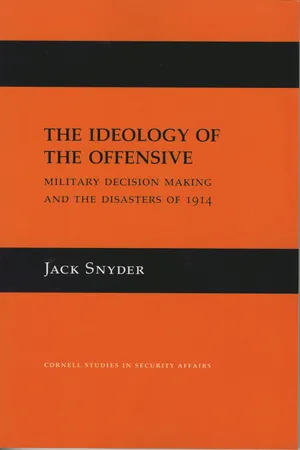
The Ideology of the Offensive
Military Decision Making and the Disasters of 1914
- 272 pages
- English
- ePUB (mobile friendly)
- Available on iOS & Android
eBook - ePub
About this book
Information
[1]
Military Bias and Offensive Strategy
All of the major continental powers entered World War I with offensive strategies; all suffered huge strategic costs when, predictably, their offensives failed to achieve their ambitious aims. These failed offensives created political and operational difficulties that haunted the states throughout the war. Germany’s Schlieffen Plan, for example, helped bring Britain into the war, provoking the protracted naval blockade that the Germans had hoped to avoid. Similarly, the miscarriage of France’s Plan 17 allowed Germany to occupy large portions of northeastern France, hindering the operation of the French wartime economy and making more difficult a negotiated settlement on the basis of the status quo ante. Finally, the annihilation of the Russian forces invading East Prussia squandered troops that might have produced decisive results if concentrated on the Austrian front. Each of these countries would thus have been in a better position to secure an acceptable outcome if it had fought the war defensively from the beginning.
The offensive strategies had another, more profound cost: the war might never have occurred had the advantages of the defender been better appreciated. States would have understood that maintaining their security did not require preventive attacks on others. The lure of conquest (in any event a secondary motive for the offensives) would have been diminished if its difficulties had been more clearly recognized.1
The adoption of these offensives cannot be explained in terms of a rational strategic calculus. As the Boer and Russo-Japanese wars had foreshadowed, the tactical and logistical technologies of this era strongly favored the defender. In no case did geopolitical considerations decisively outweigh the technological advantages of a defensive strategy. Likewise, aggressive national aims are inadequate as an explanation for deciding upon the ill-fated offensives of 1914. While none of the major continental states could be described as strictly favoring the status quo, the overriding criterion used by top military planners was security, not conquest.
The choice of offensive strategies by the continental powers was primarily the result of organizational biases and doctrinal over simplifications of professional military planners. Some causes of offensive bias may have been common to all countries. The decisive sources of bias, however, were peculiar to each case, rooted in specific interests, preconceptions, and circumstances.2
Of the three largest continental powers, the French chose the least rational strategy. Technology, geography, and the need to coordinate with Russian efforts should all have pushed them strongly toward the defensive, but offensive bias overshadowed these incentives. The source of this bias was the military’s organizational interest in preventing the professional army from being turned into a training cadre for a mass army composed of civilian reservists. Since everyone agreed that French reservists were good only for defense, the military fought institutional change by touting the indispensability of the offense. For the same reasons, they discounted the significance of German reservists, an intelligence failure that had near-fatal consequences in August 1914. In the aftermath of the venomous Dreyfus affair, institutional protection became an overwhelming concern for the French military and a powerful source of bias that had no equal in Germany or Russia.
Germany’s geopolitical circumstances offered a clear incentive neither for offense nor for defense. Because of Russia’s slow mobilization, a rapid German offensive had some chance of beating France and Russia piecemeal, before Russia’s full weight could be brought to bear. A quick victory would have been difficult, however, because of the defender’s tactical and logistical advantages. On the other hand, a German defensive strategy, based on an impregnable line of fortifications on the short Franco-German border, could not have offered quick victory either, but it would have provided two major advantages. First, if Germany had fought a strictly defensive war, Britain would not have had sufficient motive to join the Franco-Russian war effort. Second, with France checked by a German defense line, Russia would have been easier to deter or defeat.
Yet parochial interests and a parochial outlook would lead the German military to denigrate defensive alternatives. The extraordinary prestige of the German army rested on its historical ability to deliver rapid offensive victories, as it had against Austria in 1866 and France in 1870. Although German strategists recognized that improvements in firepower were making the attacker’s task tactically more difficult, they could not accept that a future war would inevitably take the form of an inglorious, unproductive stalemate. At the same time, their professional preoccupation with potential military threats led them to overestimate the inevitability of war with France and Russia. As a result, they underrated the ability of a defensive posture to deter war and overrated the need for a capability to attack preventively. Over time, these offensive predispositions became magnified and dogmatized, as the powerful, centralized General Staff succeeded in inculcating the whole officer corps with a simple, standard offensive doctrine.
Germany’s widely anticipated decision to deploy more than four-fifths of its army against France gave Russia a strong incentive to attack the German rear. In the Russian case, the error lay not in the decision to attack but in the decision to attack too soon with too weak a force. The hasty, undermanned advance into East Prussia led to the encirclement and destruction of a Russian force of 100,000 men at Tannenberg. This strategic disaster can be explained partly by intramilitary politics and partly by the Russians’ psychological need to see the necessary as possible. The General Staff in St. Petersburg, emphasizing their strategic aim of preventing a collapse of the French army, placed the highest priority on an early attack on Germany’s rear. However, local commanders in Kiev sought to divert forces for their own offensive, against Austria. The absence of a strong central authority to adjudicate this dispute resulted in a compromise that left commanders on both fronts too weak to carry out their tasks. Nonetheless, the General Staff continued to deem a hasty attack on Germany a strategic necessity. Choosing to see the necessary as possible, they discounted captured German war games that foretold the spectacular German victory at Tannenberg.
In sum, strategic decision making in all three states was similar in that institutional and cognitive biases led to the adoption of unduly offensive strategies. In each case, however, the intensity and the decisive causes of offensive bias differed because of varying external and internal circumstances. Bias was greatest—and most influenced by motivational factors—in France, where grave threats to organizational interests provided an overwhelming incentive to skew strategy and doctrine. Bias was less acute in Germany and Russia, where no single motive for error was quite so compelling. There, the choice of offensive strategy resulted from the interplay of rational plausibility, motivational biases of lesser intensity, and doctrinal oversimplifications.3
RATIONALITY AND BIAS IN STRATEGIC ANALYSIS
A rational policymaker may prefer either an offensive or a defensive strategy; the choice depends on goals and on a variety of geopolitical factors. Almost invariably, some degree of bias will influence the assessment of these factors. Generally speaking, we can divide sources of bias in decision making into two groups: the first, biases rooted in the motivations of the decision makers, especially in their parochial interests, and the second, biases that result from decision makers’ attempts to simplify and impose a structure on their complex analytical tasks. Both groups of bias can be viewed as cognitive phenomena, skewing the perceptions and choices of individual decision makers; they can also be considered organizational phenomena, shaping the structure, ideology, and standard operating procedures of institutions.4
Sometimes decision makers prefer policies because of motives they would rather not admit, even to themselves. In such cases, the need to find an acceptable justification for the policy they prefer will skew perceptions and analysis. “Decision making” will be a process of rationalization rather than of rationality. In strategic policy making, the most pervasive source of motivational bias is the institutional interest of the military.5 The military tends to favor policies that promote its organizational aims. Since these favored policies must be justified in strategic terms, strategic perceptions and analysis are likely to become skewed whenever organizational interests are at odds with sound strategy.
Rationalization is also likely when the strategist has no acceptable options—that is, when any strategy would almost certainly involve an unacceptable sacrifice of some key value. In practice, decision makers in this situation tend to adopt risky strategies, but in rationalizing this choice, they also tend to overrate the probability that their strategy will succeed. In other words, people see the “necessary” as possible.
Because decision makers need to make complex analytical tasks more manageable, they inevitably use perceptual and analytical shortcuts in devising solutions to problems6 and thus fall victim to a second group of biases. In military analysis, the most important simplifying device is the strategic doctrine, which imposes a structure on the strategic problem and suggests possible solutions. But doctrine, in simplifying reality, introduces biases into strategic analysis.
In most cases, then, the choice between offensive and defensive strategies will be the result of some combination of rational incentives, motivational biases, and doctrinal oversimplifications. In particular circumstances, examined in detail immediately below, one or another of these determinants will dominate the decision makers’ choice.
OFFENSE AND DEFENSE: A RATIONAL CALCULUS
A rational strategist’s choice of an offensive or a defensive strategy should depend on national aims (i.e., foreign-policy goals), technological and geographical constraints, and the military balance. In 1914 the particular circumstances of each of the European powers produced in each case a different set of rational incentives. France’s circumstances should have pointed decisively to defense. In Germany, there were some incentives for offense but probably stronger reasons to remain on the defensive. In the Russian case, Germany’s decision to deploy only weak forces in the East virtually forced Russia to mount some kind of attack, but a less hasty offensive would have fared better than the plan that was actually adopted.
National Aims
A state particularly needs an offensive strategy when it seeks to conquer or coerce others. France, Germany, and Russia each had some interest in revising the political status quo in Europe, but in no case did this interest outweigh security as the primary determinant of military strategy.
Historians sometimes assume that the French offensive strategy was dictated by an offensive political aim—regaining the provinces of Alsace and Lorraine, lost to Germany in 1870.7 The French General Staff certainly did hope that victory in a general European war would “enable the map of Europe to be redrawn,” but this hope did not determine the shape of their war plan.8 Even proponents of a “defensive-offensive” or “counteroffensive” strategy wanted to recapture Alsace-Lorraine, but they argued that this could be done only by capitalizing on the strategic error that Germany would make in attacking France.9 Meanwhile, proponents of offense did not dispute that operational necessities, not the revanchist urge, should shape French strategy; they simply had a different view of those necessities.10
Germany was also inclined to revise the political status quo in Europe. Although the desire to annex European territory was not particularly strong until the war had already begun, Germany had other, more diffuse revisionist aims that an offensive capability on land in Europe might have served. Germany’s “reach for world power,” a vague striving for politico-economic influence in a variety of semicolonial enterprises, was hampered by the irremediable inferiority of its fleet relative to Britain’s. Consequently, Germany needed an offensive, war-winning capability on the continent to neutralize the political consequences of the naval imbalance. Arguably, the ability to overturn the continental balance would allow Germany to get its way in colonial and sphere-of-influence disputes, not only with France and Russia but also with Britain.11
This thesis sounds so logical that it deserves to be true. In fact, however, the General Staff officers who shaped the strategy of the German army were neither so systematic nor so single-minded in the pursuit of German Weltpolitik. Each of the three chiefs of staff who worked out Germany’s offensive war plans from 1870 to 1914 was primarily preoccupied by the need to secure German survival in a two-front war. As a General Staff memorandum of 1902 put it: “We are not out for conquest, but seek merely to defend what is ours. We shall probably never be the agressor, always the attacked. The swift successes we shall need, however, can be achieved with certainty only when we take the offensive.”12 Even junior General Staff officers, some of whom were avowedly expansionist, were primarily concerned with the threat to German security posed by the encircling Entente. In their view, offense was the best defense. Conveniently, they saw no conflict between a strategy designed for security and a strategy designed for expansion.
Among Russian war planners, those who argued for an offensive against Germany proceeded strictly from considerations of Russian security. Those who argued for an offensive against Austria, however, cited not only military operational reasons but also a political aim, that of clearing the way for Russian hegemony in the Balkans and the Turkish Straits. In this sense, the overcommitted, offensive nature of the plan ultimately adopted, which provided insufficient forces for both offensives, can be partially attributed to the lure of conquest.
Technology and Geography
In strictly operational terms, both attacking and defending confer some advantages and some disadvantages. The attacker’s characteristic advantages derive from surprise and the initiative, the defender’s from terrain barriers, fortifications, shorter supply lines, and better mobility. The relative weight of these advantages and disadvantages depends on the specific technological and geographic...
Table of contents
- Preface
- 1. Military Bias and Offensive Strategy
- 2. France: Offensive Strategy as an Institutional Defense
- 3. France: Du Picq, Dreyfus, and the Errors of Plan 17
- 4. Germany: The Elusive Formula for Decisive Victory
- 5. Germany: The “Necessary” Is Possible
- 6. Russia: Bureaucratic Politics and Strategic Priorities
- 7. Russia: The Politics and Psychology of Overcommitment
- 8. The Determinants of Military Strategy
- Notes
- Selected Bibliography
Trusted by 375,005 students
Access to over 1.5 million titles for a fair monthly price.
Study more efficiently using our study tools.
Frequently asked questions
Yes, you can cancel anytime from the Subscription tab in your account settings on the Perlego website. Your subscription will stay active until the end of your current billing period. Learn how to cancel your subscription
No, books cannot be downloaded as external files, such as PDFs, for use outside of Perlego. However, you can download books within the Perlego app for offline reading on mobile or tablet. Learn how to download books offline
We are an online textbook subscription service, where you can get access to an entire online library for less than the price of a single book per month. With over 1.5 million books across 990+ topics, we’ve got you covered! Learn about our mission
Look out for the read-aloud symbol on your next book to see if you can listen to it. The read-aloud tool reads text aloud for you, highlighting the text as it is being read. You can pause it, speed it up and slow it down. Learn more about Read Aloud
Yes! You can use the Perlego app on both iOS and Android devices to read anytime, anywhere — even offline. Perfect for commutes or when you’re on the go.
Please note we cannot support devices running on iOS 13 and Android 7 or earlier. Learn more about using the app
Please note we cannot support devices running on iOS 13 and Android 7 or earlier. Learn more about using the app
Yes, you can access The Ideology of the Offensive by Jack L. Snyder in PDF and/or ePUB format, as well as other popular books in Politics & International Relations & Military & Maritime History. We have over 1.5 million books available in our catalogue for you to explore.