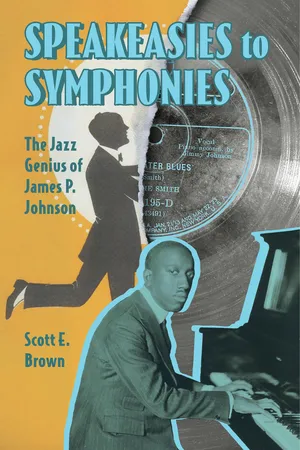
James P. Johnson (1894–1955) is one of the most important figures in twentieth-century American music. However, few people other than scholars and serious fans know of his life and work. Rare jazz aficionados know him as the Father of Harlem Stride piano but his other monumental contributions to American music are seldom acknowledged. Speakeasies to Symphonies: The Jazz Genius of James P. Johnson seeks to rectify this.
Johnson, born in New Jersey, absorbed many musical elements in his youth, especially the African American culture of the Southeastern Seaboard, to create a new musical and rhythmic force for jazz, musical theater, and symphonic music. Johnson's career stretched from the early 1910s to the early 1950s. His heyday was the 1920s—the decade known for the Jazz Age, the Harlem Renaissance, rent parties, classic blues singers, the first golden age of Broadway and the Great American Songbook, and, perhaps most notably, the worldwide music and dance phenomenon the Charleston. Johnson not only composed the signature tune that has come to define the decade but was a critical part of the other seminal cornerstones of American music.
Speakeasies to Symphonies presents a detailed portrait of Johnson's life, music, teachers, associates, protégés, and activity right up to his death. Scott E. Brown explores primary sources previously unavailable, including Johnson's personal papers, to fill in many gaps and answer lingering questions in his biography, painting a complete picture of his essential legacy.
- 465 pages
- English
- ePUB (mobile friendly)
- Available on iOS & Android
eBook - ePub
About this book
Information
Subtopic
Music BiographiesIndex
Social SciencesTable of contents
- Cover Page
- Title Page
- Copyright Page
- Contents
- Acknowledgments
- Preface
- Introduction
- Chapter 1. New Brunswick, 1894–1902
- Chapter 2. Jersey City, 1902–1908
- Chapter 3. The Jungles, 1908–1913
- Chapter 4. The Ticklers, 1913–1916
- Chapter 5. First Publications and Recordings, 1916–1917
- Chapter 6. The Giggin’ Years, 1916–1918
- Chapter 7. Toledo, 1919–1920
- Chapter 8. New York Breakout Year, 1921
- Chapter 9. Harlem Stride Piano
- Chapter 10. James P. and Fats Waller
- Chapter 11. Plantation Days, 1922–1923
- Chapter 12. Runnin’ Wild, 1923
- Chapter 13. The Rent Party
- Chapter 14. On Stage, 1924–1926
- Chapter 15. Yamekraw, 1927
- Chapter 16. Keep Shufflin’, 1928
- Chapter 17. St. Louis Blues, 1929–1930
- Chapter 18. Changing Tastes, 1931–1935
- Chapter 19. The Organizer, 1935–1940
- Chapter 20. Spirituals to Swing, 1938–1939
- Chapter 21. Café Society, 1939–1941
- Chapter 22. Concert Hall Realized, 1939–1942
- Chapter 23. In Demand Again, 1942–1943
- Chapter 24. Recording Flurry, 1943–1944
- Chapter 25. Pied Piper, 1944–1945
- Chapter 26. The Slow Decline, 1945–1946
- Chapter 27. New Patrons, 1946–1949
- Chapter 28. Sugar Hill—The Last Innovation, 1949–1950
- Chapter 29. Final Years, 1950–1955 368
- Epilogue
- Notes
- Bibliography
- General Index
- Show Index
- Tune Index
- About the Author
Trusted by 375,005 students
Access to over 1.5 million titles for a fair monthly price.
Study more efficiently using our study tools.
Frequently asked questions
Yes, you can cancel anytime from the Subscription tab in your account settings on the Perlego website. Your subscription will stay active until the end of your current billing period. Learn how to cancel your subscription
No, books cannot be downloaded as external files, such as PDFs, for use outside of Perlego. However, you can download books within the Perlego app for offline reading on mobile or tablet. Learn how to download books offline
Perlego offers two plans: Essential and Complete
- Essential is ideal for learners and professionals who enjoy exploring a wide range of subjects. Access the Essential Library with 800,000+ trusted titles and best-sellers across business, personal growth, and the humanities. Includes unlimited reading time and Standard Read Aloud voice.
- Complete: Perfect for advanced learners and researchers needing full, unrestricted access. Unlock 1.5M+ books across hundreds of subjects, including academic and specialized titles. The Complete Plan also includes advanced features like Premium Read Aloud and Research Assistant.
We are an online textbook subscription service, where you can get access to an entire online library for less than the price of a single book per month. With over 1.5 million books across 990+ topics, we’ve got you covered! Learn about our mission
Look out for the read-aloud symbol on your next book to see if you can listen to it. The read-aloud tool reads text aloud for you, highlighting the text as it is being read. You can pause it, speed it up and slow it down. Learn more about Read Aloud
Yes! You can use the Perlego app on both iOS and Android devices to read anytime, anywhere — even offline. Perfect for commutes or when you’re on the go.
Please note we cannot support devices running on iOS 13 and Android 7 or earlier. Learn more about using the app
Please note we cannot support devices running on iOS 13 and Android 7 or earlier. Learn more about using the app
Yes, you can access Speakeasies to Symphonies by Scott E. Brown in PDF and/or ePUB format, as well as other popular books in Social Sciences & Music Biographies. We have over 1.5 million books available in our catalogue for you to explore.