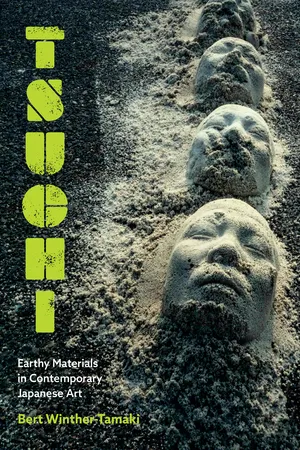
Tsuchi
eBook - ePub

Tsuchi

Earthy Materials in Contemporary Japanese Art

  1. English
  2. ePUB (mobile friendly)
  3. Available on iOS & Android
eBook - ePub

Tsuchi

Earthy Materials in Contemporary Japanese Art

About this book

An examination of Japanese contemporary art through the lens of ecocriticism and environmental history

Collectively referred to by the word tsuchi, earthy materials such as soil and clay are prolific in Japanese contemporary art. Highlighting works of photography, ceramics, and installation art, Bert Winther-Tamaki explores the many aesthetic manifestations of tsuchi and their connection to the country’s turbulent environmental history, investigating how Japanese artists have continually sought a passionate and redemptive engagement with earth.

In the seven decades following 1955, Japan has experienced severe environmental degradation as a result of natural disasters, industrial pollution, and nuclear irradiation. Artists have responded to these ongoing catastrophes through modes of “mudlarking” and “muckracking,” utilizing raw elements from nature to establish deeper contact with the primal resources of their world and expose its unfettered contamination. Providing a comparative assessment of more than seventy works of art, this study reveals Japanese artists’ engagement with a richly diverse repertoire of earthy materialities, elucidating their aesthetic properties, changing conditions, and cultural significance. 

By focusing on the role of tsuchi as a convergence point for a wide range of creative practices, this book offers a critical reassessment of contemporary art in Japan and its intrinsic relationship to the environment. Situating art within the context of ecology and urbanization, Tsuchi shows artists striving to explore and reprocess raw forms of earth beneath the corruptions of human activity.

Frequently asked questions

Yes, you can cancel anytime from the Subscription tab in your account settings on the Perlego website. Your subscription will stay active until the end of your current billing period. Learn how to cancel your subscription.
No, books cannot be downloaded as external files, such as PDFs, for use outside of Perlego. However, you can download books within the Perlego app for offline reading on mobile or tablet. Learn more here.
Perlego offers two plans: Essential and Complete
  • Essential is ideal for learners and professionals who enjoy exploring a wide range of subjects. Access the Essential Library with 800,000+ trusted titles and best-sellers across business, personal growth, and the humanities. Includes unlimited reading time and Standard Read Aloud voice.
  • Complete: Perfect for advanced learners and researchers needing full, unrestricted access. Unlock 1.4M+ books across hundreds of subjects, including academic and specialized titles. The Complete Plan also includes advanced features like Premium Read Aloud and Research Assistant.
Both plans are available with monthly, semester, or annual billing cycles.
We are an online textbook subscription service, where you can get access to an entire online library for less than the price of a single book per month. With over 1 million books across 1000+ topics, we’ve got you covered! Learn more here.
Look out for the read-aloud symbol on your next book to see if you can listen to it. The read-aloud tool reads text aloud for you, highlighting the text as it is being read. You can pause it, speed it up and slow it down. Learn more here.
Yes! You can use the Perlego app on both iOS or Android devices to read anytime, anywhere — even offline. Perfect for commutes or when you’re on the go.
Please note we cannot support devices running on iOS 13 and Android 7 or earlier. Learn more about using the app.
Yes, you can access Tsuchi by Bert Winther-Tamaki in PDF and/or ePUB format, as well as other popular books in Art & Art General. We have over one million books available in our catalogue for you to explore.

Information

Topic
Art
Subtopic
Art General

Table of contents

  1. Cover
  2. Title Page
  3. Copyright Page
  4. Dedication
  5. Contents
  6. Introduction: Japanese Cultures of Earth
  7. I. Postwar Silos of Tsuchi Media
  8. II. Convergence and Proliferation since the 1980s
  9. Acknowledgments
  10. Notes
  11. Index