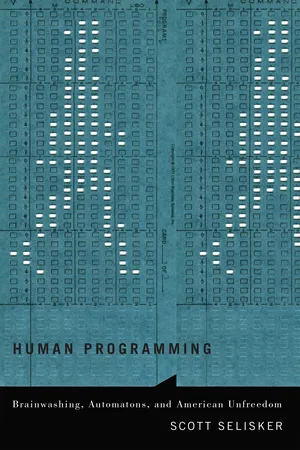
Human Programming
eBook - PDF

Human Programming

Brainwashing, Automatons, and American Unfreedom

  1. 266 pages
  2. English
  3. PDF
  4. Available on iOS & Android
eBook - PDF

Human Programming

Brainwashing, Automatons, and American Unfreedom

About this book

Do our ways of talking about contemporary terrorism have a history in the science, technology, and culture of the Cold War? Human Programming explores this history in a groundbreaking work that draws connections across decades and throughout American culture, high and low. Scott Selisker argues that literary, cinematic, and scientific representations of the programmed mind have long shaped conversations in U.S. political culture about freedom and unfreedom, and about democracy and its enemies. 

Selisker demonstrates how American conceptions of freedom and of humanity have changed in tandem with developments in science and technology, including media technology, cybernetics, behaviorist psychology, and sociology. Since World War II, propagandists, scientists, and creative artists have adapted visions of human programmability as they sought to imagine the psychological manipulation and institutional controls that could produce the inscrutable subjects of totalitarian states, cults, and terrorist cells. At the same time, writers across the political spectrum reimagined ideals of American freedom, democracy, and diversity by way of contrast with these posthuman specters of mental unfreedom. Images of such “human automatons” circulated in popular films, trials, travelogues, and the news media, giving form to the nebulous enemies of the postwar and contemporary United States: totalitarianism, communism, total institutions, cult extremism, and fundamentalist terrorism. 

Ranging from discussions of The Manchurian Candidate and cyberpunk science fiction to the cases of Patty Hearst and the “American Taliban” John Walker Lindh, Human Programming opens new ways of understanding the intertwined roles of literature, film, science, and technology in American culture.

Frequently asked questions

Yes, you can cancel anytime from the Subscription tab in your account settings on the Perlego website. Your subscription will stay active until the end of your current billing period. Learn how to cancel your subscription.
No, books cannot be downloaded as external files, such as PDFs, for use outside of Perlego. However, you can download books within the Perlego app for offline reading on mobile or tablet. Learn more here.
Perlego offers two plans: Essential and Complete
  • Essential is ideal for learners and professionals who enjoy exploring a wide range of subjects. Access the Essential Library with 800,000+ trusted titles and best-sellers across business, personal growth, and the humanities. Includes unlimited reading time and Standard Read Aloud voice.
  • Complete: Perfect for advanced learners and researchers needing full, unrestricted access. Unlock 1.4M+ books across hundreds of subjects, including academic and specialized titles. The Complete Plan also includes advanced features like Premium Read Aloud and Research Assistant.
Both plans are available with monthly, semester, or annual billing cycles.
We are an online textbook subscription service, where you can get access to an entire online library for less than the price of a single book per month. With over 1 million books across 1000+ topics, we’ve got you covered! Learn more here.
Look out for the read-aloud symbol on your next book to see if you can listen to it. The read-aloud tool reads text aloud for you, highlighting the text as it is being read. You can pause it, speed it up and slow it down. Learn more here.
Yes! You can use the Perlego app on both iOS or Android devices to read anytime, anywhere — even offline. Perfect for commutes or when you’re on the go.
Please note we cannot support devices running on iOS 13 and Android 7 or earlier. Learn more about using the app.
Yes, you can access Human Programming by Scott Selisker in PDF and/or ePUB format, as well as other popular books in Social Sciences & Cognitive Science. We have over one million books available in our catalogue for you to explore.

Table of contents

  1. Cover
  2. Half Title
  3. Title
  4. Copyright
  5. Contents
  6. Acknowledgments
  7. Introduction Enemies of Freedom
  8. 1 Uniquely American Symptoms: Cold War Brainwashing and American Exceptionalism
  9. 2 Anti-institutional Automatons: New Left Reappropriations of Automatism
  10. 3 Human Programming: Computation, Emotion, and the Posthuman Other
  11. 4 Cult Programming: Extremism, Narrative, and the Social Science of Cults
  12. 5 Fundamentalist Automatons: Representing Terrorist Consciousness in the War on Terror
  13. Conclusion Automatism and Agency
  14. Notes
  15. Index