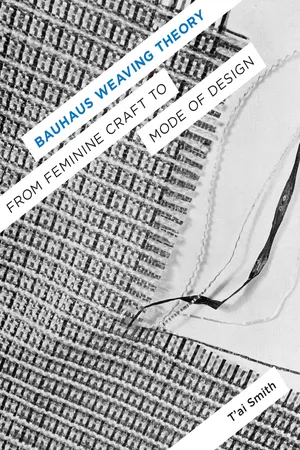
Bauhaus Weaving Theory
eBook - ePub

Bauhaus Weaving Theory

From Feminine Craft to Mode of Design

  1. English
  2. ePUB (mobile friendly)
  3. Available on iOS & Android
eBook - ePub

Bauhaus Weaving Theory

From Feminine Craft to Mode of Design

About this book

The Bauhaus school in Germany has long been understood through the writings of its founding director, Walter Gropius, and well-known artists who taught there such as Wassily Kandinsky and László Moholy-Nagy. Far less recognized are texts by women in the school’s weaving workshop. In Bauhaus Weaving Theory, T’ai Smith uncovers new significance in the work the Bauhaus weavers did as writers.

From colorful, expressionist tapestries to the invention of soundproofing and light-reflective fabric, the workshop’s innovative creations influenced a modernist theory of weaving. In the first careful examination of the writings of Bauhaus weavers, including Anni Albers, Gunta Stözl, and Otti Berger, Smith details how these women challenged assumptions about the feminine nature of their craft. As they harnessed the vocabulary of other disciplines like painting, architecture, and photography, Smith argues, the weavers resisted modernist thinking about distinct media. In parsing texts about tapestries and functional textiles, the vital role these women played in debates about medium in the twentieth century and a nuanced history of the Bauhaus comes to light.

Bauhaus Weaving Theory deftly reframes the Bauhaus weaving workshop as central to theoretical inquiry at the school. Putting questions of how value and legitimacy are established in the art world into dialogue with the limits of modernism, Smith confronts the belief that the crafts are manual and technical but never intellectual arts.

Frequently asked questions

Yes, you can cancel anytime from the Subscription tab in your account settings on the Perlego website. Your subscription will stay active until the end of your current billing period. Learn how to cancel your subscription.
No, books cannot be downloaded as external files, such as PDFs, for use outside of Perlego. However, you can download books within the Perlego app for offline reading on mobile or tablet. Learn more here.
Perlego offers two plans: Essential and Complete
  • Essential is ideal for learners and professionals who enjoy exploring a wide range of subjects. Access the Essential Library with 800,000+ trusted titles and best-sellers across business, personal growth, and the humanities. Includes unlimited reading time and Standard Read Aloud voice.
  • Complete: Perfect for advanced learners and researchers needing full, unrestricted access. Unlock 1.4M+ books across hundreds of subjects, including academic and specialized titles. The Complete Plan also includes advanced features like Premium Read Aloud and Research Assistant.
Both plans are available with monthly, semester, or annual billing cycles.
We are an online textbook subscription service, where you can get access to an entire online library for less than the price of a single book per month. With over 1 million books across 1000+ topics, we’ve got you covered! Learn more here.
Look out for the read-aloud symbol on your next book to see if you can listen to it. The read-aloud tool reads text aloud for you, highlighting the text as it is being read. You can pause it, speed it up and slow it down. Learn more here.
Yes! You can use the Perlego app on both iOS or Android devices to read anytime, anywhere — even offline. Perfect for commutes or when you’re on the go.
Please note we cannot support devices running on iOS 13 and Android 7 or earlier. Learn more about using the app.
Yes, you can access Bauhaus Weaving Theory by T’ai Smith in PDF and/or ePUB format, as well as other popular books in Art & History of Art. We have over one million books available in our catalogue for you to explore.

Information

Table of contents

  1. Cover
  2. Title Page
  3. Copyright Page
  4. Dedication
  5. Contents
  6. Acknowledgments
  7. Introduction: Textiles, Text, and a Medium-Specific Craft
  8. 1. Pictures Made of Wool: Weaving Labor in the Workshop
  9. 2. Toward a Modernist Theory of Weaving: The Use of Textiles in Architectural Space
  10. 3. The Haptics of Optics: Weaving and Photography
  11. 4. Weaving as Invention: Patenting Authorship
  12. Conclusion: On Weaving, on Writing
  13. Notes
  14. Index
  15. About the Author
  16. Plates