The Shape of Utopia
eBook - PDF

The Shape of Utopia

The Architecture of Radical Reform in Nineteenth-Century America

  1. 358 pages
  2. English
  3. PDF
  4. Available on iOS & Android
eBook - PDF

The Shape of Utopia

The Architecture of Radical Reform in Nineteenth-Century America

About this book

How nineteenth-century social reformers devised a new set of radical blueprints for society

In the middle of the nineteenth century, a utopian impulse flourished in the United States through the circulation of architectural and urban plans predicated on geometrically distinct designs. Though the majority of such plans remained unrealized, The Shape of Utopia emphasizes the enduring importance of these radical propositions and their ability to visualize alternatives to what was then a newly emerging capitalist nation.

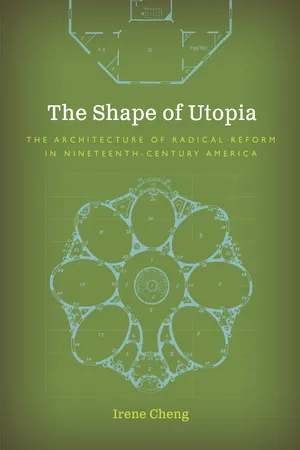
Drawing diagrammatic plans for structures such as octagonal houses, a hexagonal anarchist city, and circular centers of equitable commerce, these various architectural utopians applied geometric forms to envision a more just and harmonious society. Highlighting the inherent political capacity of architecture, Irene Cheng showcases how these visionary planners used their blueprints as persuasive visual rhetoric that could mobilize others to share in their aspirations for a better world.

Offering an extensive and uniquely focused view of mid-nineteenth-century America’s rapidly changing cultural landscape, this book examines these utopian plans within the context of significant economic and technological transformation, encompassing movements such as phrenology, anarchism, and spiritualism. Engaging equally with architectural history, visual culture studies, and U.S. history, The Shape of Utopia documents a pivotal moment in American history when ordinary people ardently believed in the potential to reshape society.

Frequently asked questions

Yes, you can cancel anytime from the Subscription tab in your account settings on the Perlego website. Your subscription will stay active until the end of your current billing period. Learn how to cancel your subscription.
No, books cannot be downloaded as external files, such as PDFs, for use outside of Perlego. However, you can download books within the Perlego app for offline reading on mobile or tablet. Learn more here.
Perlego offers two plans: Essential and Complete
  • Essential is ideal for learners and professionals who enjoy exploring a wide range of subjects. Access the Essential Library with 800,000+ trusted titles and best-sellers across business, personal growth, and the humanities. Includes unlimited reading time and Standard Read Aloud voice.
  • Complete: Perfect for advanced learners and researchers needing full, unrestricted access. Unlock 1.4M+ books across hundreds of subjects, including academic and specialized titles. The Complete Plan also includes advanced features like Premium Read Aloud and Research Assistant.
Both plans are available with monthly, semester, or annual billing cycles.
We are an online textbook subscription service, where you can get access to an entire online library for less than the price of a single book per month. With over 1 million books across 1000+ topics, we’ve got you covered! Learn more here.
Look out for the read-aloud symbol on your next book to see if you can listen to it. The read-aloud tool reads text aloud for you, highlighting the text as it is being read. You can pause it, speed it up and slow it down. Learn more here.
Yes! You can use the Perlego app on both iOS or Android devices to read anytime, anywhere — even offline. Perfect for commutes or when you’re on the go.
Please note we cannot support devices running on iOS 13 and Android 7 or earlier. Learn more about using the app.
Yes, you can access The Shape of Utopia by Irene Cheng in PDF and/or ePUB format, as well as other popular books in Architecture & History of Architecture. We have over one million books available in our catalogue for you to explore.

Table of contents

  1. Cover Page
  2. Series Page
  3. Title Page
  4. Copyright Page
  5. Contents
  6. Introduction: The Visual Rhetoric of Reform
  7. Chapter 1. Antinomies of American Utopia: Thomas Jefferson’s Grids and Octagons
  8. Chapter 2. The Visual Rhetoric of Equality: The Land Reformers’ Grid
  9. Chapter 3. Cultivating the Liberal Self: Orson Fowler’s Octagon House
  10. Chapter 4. Picturing Sociality without Socialism: The Kansas Vegetarian Octagon Colony
  11. Chapter 5. Toward More Transparent Representation: The Hexagonal ā€œAnarchistā€ City of Josiah Warren
  12. Chapter 6: Models, Machines, and Manifestations: The Spiritualists’ Circular Utopias
  13. Epilogue: The Afterlife of Geometric Utopianism
  14. Acknowledgments
  15. Notes
  16. Selected Bibliography
  17. Index
  18. About the Author