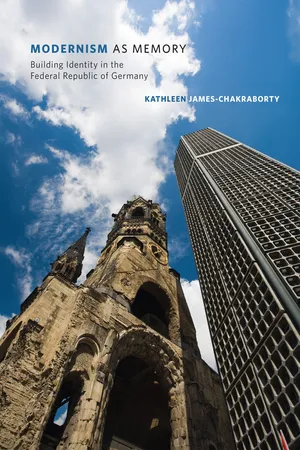
Modernism as Memory
eBook - PDF

Modernism as Memory

Building Identity in the Federal Republic of Germany

  1. 318 pages
  2. English
  3. PDF
  4. Available on iOS & Android
eBook - PDF

Modernism as Memory

Building Identity in the Federal Republic of Germany

About this book

After World War II, West Germans and West Berliners found ways of communicating both their recent sufferings and aspirations for stable communities through buildings that fused the ruins of historicist structures with new constructions rooted in the modernism of the 1910s and ‘20s. As Modernism as Memory illustrates, these postwar practices undergird the approaches later taken in influential structures created or renovated in Berlin following the fall of the Wall, including the Jewish Museum and the Reichstag, the New Museum and the Topography of Terror.

While others have characterized contemporary Berlin’s museums and memorials as postmodern, Kathleen James-Chakraborty argues that these environments are examples of an “architecture of modern memory” that is much older, more complex, and historically contingent. She reveals that churches and museums repaired and designed before 1989 in Düren, Hanover, Munich, Neviges, Pforzheim, Stuttgart, and Weil am Rhein contributed to a modernist precedent for the relationship between German identity and the past developed since then in the Ruhr region and in Berlin. 

Modernism as Memory demonstrates that how one remembers can be detached from what one remembers, contrasting ruins with recollections of modernism to commemorate German suffering, the Holocaust, and the industrial revolution, as well as new spaces for Islam in the country.

Frequently asked questions

Yes, you can cancel anytime from the Subscription tab in your account settings on the Perlego website. Your subscription will stay active until the end of your current billing period. Learn how to cancel your subscription.
No, books cannot be downloaded as external files, such as PDFs, for use outside of Perlego. However, you can download books within the Perlego app for offline reading on mobile or tablet. Learn more here.
Perlego offers two plans: Essential and Complete
  • Essential is ideal for learners and professionals who enjoy exploring a wide range of subjects. Access the Essential Library with 800,000+ trusted titles and best-sellers across business, personal growth, and the humanities. Includes unlimited reading time and Standard Read Aloud voice.
  • Complete: Perfect for advanced learners and researchers needing full, unrestricted access. Unlock 1.4M+ books across hundreds of subjects, including academic and specialized titles. The Complete Plan also includes advanced features like Premium Read Aloud and Research Assistant.
Both plans are available with monthly, semester, or annual billing cycles.
We are an online textbook subscription service, where you can get access to an entire online library for less than the price of a single book per month. With over 1 million books across 1000+ topics, we’ve got you covered! Learn more here.
Look out for the read-aloud symbol on your next book to see if you can listen to it. The read-aloud tool reads text aloud for you, highlighting the text as it is being read. You can pause it, speed it up and slow it down. Learn more here.
Yes! You can use the Perlego app on both iOS or Android devices to read anytime, anywhere — even offline. Perfect for commutes or when you’re on the go.
Please note we cannot support devices running on iOS 13 and Android 7 or earlier. Learn more about using the app.
Yes, you can access Modernism as Memory by Kathleen James-Chakraborty in PDF and/or ePUB format, as well as other popular books in Architecture & Architecture Criticism. We have over one million books available in our catalogue for you to explore.

Table of contents

  1. Cover
  2. Half Title
  3. Title
  4. Dedication
  5. Copyright
  6. Contents
  7. Introduction: Making Memory Modern
  8. 1. Making German Architecture Modern
  9. 2. Inserting Memory into Modern Architecture
  10. 3. An Architecture of Fragmentation and Absence
  11. 4. Critical Reconstruction or Neomodernist Shards?
  12. 5. Manufacturing Memory in the Ruhr Region
  13. 6. Assimilating Modern Memory
  14. Conclusion: The Kolumba Museum in Cologne
  15. Acknowledgments
  16. Notes
  17. Index