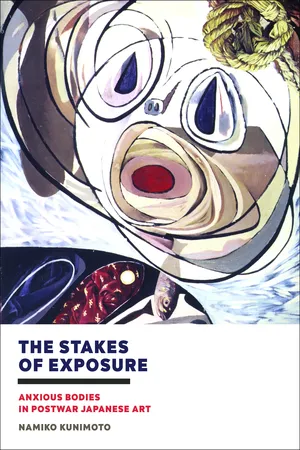
The Stakes of Exposure
eBook - ePub

The Stakes of Exposure

Anxious Bodies in Postwar Japanese Art

  1. English
  2. ePUB (mobile friendly)
  3. Available on iOS & Android
eBook - ePub

The Stakes of Exposure

Anxious Bodies in Postwar Japanese Art

About this book

How would artistic practice contribute to political change in post–World War II Japan? How could artists negotiate the imbalanced global dynamics of the art world and also maintain a sense of aesthetic and political authenticity? While the contemporary art world has recently come to embrace some of Japan’s most daring postwar artists, the interplay of art and politics remains poorly understood in the Americas and Europe. The Stakes of Exposure fills this gap and explores art, visual culture, and politics in postwar Japan from the 1950s to the 1970s, paying special attention to how anxiety and confusion surrounding Japan’s new democracy manifested in representations of gender and nationhood in modern art. 

Through such pivotal postwar episodes as the Minamata Disaster, the Lucky Dragon Incident, the budding antinuclear movement, and the ANPO protests of the 1960s, The Stakes of Exposure examines a wide range of issues addressed by the period’s prominent artists, including Tanaka Atsuko and Shiraga Kazuo (key members of the Gutai Art Association), Katsura Yuki, and Nakamura Hiroshi. Through a close study of their paintings, illustrations, and assemblage and performance art, Namiko Kunimoto reveals that, despite dissimilar aesthetic approaches and divergent political interests, Japanese postwar artists were invested in the entangled issues of gender and nationhood that were redefining Japan and its role in the world. 

Offering many full-color illustrations of previously unpublished art and photographs, as well as period manga, The Stakes of Exposure shows how contention over Japan’s new democracy was expressed, disavowed, and reimagined through representations of the gendered body.

Frequently asked questions

Yes, you can cancel anytime from the Subscription tab in your account settings on the Perlego website. Your subscription will stay active until the end of your current billing period. Learn how to cancel your subscription.
No, books cannot be downloaded as external files, such as PDFs, for use outside of Perlego. However, you can download books within the Perlego app for offline reading on mobile or tablet. Learn more here.
Perlego offers two plans: Essential and Complete
  • Essential is ideal for learners and professionals who enjoy exploring a wide range of subjects. Access the Essential Library with 800,000+ trusted titles and best-sellers across business, personal growth, and the humanities. Includes unlimited reading time and Standard Read Aloud voice.
  • Complete: Perfect for advanced learners and researchers needing full, unrestricted access. Unlock 1.4M+ books across hundreds of subjects, including academic and specialized titles. The Complete Plan also includes advanced features like Premium Read Aloud and Research Assistant.
Both plans are available with monthly, semester, or annual billing cycles.
We are an online textbook subscription service, where you can get access to an entire online library for less than the price of a single book per month. With over 1 million books across 1000+ topics, we’ve got you covered! Learn more here.
Look out for the read-aloud symbol on your next book to see if you can listen to it. The read-aloud tool reads text aloud for you, highlighting the text as it is being read. You can pause it, speed it up and slow it down. Learn more here.
Yes! You can use the Perlego app on both iOS or Android devices to read anytime, anywhere — even offline. Perfect for commutes or when you’re on the go.
Please note we cannot support devices running on iOS 13 and Android 7 or earlier. Learn more about using the app.
Yes, you can access The Stakes of Exposure by Namiko Kunimoto in PDF and/or ePUB format, as well as other popular books in Art & Asian Art. We have over one million books available in our catalogue for you to explore.

Information

Topic
Art
Subtopic
Asian Art

Table of contents

  1. Cover
  2. Title Page
  3. Copyright Page
  4. Contents
  5. List of Illustrations
  6. Note on Translations and Names
  7. Introduction: Gendered Bodies and the Minamata Disaster
  8. 1. Katsura Yuki’s Bodies of Resistance
  9. 2. Nakamura Hiroshi and the Politics of Embodiment
  10. 3. Tanaka Atsuko and the Circuits of Subjectivity
  11. 4. Heroic Violence in the Art of Shiraga Kazuo
  12. Conclusion: Thresholds of Exposure
  13. Acknowledgment
  14. Notes
  15. Plates
  16. Bibliography
  17. Index