Asking the Audience
eBook - PDF

Asking the Audience

Participatory Art in 1980s New York

  1. 284 pages
  2. English
  3. PDF
  4. Available on iOS & Android
eBook - PDF

Asking the Audience

Participatory Art in 1980s New York

About this book

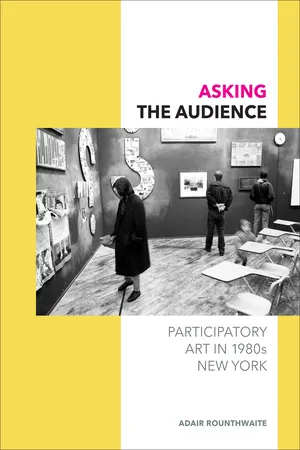
The 1980s was a critical decade in shaping today’s art production. While newly visible work concerned with power and identity hinted at a shift toward multiculturalism, the ‘80s were also a time of social conservatism that resulted in substantial changes in arts funding. In Asking the Audience, Adair Rounthwaite uses this context to analyze the rising popularity of audience participation in American art during this important decade.

Rounthwaite explores two seminal and interrelated art projects sponsored by the Dia Art Foundation in New York: Group Material’s Democracy and Martha Rosler’s If You Lived Here…. These projects married issues of social activism—such as homelessness and the AIDS crisis—with various forms of public participation, setting the precedent for the high-profile participatory practices currently dominating global contemporary art. Rounthwaite draws on diverse archival images, audio recordings, and more than thirty new interviews to analyze the live affective dynamics to which the projects gave rise. Seeking to foreground the audience experience in understanding the social context of participatory art, she argues that affect is key to the audience’s ability to exercise agency within the participatory artwork.

From artists and audiences to institutions, funders, and critics, Asking the Audience traces the networks that participatory art creates between various agents, demonstrating how, since the 1980s, leftist political engagement has become a cornerstone of the institutionalized consumption of contemporary art.

Frequently asked questions

Yes, you can cancel anytime from the Subscription tab in your account settings on the Perlego website. Your subscription will stay active until the end of your current billing period. Learn how to cancel your subscription.
No, books cannot be downloaded as external files, such as PDFs, for use outside of Perlego. However, you can download books within the Perlego app for offline reading on mobile or tablet. Learn more here.
Perlego offers two plans: Essential and Complete
  • Essential is ideal for learners and professionals who enjoy exploring a wide range of subjects. Access the Essential Library with 800,000+ trusted titles and best-sellers across business, personal growth, and the humanities. Includes unlimited reading time and Standard Read Aloud voice.
  • Complete: Perfect for advanced learners and researchers needing full, unrestricted access. Unlock 1.4M+ books across hundreds of subjects, including academic and specialized titles. The Complete Plan also includes advanced features like Premium Read Aloud and Research Assistant.
Both plans are available with monthly, semester, or annual billing cycles.
We are an online textbook subscription service, where you can get access to an entire online library for less than the price of a single book per month. With over 1 million books across 1000+ topics, we’ve got you covered! Learn more here.
Look out for the read-aloud symbol on your next book to see if you can listen to it. The read-aloud tool reads text aloud for you, highlighting the text as it is being read. You can pause it, speed it up and slow it down. Learn more here.
Yes! You can use the Perlego app on both iOS or Android devices to read anytime, anywhere — even offline. Perfect for commutes or when you’re on the go.
Please note we cannot support devices running on iOS 13 and Android 7 or earlier. Learn more about using the app.
Yes, you can access Asking the Audience by Adair Rounthwaite in PDF and/or ePUB format, as well as other popular books in Art & Art General. We have over one million books available in our catalogue for you to explore.

Information

Topic
Art
Subtopic
Art General

Table of contents

  1. Cover
  2. Half Title
  3. Title
  4. Copyright
  5. Dedication
  6. Contents
  7. Introduction: Recovering Audience
  8. 1. The Politics of Participation
  9. 2. The Pedagogical Subject of Participation
  10. 3. Photography, Agency, and Participation
  11. 4. Art, Affect, Crisis
  12. Conclusion: Participation in the Present
  13. Acknowledgments
  14. Notes
  15. Index