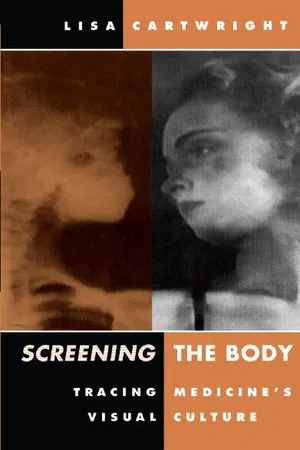
Moving images are used as diagnostic tools and locational devices every day in hospitals, clinics, and laboratories. But how and when did they come to be established and accepted sources of knowledge about the body in medical culture? How are the specialized techniques and codes of these imaging techniques determined, and whose bodies are studied, diagnosed, and treated with the help of optical recording devices? Screening the Body traces the fascinating history of scientific film during the late nineteenth and early twentieth centuries to show that early experiments with cinema are important precedents of contemporary medical techniques such as ultrasound and PET scanning. Lisa Cartwright brings to light eccentric projects in the history of science and medicine, such as Thomas Edison's sensational attempt to image the brain with X rays before a public audience, and the efforts of doctors to use the motion picture camera to capture movements of the body, from the virtually imperceptible flow of blood to epileptic seizures. Drawing on feminist film theory, cultural studies, the history of film, and the writings of Foucault, Cartwright illustrates how this scientific cinema was part of a broader tendency in society toward the technological surveillance, management, and physical transformation of the individual body and the social body. She unveils an area of film culture that has rarely been discussed but that will leave readers with a new way of seeing the everyday practice of diagnostic imaging that we all inevitably encounter in clinics and hospitals.
- 220 pages
- English
- PDF
- Available on iOS & Android
eBook - PDF
About this book
Information
Subtopic
Film History & CriticismTable of contents
- Contents
- Acknowledgments
- Introduction
- 1. Science and the Cinema
- 2. "Experiments of Destruction": Cinematic Inscriptions of Physiology
- 3. An Etiology of the Neurological Gaze
- 4. A Microphysics of the Body: Microscopy and the Cinema
- 5. Decomposing the Body: X Rays and the Cinema
- 6. Women and the Public Culture of Radiography
- Notes
- Index
Trusted by 375,005 students
Access to over 1.5 million titles for a fair monthly price.
Study more efficiently using our study tools.
Frequently asked questions
Yes, you can cancel anytime from the Subscription tab in your account settings on the Perlego website. Your subscription will stay active until the end of your current billing period. Learn how to cancel your subscription
No, books cannot be downloaded as external files, such as PDFs, for use outside of Perlego. However, you can download books within the Perlego app for offline reading on mobile or tablet. Learn how to download books offline
Perlego offers two plans: Essential and Complete
- Essential is ideal for learners and professionals who enjoy exploring a wide range of subjects. Access the Essential Library with 800,000+ trusted titles and best-sellers across business, personal growth, and the humanities. Includes unlimited reading time and Standard Read Aloud voice.
- Complete: Perfect for advanced learners and researchers needing full, unrestricted access. Unlock 1.5M+ books across hundreds of subjects, including academic and specialized titles. The Complete Plan also includes advanced features like Premium Read Aloud and Research Assistant.
We are an online textbook subscription service, where you can get access to an entire online library for less than the price of a single book per month. With over 1.5 million books across 990+ topics, we’ve got you covered! Learn about our mission
Look out for the read-aloud symbol on your next book to see if you can listen to it. The read-aloud tool reads text aloud for you, highlighting the text as it is being read. You can pause it, speed it up and slow it down. Learn more about Read Aloud
Yes! You can use the Perlego app on both iOS and Android devices to read anytime, anywhere — even offline. Perfect for commutes or when you’re on the go.
Please note we cannot support devices running on iOS 13 and Android 7 or earlier. Learn more about using the app
Please note we cannot support devices running on iOS 13 and Android 7 or earlier. Learn more about using the app
Yes, you can access Screening The Body by Lisa Cartwright in PDF and/or ePUB format, as well as other popular books in Media & Performing Arts & Film History & Criticism. We have over 1.5 million books available in our catalogue for you to explore.