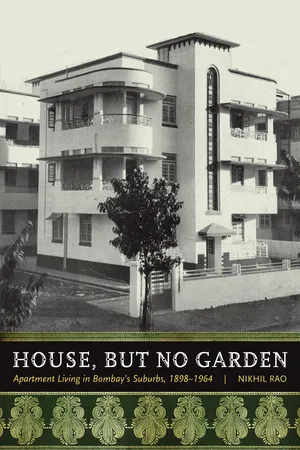
House, but No Garden
eBook - PDF

House, but No Garden

Apartment Living in Bombay's Suburbs, 1898-1964

  1. 312 pages
  2. English
  3. PDF
  4. Available on iOS & Android
eBook - PDF

House, but No Garden

Apartment Living in Bombay's Suburbs, 1898-1964

About this book

Between the well-documented development of colonial Bombay and sprawling contemporary Mumbai, a profound shift in the city’s fabric occurred: the emergence of the first suburbs and their distinctive pattern of apartment living. In House, but No Garden Nikhil Rao considers this phenomenon and its significance for South Asian urban life. It is the first book to explore an organization of the middle-class neighborhood that became ubiquitous in the mid-twentieth-century city and that has spread throughout the subcontinent.

Rao examines how the challenge of converting lands from agrarian to urban use created new relations between the state, landholders, and other residents of the city. At the level of dwellings, apartment living in self-contained flats represented a novel form of urban life, one that expressed a compromise between the caste and class identities of suburban residents who are upper caste but belong to the lower-middle or middle class. Living in such a built environment, under the often conflicting imperatives of maintaining the exclusivity of caste and subcaste while assembling residential groupings large enough to be economically viable, led suburban residents to combine caste with class, type of work, and residence to forge new metacaste practices of community identity.

As it links the colonial and postcolonial city—both visually and analytically—Rao’s work traces the appearance of new spatial and cultural configurations in the middle decades of the twentieth century in Bombay. In doing so, it expands our understanding of how built environments and urban identities are constitutive of one another.

Frequently asked questions

Yes, you can cancel anytime from the Subscription tab in your account settings on the Perlego website. Your subscription will stay active until the end of your current billing period. Learn how to cancel your subscription.
No, books cannot be downloaded as external files, such as PDFs, for use outside of Perlego. However, you can download books within the Perlego app for offline reading on mobile or tablet. Learn more here.
Perlego offers two plans: Essential and Complete
  • Essential is ideal for learners and professionals who enjoy exploring a wide range of subjects. Access the Essential Library with 800,000+ trusted titles and best-sellers across business, personal growth, and the humanities. Includes unlimited reading time and Standard Read Aloud voice.
  • Complete: Perfect for advanced learners and researchers needing full, unrestricted access. Unlock 1.4M+ books across hundreds of subjects, including academic and specialized titles. The Complete Plan also includes advanced features like Premium Read Aloud and Research Assistant.
Both plans are available with monthly, semester, or annual billing cycles.
We are an online textbook subscription service, where you can get access to an entire online library for less than the price of a single book per month. With over 1 million books across 1000+ topics, we’ve got you covered! Learn more here.
Look out for the read-aloud symbol on your next book to see if you can listen to it. The read-aloud tool reads text aloud for you, highlighting the text as it is being read. You can pause it, speed it up and slow it down. Learn more here.
Yes! You can use the Perlego app on both iOS or Android devices to read anytime, anywhere — even offline. Perfect for commutes or when you’re on the go.
Please note we cannot support devices running on iOS 13 and Android 7 or earlier. Learn more about using the app.
Yes, you can access House, but No Garden by Nikhil Rao in PDF and/or ePUB format, as well as other popular books in Architecture & History of Architecture. We have over one million books available in our catalogue for you to explore.

Table of contents

  1. HOUSE, BUT NO GARDEN: Apartment Living in Bombay's Suburbs, 1898-1964
  2. Contents
  3. Abbreviations
  4. Untitled
  5. Introduction
  6. Chapter 1: An Indian Suburb
  7. Chapter 2: Peopling the Suburbs
  8. Chapter 3: The Rise of the Bombay Flat
  9. Chapter 4: The Spread of Apartment Living
  10. Chapter 5: From Southern Indians to “South Indians”
  11. Chapter 6: Toward Greater Mumbai
  12. Conclusion
  13. Acknowedgments
  14. Notes
  15. Bibliography
  16. Index