“Valuable both for the perspicacity of the brilliant nuggets that turn up in Julie Abraham’s excavation of her subject and for the clear, liberating distinction she makes between ‘lesbian novels’ and ‘lesbian writing.’” —Harvard Gay and Lesbian Review
“The discussions of individual writers in Are Girls Necessary? are uniformly astute and provocative in company with one another.” —Women’s Review of Books
“Forceful and original. An important contribution to lesbian studies.” —Modern Fiction Studies
“Anyone with a poignant interest in lesbian writing—its history and ramifications in the literary world—will welcome the challenge presented in Abraham’s studies.” —Lambda Book Report
“Abraham’s book breaks new ground in its teasing out of the meanings and functions of ‘history’ in lesbian writing. It’s a must-read for scholars in the field—and not just because it has such a great title.” —Lesbian Review of Books
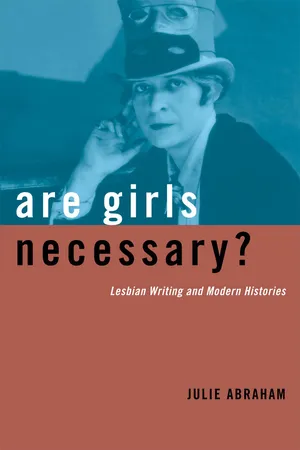
In this analysis of twentieth-century lesbian writing, Julie Abraham offers new readings of pulp novelists alongside high modernists—authors as various as Gertrude Stein, Willa Cather, Mary Renault, and Virgina Woolf—to examine how these writers created new lesbian narratives.
“The discussions of individual writers in Are Girls Necessary? are uniformly astute and provocative in company with one another.” —Women’s Review of Books
“Forceful and original. An important contribution to lesbian studies.” —Modern Fiction Studies
“Anyone with a poignant interest in lesbian writing—its history and ramifications in the literary world—will welcome the challenge presented in Abraham’s studies.” —Lambda Book Report
“Abraham’s book breaks new ground in its teasing out of the meanings and functions of ‘history’ in lesbian writing. It’s a must-read for scholars in the field—and not just because it has such a great title.” —Lesbian Review of Books
In this analysis of twentieth-century lesbian writing, Julie Abraham offers new readings of pulp novelists alongside high modernists—authors as various as Gertrude Stein, Willa Cather, Mary Renault, and Virgina Woolf—to examine how these writers created new lesbian narratives.