Debates in the Digital Humanities 2023
eBook - PDF

Debates in the Digital Humanities 2023

  1. 461 pages
  2. English
  3. PDF
  4. Available on iOS & Android
eBook - PDF

Debates in the Digital Humanities 2023

About this book

A cutting-edge view of the digital humanities at a time of global pandemic, catastrophe, and uncertainty

Where do the digital humanities stand in 2023? Debates in the Digital Humanities 2023 presents a state-of-the-field vision of digital humanities amid rising social, political, economic, and environmental crises; a global pandemic; and the deepening of austerity regimes in U.S. higher education. Providing a look not just at where DH stands but also where it is going, this fourth volume in the Debates in the Digital Humanities series features both established scholars and emerging voices pushing the field’s boundaries, asking thorny questions, and providing space for practitioners to bring to the fore their research and their hopes for future directions in the field. Carrying forward the themes of political and social engagement present in the series throughout, it includes crucial contributions to the field—from a vital forum centered on the voices of Black women scholars, manifestos from feminist and Latinx perspectives on data and DH, and a consideration of Indigenous data and artificial intelligence, to essays that range across topics such as the relation of DH to critical race theory, capital, and accessibility.

Contributors: Harmony Bench, Ohio State U; Christina Boyles, Michigan State U; Megan R. Brett, George Mason U; Michelle Lee Brown, Washington State U; Patrick J. Burns, New York U; Kent K. Chang, U of California, Berkeley; Rico Devara Chapman, Clark Atlanta U; Marika Cifor, U of Washington; María Eugenia Cotera, U of Texas; T. L. Cowan, U of Toronto; Marlene L. Daut, U of Virginia; Quinn Dombrowski, Stanford U; Kate Elswit, U of London; Nishani Frazier, U of Kansas; Kim Gallon, Brown U; Patricia Garcia, U of Michigan; Lorena Gauthereau, U of Houston; Masoud Ghorbaninejad, University of Victoria; Abraham Gibson, U of Texas at San Antonio; Nathan P. Gibson, Ludwig-Maximilians-Universität, Munich; Kaiama L. Glover, Barnard College; Hilary N. Green, Davidson College; Jo Guldi, Southern Methodist U; Matthew N. Hannah, Purdue U Libraries; Jeanelle Horcasitas, DigitalOcean; Christy Hyman, Mississippi State U; Arun Jacob, U of Toronto; Jessica Marie Johnson, Johns Hopkins U and Harvard U; Martha S. Jones, Johns Hopkins U; Annette K. Joseph-Gabriel, Duke U; Mills Kelly, George Mason U; Spencer D. C. Keralis, Digital Frontiers; Zoe LeBlanc, U of Illinois at Urbana-Champaign; Jason Edward Lewis, Concordia U; James Malazita, Rensselaer Polytechnic Institute; Alison Martin, Dartmouth College; Linda García Merchant, U of Houston Libraries; Rafia Mirza, Southern Methodist U; Mame-Fatou Niang, Carnegie Mellon U; Jessica Marie Otis, George Mason U; Marisa Parham, U of Maryland; Andrew Boyles Petersen, Michigan State U Libraries; Emily Pugh, Getty Research Institute; Olivia Quintanilla, UC Santa Barbara; Jasmine Rault, U of Toronto Scarborough; Anastasia Salter, U of Central Florida; Maura Seale, U of Michigan; Celeste Tường Vy Sharpe, Normandale Community College; Astrid J. Smith, Stanford U Libraries; Maboula Soumahoro, U of Tours; Mel Stanfill, U of Central Florida; Tonia Sutherland, U of Hawaiʻi at Mānoa; Gabriela Baeza Ventura, U of Houston; Carolina Villarroel, U of Houston; Melanie Walsh, U of Washington; Hēmi Whaanga, U of Waikato; Bridget Whearty, Binghamton U; Jeri Wieringa, U of Alabama; David Joseph Wrisley, NYU Abu Dhabi.


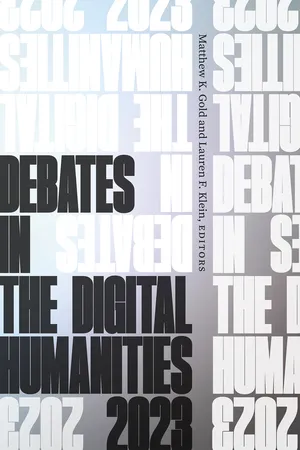
Cover alt text: A text-based cover with the main title repeating right-side up and upside down. The leftmost iteration appears in black ink; all others are white.

Frequently asked questions

Yes, you can cancel anytime from the Subscription tab in your account settings on the Perlego website. Your subscription will stay active until the end of your current billing period. Learn how to cancel your subscription.
No, books cannot be downloaded as external files, such as PDFs, for use outside of Perlego. However, you can download books within the Perlego app for offline reading on mobile or tablet. Learn more here.
Perlego offers two plans: Essential and Complete
  • Essential is ideal for learners and professionals who enjoy exploring a wide range of subjects. Access the Essential Library with 800,000+ trusted titles and best-sellers across business, personal growth, and the humanities. Includes unlimited reading time and Standard Read Aloud voice.
  • Complete: Perfect for advanced learners and researchers needing full, unrestricted access. Unlock 1.4M+ books across hundreds of subjects, including academic and specialized titles. The Complete Plan also includes advanced features like Premium Read Aloud and Research Assistant.
Both plans are available with monthly, semester, or annual billing cycles.
We are an online textbook subscription service, where you can get access to an entire online library for less than the price of a single book per month. With over 1 million books across 1000+ topics, we’ve got you covered! Learn more here.
Look out for the read-aloud symbol on your next book to see if you can listen to it. The read-aloud tool reads text aloud for you, highlighting the text as it is being read. You can pause it, speed it up and slow it down. Learn more here.
Yes! You can use the Perlego app on both iOS or Android devices to read anytime, anywhere — even offline. Perfect for commutes or when you’re on the go.
Please note we cannot support devices running on iOS 13 and Android 7 or earlier. Learn more about using the app.
Yes, you can access Debates in the Digital Humanities 2023 by Matthew K. Gold,Lauren F. Klein in PDF and/or ePUB format, as well as other popular books in Education & Higher Education. We have over one million books available in our catalogue for you to explore.

Information

Table of contents

  1. Cover Page
  2. Title Page
  3. Copyright Page
  4. Contents
  5. Introduction: The Digital Humanities, Moment to Moment
  6. Part I: Openings and Interventions
  7. Chapter 1: Toward a Political Economy of Digital Humanities
  8. Chapter 2: All the Work You Do Not See: Labor, Digitizers, and the Foundations of Digital Humanities
  9. Chapter 3: Right-to-Left (RTL) Text: Digital Humanists Plus Half a Billion Users
  10. Chapter 4: Relation-Oriented AI: Why Indigenous Protocols Matter for the Digital Humanities
  11. Chapter 5: A U.S. Latinx Digital Humanities Manifesto
  12. Part II: Theories and Approaches
  13. Chapter 6: The Body Is Not (Only) a Metaphor: Rethinking Embodiment in DH
  14. Chapter 7: The Queer Gap in Cultural Analytics
  15. Chapter 8: The Feminist Data Manifest-NO: An Introduction and Four Reflections
  16. Chapter 9: Black Is Not the Absence of Light: Restoring Black Visibility and Liberation to Digital Humanities
  17. Chapter 10: Digital Humanities in the Deepfake Era
  18. Chapter 11: Operationalizing Surveillance Studies in the Digital Humanities
  19. Part III: Disciplines and Institutions
  20. Chapter 12: A Voice Interrupts: Digital Humanities as a Tool to Hear Black Life
  21. Chapter 13: Addressing an Emergency: The “Pragmatic Tilt” Required of Scholarship, Data, and Design by the Climate Crisis
  22. Chapter 14: Digital Art History as Disciplinary Practice
  23. Chapter 15: Building and Sustaining Africana Digital Humanities at HBCUs
  24. Chapter 16: A Call to Research Action: Transnational Solidarity for Digital Humanists
  25. Chapter 17: Game Studies, Endgame?
  26. Part IV: Pedagogies and Practices
  27. Chapter 18: The Challenges and Possibilities of Social Media Data: New Directions in Literary Studies and the Digital Humanities
  28. Chapter 19: Language Is Not a Default Setting: Countering DH’s English Problem
  29. Chapter 20: Librarians’ Illegible Labor: Toward a Documentary Practice of Digital Humanities
  30. Chapter 21: Reframing the Conversation: Digital Humanists, Disabilities, and Accessibility
  31. Chapter 22: From Precedents to Collective Action: Realities and Recommendations for Digital Dissertations in History
  32. Chapter 23: Critique Is the Steam: Reorienting Critical Digital Humanities across Disciplines
  33. Part V: Forum: #UnsilencedPast
  34. Chapter 24: Being Undisciplined: Black Womanhood in Digital Spaces
  35. Chapter 25: How This Helps Us Get Free: Telling Black Stories through Technology
  36. Chapter 26: “Blackness” in France: Taking Up Mediatized Space
  37. Chapter 27: The Power to Create: Building Alternative (Digital) Worlds
  38. Acknowledgments
  39. Contributors