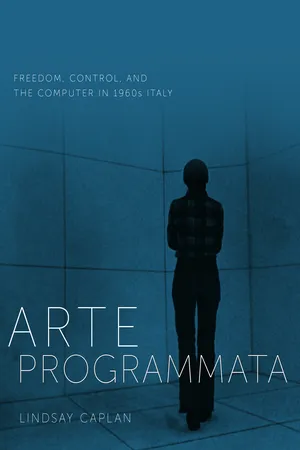
Arte Programmata
eBook - ePub

Arte Programmata

Freedom, Control, and the Computer in 1960s Italy

  1. English
  2. ePUB (mobile friendly)
  3. Available on iOS & Android
eBook - ePub

Arte Programmata

Freedom, Control, and the Computer in 1960s Italy

About this book

Tracing the evolution of the Italian avant-garde’s pioneering experiments with art and technology and their subversion of freedom and control

In postwar Italy, a group of visionary artists used emergent computer technologies as both tools of artistic production and a means to reconceptualize the dynamic interrelation between individual freedom and collectivity. Working contrary to assumptions that the rigid, structural nature of programming limits subjectivity, this book traces the multifaceted practices of these groundbreaking artists and their conviction that technology could provide the conditions for a liberated social life.

Situating their developments within the context of the Cold War and the ensuing crisis among the Italian left, Arte Programmata describes how Italy’s distinctive political climate fueled the group’s engagement with computers, cybernetics, and information theory. Creating a broad range of immersive environments, kinetic sculptures, domestic home goods, and other multimedia art and design works, artists such as Bruno Munari, Enzo Mari, and others looked to the conceptual frameworks provided by this new technology to envision a way out of the ideological impasses of the age.

Showcasing the ingenuity of Italy’s earliest computer-based art, this study highlights its distinguishing characteristics while also exploring concurrent developments across the globe. Centered on the relationships between art, technology, and politics, Arte Programmata considers an important antecedent to the digital age. 

Frequently asked questions

Yes, you can cancel anytime from the Subscription tab in your account settings on the Perlego website. Your subscription will stay active until the end of your current billing period. Learn how to cancel your subscription.
No, books cannot be downloaded as external files, such as PDFs, for use outside of Perlego. However, you can download books within the Perlego app for offline reading on mobile or tablet. Learn more here.
Perlego offers two plans: Essential and Complete
  • Essential is ideal for learners and professionals who enjoy exploring a wide range of subjects. Access the Essential Library with 800,000+ trusted titles and best-sellers across business, personal growth, and the humanities. Includes unlimited reading time and Standard Read Aloud voice.
  • Complete: Perfect for advanced learners and researchers needing full, unrestricted access. Unlock 1.4M+ books across hundreds of subjects, including academic and specialized titles. The Complete Plan also includes advanced features like Premium Read Aloud and Research Assistant.
Both plans are available with monthly, semester, or annual billing cycles.
We are an online textbook subscription service, where you can get access to an entire online library for less than the price of a single book per month. With over 1 million books across 1000+ topics, we’ve got you covered! Learn more here.
Look out for the read-aloud symbol on your next book to see if you can listen to it. The read-aloud tool reads text aloud for you, highlighting the text as it is being read. You can pause it, speed it up and slow it down. Learn more here.
Yes! You can use the Perlego app on both iOS or Android devices to read anytime, anywhere — even offline. Perfect for commutes or when you’re on the go.
Please note we cannot support devices running on iOS 13 and Android 7 or earlier. Learn more about using the app.
Yes, you can access Arte Programmata by Lindsay Caplan in PDF and/or ePUB format, as well as other popular books in Art & Art General. We have over one million books available in our catalogue for you to explore.

Information

Topic
Art
Subtopic
Art General

Table of contents

  1. Cover
  2. Title Page
  3. Copyright Page
  4. Contents
  5. Introduction: Between the Programmed and the Free
  6. Chapter 1. Collectivizing Authorship: Arte Programmata and the Open Work, 1962
  7. Chapter 2. Programming the Spectator: Environments and Control, 1964–1967
  8. Chapter 3. The Politics of Information: Arte Programmata and International Computer Art, 1965–1970
  9. Chapter 4. Autonomy and Organization: Progettazione and the Ends of Programmed Art, 1970s
  10. Conclusion
  11. Acknowledgments
  12. Notes
  13. Index
  14. About the Author
  15. Color Plates