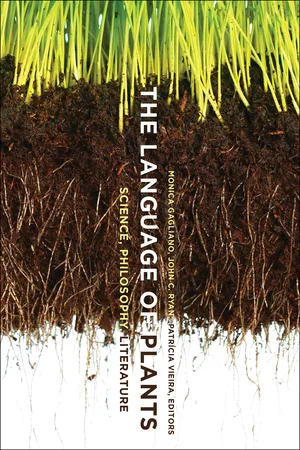
The Language of Plants
eBook - PDF

The Language of Plants

Science, Philosophy, Literature

  1. 348 pages
  2. English
  3. PDF
  4. Available on iOS & Android
eBook - PDF

The Language of Plants

Science, Philosophy, Literature

About this book

The eighteenth-century naturalist Erasmus Darwin (grandfather of Charles) argued that plants are animate, living beings and attributed them sensation, movement, and a certain degree of mental activity, emphasizing the continuity between humankind and plant existence. Two centuries later, the understanding of plants as active and communicative organisms has reemerged in such diverse fields as plant neurobiology, philosophical posthumanism, and ecocriticism. The Language of Plants brings together groundbreaking essays from across the disciplines to foster a dialogue between the biological sciences and the humanities and to reconsider our relation to the vegetal world in new ethical and political terms.

Viewing plants as sophisticated information-processing organisms with complex communication strategies (they can sense and respond to environmental cues and play an active role in their own survival and reproduction through chemical languages) radically transforms our notion of plants as unresponsive beings, ready to be instrumentally appropriated. By providing multifaceted understandings of plants, informed by the latest developments in evolutionary ecology, the philosophy of biology, and ecocritical theory, The Language of Plants promotes the freedom of imagination necessary for a new ecological awareness and more sustainable interactions with diverse life forms.

Contributors: Joni Adamson, Arizona State U; Nancy E. Baker, Sarah Lawrence College; Karen L. F. Houle, U of Guelph; Luce Irigaray, Centre National de la Recherche Scientifique, Paris; Erin James, U of Idaho; Richard Karban, U of California at Davis; André Kessler, Cornell U; Isabel Kranz, U of Vienna; Michael Marder, U of the Basque Country (UPV-EHU); Timothy Morton, Rice U; Christian Nansen, U of California at Davis; Robert A. Raguso, Cornell U; Catriona Sandilands, York U.

Frequently asked questions

Yes, you can cancel anytime from the Subscription tab in your account settings on the Perlego website. Your subscription will stay active until the end of your current billing period. Learn how to cancel your subscription.
No, books cannot be downloaded as external files, such as PDFs, for use outside of Perlego. However, you can download books within the Perlego app for offline reading on mobile or tablet. Learn more here.
Perlego offers two plans: Essential and Complete
  • Essential is ideal for learners and professionals who enjoy exploring a wide range of subjects. Access the Essential Library with 800,000+ trusted titles and best-sellers across business, personal growth, and the humanities. Includes unlimited reading time and Standard Read Aloud voice.
  • Complete: Perfect for advanced learners and researchers needing full, unrestricted access. Unlock 1.4M+ books across hundreds of subjects, including academic and specialized titles. The Complete Plan also includes advanced features like Premium Read Aloud and Research Assistant.
Both plans are available with monthly, semester, or annual billing cycles.
We are an online textbook subscription service, where you can get access to an entire online library for less than the price of a single book per month. With over 1 million books across 1000+ topics, we’ve got you covered! Learn more here.
Look out for the read-aloud symbol on your next book to see if you can listen to it. The read-aloud tool reads text aloud for you, highlighting the text as it is being read. You can pause it, speed it up and slow it down. Learn more here.
Yes! You can use the Perlego app on both iOS or Android devices to read anytime, anywhere — even offline. Perfect for commutes or when you’re on the go.
Please note we cannot support devices running on iOS 13 and Android 7 or earlier. Learn more about using the app.
Yes, you can access The Language of Plants by Monica Gagliano,John C. Ryan,Patrícia Vieira in PDF and/or ePUB format, as well as other popular books in Philosophy & Philosophy History & Theory. We have over one million books available in our catalogue for you to explore.

Table of contents

  1. Cover
  2. Half Title
  3. Title
  4. Copyright
  5. CONTENTS
  6. INTRODUCTION
  7. Part I. Science
  8. Part II. Philosophy
  9. Part III. Literature
  10. ACKNOWLEDGMENTS
  11. CONTRIBUTORS
  12. INDEX