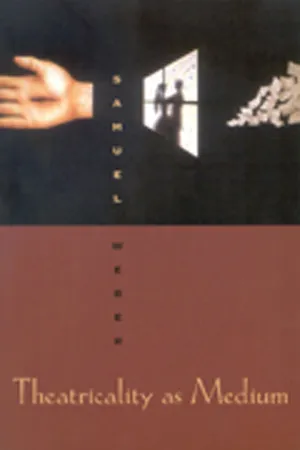
Ever since Aristotle's Poetics, both the theory and the practice of theater have been governed by the assumption that it is a form of representation dominated by what Aristotle calls the "mythos," or the "plot." This conception of theater has subordinated characteristics related to the theatrical medium, such as the process and place of staging, to the demands of a unified narrative.
This readable, thought-provoking, and multidisciplinary study explores theatrical writings that question this aesthetical-generic conception and seek instead to work with the medium of theatricality itself. Beginning with Plato, Samuel Weber tracks the uneasy relationships among theater, ethics, and philosophy through Aristotle, the major Greek tragedians, Shakespeare, Kierkegaard, Kafka, Freud, Benjamin, Artaud, and many others who develop alternatives to dominant narrative-aesthetic assumptions about the theatrical medium.
His readings also interrogate the relation of theatricality to the introduction of
electronic media. The result is to show that, far from breaking with the characteristics of live staged performance, the new media intensify ambivalences about place and identity already at work in theater since the Greeks.
Praise for Samuel Weber: "What kind of questioning is primarily after something other than an answer that can be measured . . . in cognitive terms? Those interested in the links between modern philosophy nd media culture will be impressed by the unusual intellectual clarity and depth with which Weber formulates the . . . questions that constiture the true challenge to cultural studies today. . . . one of our most important cultural critics and thinkers"—MLN
- 414 pages
- English
- ePUB (mobile friendly)
- Available on iOS & Android
eBook - ePub
Theatricality as Medium
About this book
Information
Publisher
Fordham University PressYear
2009Print ISBN
9780823224166
9780823224159
eBook ISBN
9780823224173
1
Theatrocracy; or, Surviving the Break
THE RELATION between theater and politics has a long and vexed history. Of all the “arts,” theater most directly resembles politics insofar as traditionally it has been understood to involve the assemblage of people in a shared space. But the audience in the theater differs from the members of a political grouping: its existence is limited in time, whereas a polity generally aspires to greater duration. Theater acknowledges artificiality and artifice, whereas political communities are often construed in terms of a certain naturalness, an association underscored by the etymology of the word nation—deriving from Latin nasci, to be born.1 Political entities have historically derived their legitimacy from their ability to promote what is shared and common—a “commonwealth”—whereas theater tends frequently to the extreme and to the exceptional.2 Politics is supposed to involve an appeal to reason, whereas theater frequently appeals unabashedly to desire and emotion. Finally, perhaps most important of all, politics as generally practiced claims to be the most effective means of regulating or at least controlling conflict, whereas theater flourishes by exacerbating it. Yet both the thinkers of politics and its practitioners have recognized a need to come to terms with theater, lest it wind up dictating its terms to them.
One of the earliest and most illuminating articulations of this strained relation between politics and theatricality is to be found in book 3 of Plato’s Laws. As has often been noted, not the least significant of the paradoxes that mark Plato’s work is that such an eminently theatrical writer should have so profoundly mistrusted the political effects of theatricality. In the passage I am referring to from the Laws, the main speaker, called simply “The Athenian,” discusses the reasons for the decline of his city. He identifies as a major issue the way in which political communities respond to fear. Formerly, he recalls, his countrymen had been able to resist the onslaught of the Persians only because of two interrelated factors, both involving fear: fear of the enemy and of the consequences of defeat, and “that other fear instilled by subjection to preexisting law,” which allowed them to turn mere fear into disciplined resistance (699c).3 The Athenian concludes his historical review, however, with an ominous, if at first enigmatic, observation. Noting the obvious differences in the respective political histories of the Athenians and the Persians—how the latter “reduced the commonality to utter subjection, whereas we encouraged the multitude toward unqualified liberty”—the Athenian asserts that such differences notwithstanding, “our fate has, in a way, been the same as that of the Persians” (699e). Megillus, one of his interlocutors, is understandably puzzled and asks for clarification. In response, the Athenian, somewhat surprisingly, invokes the history of music as an exemplary illustration of how liberty can degenerate into license and bring about the collapse of a state of law. In times gone by, he remembers,
our music was divided into several kinds and patterns… . These and other types were definitely fixed, and it was not permissible to misuse one kind of melody for another. The competence to take cognizance of these rules, to pass verdicts in accord with them, and, in case of need, to penalize their infraction was not left, as it is today, to the catcalls and discordant outcries of the crowd, nor yet to the clapping of applauders; the educated made it their rule to hear the performances through in silence and for the boys, their attendants, and the rabble at large, there was the discipline of the official’s rod to enforce order. Thus, the bulk of the populace was content to submit to this strict control in such matters without venturing to pronounce judgment by its clamors.
Afterward, in the course of time, an unmusical license set in with the appearance of poets who were men of native genius, but ignorant of what is right and legitimate in the realm of the Muses. Possessed by a frantic and unhallowed lust for pleasure, they contaminated laments with hymns and paeans with dithyrambs, actually imitated the strains of the flute on the harp, and created a universal confusion of forms… . By compositions of such a kind and discourse to the same effect, they naturally inspired the multitude with contempt of musical law, and a conceit of their own competence as judges. Thus our once silent audiences have found a voice, in the persuasion that they understand what is good and bad in art; the old sovereignty of the best, aristocracy, has given way to an evil “sovereignty of the audience,” a theatrocracy [theatrokratia]. (700–701a)4
“Theatrocracy” as the rule of the audience, which is to say, of a more or less contingent, more or less temporary assemblage, is, for the Athenian, worse even than democracy, which is far from his favorite form of government:
If the consequences had been even a democracy, no great harm would have been done, so long as the democracy was confined to art, and composed of free men. But, as things are with us, music has given occasion to a general conceit of universal knowledge and contempt for law, and liberty has followed in their train… .
So the next stage of the journey toward liberty will be refusal to submit to the magistrates, and on this will follow emancipation from the authority and correction of parents and elders; then … comes the effort to escape obedience to the law, and when that goal is all but reached, contempt for oaths, for the plighted word, and all religion. The spectacle of the Titanic nature of which our old legends speak is reenacted; man returns to the old condition of a hell of unending misery. (701a-c)
A democracy, although obviously not the political form of choice for the Athenian, would at least have respected certain “confines”: it would have been “confined to art,” and it would have confined its demos to “free men,” thus excluding (but also presupposing, for its freedom) women and slaves. What is so frightening and fearful about theatrocracy, by contrast, is that it appears to respect no such limits. And how, after all, can there be a polis, or anything political, without limits and confinement?5 It is the established system of such demarcations, epitomized here by the organization of music into fixed genres and types, that is progressively dissolved by a practice that mixes genres and finally leaves no delimitation untouched or unquestioned. The driving force of such a development seems at first glance to be hedonistic, and so it is usually read. But the mere fact that the “lust for pleasure” is qualified as being “frantic and unhallowed” suggests that here, no less than in their military struggles, the Athenians are driven as much by fear as by desire: or, rather, that fear and desire may turn out to be very difficult to separate. As Socrates observes in the Philebus: “In laments and tragedies and comedies—and not only in those of the stage but in the whole tragicomedy of life—as well as on countless other occasions, pains are mixed with pleasures” (50b).6 The mixing of pleasures has as its privileged site the stage, the place and medium of theater, but the danger, here and elsewhere, is that such mixing will not confine itself to a single place but rather will be driven, almost by nature, to transgress all places, limits, and laws.7 Like theater itself, the theatrocratic usurpation of the rule of law is driven as much by fear as by pleasure. At the same time, this drive appears to be associated with an acoustical rather than simply a visual medium: song, dance, and music break down most effectively the sense of propriety and the barriers that are its condition, giving the “silent” majority a voice and producing a hybrid music bordering on noise.8
The emergence of theatrocracy thus necessarily and essentially involves what today we would call “multimedia.” The reference to theater acquires special significance against this background. The theater that is being referred to—indirectly, via the notion of “theatrocracy”—is clearly not that of tragedy or comedy, which will furnish Aristotle with his canonical instances, and yet it is still designated as theater. As already noted, the Greek word theatron designates the place from which one sees. The notion of theatrocracy retains this reference to a specific place or site, but it is disrupted, disorganized by the different media that converge upon it. Curiously, the “rule” of the theatron seems to entail the absence of all stable rules. The theater emerges as an open-air version of the Platonic cave. It is a place where one comes and goes, and yet where one is not free in one’s movements.
What results, then, is described by the Athenian in a judgment that has lost little of its resonance in the thousands of years since Plato: “Everybody knows everything, and is ready to say anything; the age of reverence is gone, and the age of irreverence and licentiousness has begun.”9 From Plato to the present, this verdict has served to condemn “the media.”
Even Walter Benjamin, who, in contrast to his colleagues of the Frankfurt Institute for Social Research, did not have a predominantly negative view of the media, did not hesitate to designate “theatrocracy” as the enemy of all innovation and change. But, in a characteristic departure from traditional moralistic critiques, he added the decisive nuance that theatrocracy is especially dangerous when it becomes the alibi of a “criticism” that invokes the “false, dissimulating totality” of the “audience” (Publikum) as the ultimate and unquestioned criterion. Benjamin’s condemnation of “theatrocracy,” while ostensibly echoing the Platonic critique, is diametrically opposed to it. What Benjamin finds dangerous is not the appeal to the “audience” but the pretense that the addressee of that appeal is one and the same, monolithic, unchangeable, natural. Such fetishization—in the Marxian (and perhaps also Freudian) sense—of the audience justifies a criticism that is in fact an apology for existing power relations. By treating the audience as monolithic and immutable, such criticism tends to universalize and perpetuate a relation of forces whose relativity it denies and obscures. For Benjamin, the potentiality of theatrical spectators is not to be found in their staying the same, but in their possibility for change.
This possibility, however, is precisely what concerned Plato. His concern indicates that he recognizes a similar potential in theater, although he valorizes it negatively: the potential of disturbing and transforming the established order, traditional authority, and the hierarchies it entails. It is this potential that leads Plato, through the figure of the Athenian, to forge the word theatrocracy.
Having thus designated the danger, the question now becomes: Wherein does its power lie? We can already surmise that the answer will have something to do with the nature of the theatrical site and the way it influences the perceptions and behavior of those who fall under its sway. As we will see, for Plato the fascinating power of the theatrocracy is marked by a resurgence of thauma, the wonder that draws and holds one’s gaze, and whose powerful fascination is therefore very difficult to control.
The consequences of this “thaumatic” aspect of theatrocracy emerge more clearly in book 7 of the Laws that I want to discuss briefly, from book 7. In it, the Athenian sketches another nightmare scenario, this time drawn not from the history of Athens but from its contemporary life, thereby illustrating the depths of political degradation into which his city has descended:
A magistrate has just offered sacrifice in the name of the public when a choir, or rather a number of choirs, turn up, plant themselves not at a remote distance from the altar, but, often enough, in actual contact with it, and drown the solemn ceremony with sheer blasphemy, harrowing the feelings of their audience with their language, rhythms, and lugubrious strains, and the choir which is most successful in plunging the city which has just offered sacrifice into sudden tears is adjudged the victor. Surely, our vote will be cast against such a practice. (800c-d)10
Public rites are disturbed by itinerant choirs, who lack all respect for constituted authority and who show this lack of respect through their very movement, refusing to stay “at a remote distance from the altar but often enough” entering “in actual contact with it.”11 Through such proximity, the voices of these moving masses can “drown” out the “solemn ceremony,” just as the noise of the audience overwhelms the voices of reason and competence in theatrocracy.
If we reflect on just what elicits condemnation in these two passages, we come to two conclusions. First, theatrocracy, which replaces aristocracy and is not even democratic, is associated with the dissolution of universally valid laws and consequently with the destabilization of the social space that those laws both presuppose and help maintain. The rise of theatrocracy subverts and perverts the unity of the theatron as a social and political site by introducing an irreducible and unpredictable heterogeneity, a multiplicity of perspectives and a cacophony of voices. This disruption of the theatron goes together, it seems, with a concomitant disruption of theory, which is to say, of the ability of knowledge and competence to localize things, keep them in their proper place and thus to contribute to social stability.
It should be remembered, however, that theatrocracy does not originate in the audience but rather in those poets and composers “of native genius” whose experimentation sets the fateful precedent of undermining the authority of established rules and laws. There is something in the “nature” of poets and musicians, then, that encourages or at least allows the flouting of established law and convention. Thus the exclusion of the poets and artists from the polis finds powerful support in the responsibility for the rise of theatrocracy attributed to them here.
But it is only in the second passage, or scene—since, as the Athenian himself notes ironically, his own arguments are themselves often quite theatrical, despite (or because of?) his aversion to theatrical spectacle—that the subversive force of theatrocracy reveals its true resource. This consists in the power to move and disrupt the consecrated and institutionalized boundaries that structure political space: those, for instance, that separate the sacred from the profane, the “altar” from the public. Theatricality demonstrates its subversive power when it forsakes the confines of the theatron and begins to wander: when, in short, it separates itself from theater. For in so doing it begins to escape control by the prevailing rules of representation, whether aesthetic, social, or political. Its vehicle is irreducibly plural and, even more, heterogeneous: not just “a choir” but rather “a number of choirs,” which “turn up” in the most unexpected places, disorganizing official sacrifices, not so much through brute force as through the seductive fascination of their chants, “harrowing the feelings of their audience with their language, rhythms, and lugubrious strains” and thereby subverting the success of the sacrificial ceremony. Such wandering groups or choruses do not attempt to take the altar by storm, from without, as it were. They simply sidle up next to it, in “actual contact with it,” brushing up against it without overrunning it; touching it and touching all those who cannot resist the insidious force of their “lugubrious strains.” The power of such choruses is seductive, contagious, hypnotic. It breaks down the borders of propriety and restraint in others while itself remaining difficult to control or even to identify. What makes these “choirs” all the more wondrous is that they seem to be composed neither of simple amateurs nor of pure professionals. And yet, since the need to which they respond appears undeniable, the Athenian is led to make the following, exasperated suggestion:
If there is really any need for our citizens to listen to such doleful strains on some day which stands accursed in the calendar, surely it would be more proper that a hired set of performers should be imported from abroad for the occasion to render them, like the hired minstrels who escort funerals with Carian music. The arrangement, I take it, would be equally in place in performances of the sort we are discussing. (800d-e)
If the “arrangement … would be equally in place in performances of the sort we are discussing,” it is for the simple reason that the relation of employer to employee, the “hiring” of professional musicians, would impose upon the performers a relatively recognizable social role and respect for the rules. Salaried musicians can be expected to know their place, at least if they want to keep their salaries. Conversely, it is precisely the absence of such knowledge and discipline in theatrocracy that so alarms Plato. When theater rules, people forget their proper place. And places become so unstable that they can hardly become familiar, much less forgotten.
It is the stability of place and the durability of placing that theatrocracy profoundly disturbs. In this respect, its perverse effects are the culmination of Plato’s worst fears concerning mimesis in general: “The mimetic poet sets up in each individual soul a vicious constitution by fashioning phantoms far removed from reality, and by currying favor with the senseless element that cannot distinguish the greater from the less, but calls the same thing now one, now the other” (Republic, 10.605b-c, my emphasis).
Imitation destroys the self-identity of the “same” and the fixity of values by implanting “in each individual soul” a propensity that leads it to confuse phantoms with reality and to “call the same thing now one, now the other.” The exemplary space in which such a “vicious constitution...
Table of contents
- Cover Page
- Title Page
- Copyright Page
- Dedication
- Contents
- Preface
- Prior Publication
- Introduction: Theatricality as Medium
- 1 Theatrocracy; or, Surviving the Break
- 2 Technics, Theatricality, Installation
- 3 Scene and Screen: Electronic Media and Theatricality
- 4 Antigone’s Nomos
- 5 The Place of Death: Oedipus at Colonus
- 6 Storming the Work: Allegory and Theatricality in Benjamin’s Origin of the German Mourning Play
- 7 “Ibi et ubique”: The Incontinent Plot (Hamlet)
- 8 Kierkegaard’s Posse
- 9 After the End: Adorno
- 10 Psychoanalysis and Theatricality
- 11 “The Virtual Reality of Theater”: Antonin Artaud
- 12 Double Take: Acting and Writing in Genet’s “The Strange Word Urb
- 13 “Being … and eXistenZ”: Some Preliminary Considerations on Theatricality in Film
- 14 “War,” “Terrorism,” and “Spectacle”: On Towers and Caves
- 15 Stages and Plots: Theatricality after September 11, 2001 336
- Appendix: Other Publications by Samuel Weber dealing with Theater
- Notes
- Index
Trusted by 375,005 students
Access to over 1.5 million titles for a fair monthly price.
Study more efficiently using our study tools.
Frequently asked questions
Yes, you can cancel anytime from the Subscription tab in your account settings on the Perlego website. Your subscription will stay active until the end of your current billing period. Learn how to cancel your subscription
No, books cannot be downloaded as external files, such as PDFs, for use outside of Perlego. However, you can download books within the Perlego app for offline reading on mobile or tablet. Learn how to download books offline
Perlego offers two plans: Essential and Complete
- Essential is ideal for learners and professionals who enjoy exploring a wide range of subjects. Access the Essential Library with 800,000+ trusted titles and best-sellers across business, personal growth, and the humanities. Includes unlimited reading time and Standard Read Aloud voice.
- Complete: Perfect for advanced learners and researchers needing full, unrestricted access. Unlock 1.5M+ books across hundreds of subjects, including academic and specialized titles. The Complete Plan also includes advanced features like Premium Read Aloud and Research Assistant.
We are an online textbook subscription service, where you can get access to an entire online library for less than the price of a single book per month. With over 1.5 million books across 990+ topics, we’ve got you covered! Learn about our mission
Look out for the read-aloud symbol on your next book to see if you can listen to it. The read-aloud tool reads text aloud for you, highlighting the text as it is being read. You can pause it, speed it up and slow it down. Learn more about Read Aloud
Yes! You can use the Perlego app on both iOS and Android devices to read anytime, anywhere — even offline. Perfect for commutes or when you’re on the go.
Please note we cannot support devices running on iOS 13 and Android 7 or earlier. Learn more about using the app
Please note we cannot support devices running on iOS 13 and Android 7 or earlier. Learn more about using the app
Yes, you can access Theatricality as Medium by Samuel Weber in PDF and/or ePUB format, as well as other popular books in Literature & Drama. We have over 1.5 million books available in our catalogue for you to explore.