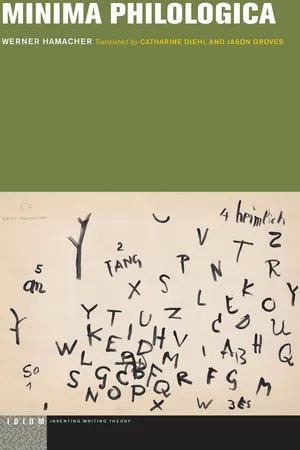
Minima Philologica brings together two essays by Werner Hamacher that are meant to revitalize philology as a practice beyond its restriction to the restoration of linguistic data and their meanings. In these two texts, "95 Theses on Philology" and "For—Philology," Hamacher propounds a notion of generalized philology that is equivalent to the real production of linguistic utterances, and indeed utterances not limited to predicative or even discursive statements. Philology, in speaking for language where no clear and distinct language is given, exhibits and exposes the structure of language in general. The first text, "95 Theses on Philology," challenges academic philology as well as other disciplines across the humanities and sciences that "use" language, assuming it to be a given entity and not an event. The theses develop what Hamacher calls the "idea of philology" by describing the constitution of its objects, its relation to knowledge, its suspension of consciousness, and its freedom for what remains always still to be said.
In "For—Philology," both speaking and writing, Hamacher argues, follow, discursively and non-discursively, the desire for language. Desire—philía—is the insatiable affect that drives the movement between utterances toward the next and the one after that. Desiring language—logos—means to respond to an alien utterance that precedes you, ignorant about where the path will lead, accepting loss and uncertainty, thinking in and through language and the lack of it, exceeding, returning, responding to others, cutting into and off what is to be said. In arguing this, Hamacher responds, directly or obliquely, to other philological thinkers such as Plato and Schlegel, Nietzsche, Benjamin, and Heidegger, as well as to poets such as Rene Char, Francis Ponge, Paul Celan, and Friedrich Holderlin. Taken together, the essays of Minima Philologica constitute a manifesto for a new understanding of linguistic existence that breaks new ways of attending to language and those who live by it.
eBook - ePub
Minima Philologica
- 176 pages
- English
- ePUB (mobile friendly)
- Available on iOS & Android
eBook - ePub
Minima Philologica
About this book
Information
Publisher
Fordham University PressYear
2015Print ISBN
9780823265350
9780823265343
eBook ISBN
9780823265367
MINIMA PHILOLOGICA

MINIMA PHILOLOGICA
WERNER HAMACHER
Translated by CATHARINE DIEHL and JASON GROVES
Fordham University Press New York 2015
Copyright © 2015 Fordham University Press
All rights reserved. No part of this publication may be reproduced, stored in a retrieval system, or transmitted in any form or by any means—electronic, mechanical, photocopy, recording, or any other—except for brief quotations in printed reviews, without the prior permission of the publisher.
“Ninety-Five Theses on Philology”: This work is reprinted from “95 Theses on Philology” (Diacritics 39.1 [Spring 2009]: 25–44). Excerpts from it were published on invitation by Jonathan Culler and Cathy Caruth in a special edition of the PMLA (125.4 [2010]: 994–1001). It was originally published by Urs Engeler as Roughbooks 008: Werner Hamacher, 95 Thesen zur Philologie (2010).
“For—Philology”: This work was originally part of a lecture series on philological questions organized by Jürgen Paul Schwindt at the University of Heidelberg in 2002–3. It appeared in the published version of the colloquium Was ist eine philologische Frage?—Beiträge zur Erkundung einer theoretischen Einstellung. Jürgen Paul Schwindt, ed. (Suhrkamp 2009: 21–60). It was also published independently by Urs Engeler as Roughbooks 004: Werner Hamacher, Für—die Philologie (2009).
Fordham University Press has no responsibility for the persistence or accuracy of URLs for external or third-party Internet websites referred to in this publication and does not guarantee that any content on such websites is, or will remain, accurate or appropriate.
Fordham University Press also publishes its books in a variety of electronic formats. Some content that appears in print may not be available in electronic books.
Visit us online at www.fordhampress.com.
Library of Congress Cataloging-in-Publication Data available online at catalog.loc.gov.
Printed in the United States of America
17 16 15 5 4 3 2 1
First edition
CONTENTS
PART I: Ninety-Five Theses on Philology
PART II: For—Philology
Notes
Minima Philologica
NINETY-FIVE THESES ON PHILOLOGY
—Translated by Catharine Diehl
1
The elements of language explicate one another. They speak for that which still remains to be said within that which is said; they speak as philological additions to one another. Language is archiphilology.
2
The elements of language explicate one another: they offer additions to what has hitherto been said, speak for one another as witnesses, as advocates, and as translators that open that which has been said onto that which is to be said: the elements of language relate to one another as languages. There is not one language but a multiplicity; not a stable multiplicity but only a perpetual multiplication of languages. The relation that the many languages within each individual language, and all individual languages, entertain to one another is philology. Philology: the perpetual extension of the elements of linguistic existence.
3
The fact that languages must be philologically clarified indicates that they remain obscure and reliant upon further clarifications. The fact that they must be expanded philologically indicates that they never suffice. Philology is repetition, clarification, and multiplication of impenetrably obscure languages.
4
To be able to speak means to be able to speak beyond everything that has been spoken and means never to be able to speak enough. The agent of this “beyond” and of this “neverenough” is philology. Philology: transcending without transcendence.
5
The idea of philology lies in a sheer speaking to and for [Zusprechen] without anything spoken of or addressed, without anything intended or communicated.
6
The idea of philology, like the idea of language, forbids us from regarding them as something had [eine Habe]. Since the Aristotelian definition of man as a living being having language uses the (linguistic) category of having [Habe] for language itself, and thus tautologically, language is without a finite object and is itself a nonfinite category, an apeiron.
7
The object of philology is—in extension and in intensity (reality), as well as in the intention directed toward it—infinite. It lies, as Plato might say, epékeina tes ousías. It is therefore not an object of a representation or of a concept, but an idea.
8
From the logos apophantikos, the language of propositions relating to finite objects in sentences capable of truth, Aristotle distinguishes another logos, one that does not say something about something and therefore can be neither true nor false. His only example of this nonapophantic language is the euche, the plea, the prayer, the desire. Propositional language is the medium and object of ontology as well as of all the epistemic disciplines under its direction. Meaningful but nonpropositional language is that of prayer, wish, and poetry. It knows no “is” and no “must” but only a “be” and a “would be” that withdraw themselves from every determining and every determined cognition.
9
Unlike the sciences—ontology, biology, geology—that belong to the order of the logos apophantikos, philology speaks in the realm of the euche. Its name does not signify knowledge of the logos—of speech, language, or relation—but affection for, friendship with, inclination to it. The part of philia in this appellation was forgotten early on, so that philology was increasingly understood as logology, the study of language, erudition, and finally as the scientific method of dealing with linguistic, in particular literary, documents. Still, philology has remained the movement that, even before the language of knowledge, awakens the wish for it and preserves within cognition the claim of that which remains to be cognized.
10a
In contrast to philosophy, which claims to make statements about that which itself is supposed to have the structure of statements, philology appeals only to another language and only toward this other language. It addresses it and confers itself to it. It does not proceed from the givenness of a common language but gives itself to a language that is unknown to it. Since it does this without heed and à corps perdu, it can remain unknown to itself; since it seeks a hold in the other language, in the one that appeals to philology, it can assume that it recognizes itself in this language. Out of a language of unknowing, it springs into a form of knowing. It defines itself as the mediation of nonknowing and knowing, determines itself as the bearer of the speech of the same to the same, becomes the methodical procedure of the securing of epistemic orders, and furthers—against itself—their hegemony. Philology loves and in the beloved forgets love.
10b
The privileging of predication over plea, of propositional knowledge over wish, of topical language over the atopical, can be reversed neither by a violent act of knowing better nor by utopian wishes. But philological experience is recalcitrant. It shows that the desire for language cannot be restricted to the forms of knowledge. Since it is itself the advocate of this desire, it is close to the conjecture that forms of knowledge are only stations of this desire, not its structure.
11
If all propositions are not only capable of addition but also in want of it—be it only in their demand to be heard, understood, answered—then propositions belong to a language that for its own part is not structured as proposition but as claim, as plea, wish, or desire.
12
The languages of knowledge are grounded in languages of nonknowledge, epistemic practices in those of the euche: ontology in philology.
13
Poetry is the language of euche. Departing from the other, going out toward the other that is not and is not not, phílein of a speaking, addressing, affirming without likeness, unlike itself: impredicable.
14
Poetry is prima philologia.
15
That philology is founded in poetry means, on the one hand, that the factual ground for philology’s gestures and operations must be found in the structure of poetry—and that it can only thereby lay claim to a cognition that would do justice to it; on the other hand, it means that philology cannot find any secure, coherent, or constant ground in the structure of poetry. It must, therefore—albeit as an advocate for the cause of poetry—speak with another voice than that of poetry: as divination, conjecture, interpretation. Its fundamentum in re is an abyss. Wherever there is no form of proposition, there is no ground of knowledge.
16
The two languages of philology—the language of longing and the language of knowledge of longing—speak with each other. But the second can only repeat [wiederholen] what the first says; the first can only overtake [überholen] what is said by the other one. In this way they speak each other, speak themselves asunder, and spea...
Table of contents
- CONTENTS
Trusted by 375,005 students
Access to over 1.5 million titles for a fair monthly price.
Study more efficiently using our study tools.
Frequently asked questions
Yes, you can cancel anytime from the Subscription tab in your account settings on the Perlego website. Your subscription will stay active until the end of your current billing period. Learn how to cancel your subscription
No, books cannot be downloaded as external files, such as PDFs, for use outside of Perlego. However, you can download books within the Perlego app for offline reading on mobile or tablet. Learn how to download books offline
Perlego offers two plans: Essential and Complete
- Essential is ideal for learners and professionals who enjoy exploring a wide range of subjects. Access the Essential Library with 800,000+ trusted titles and best-sellers across business, personal growth, and the humanities. Includes unlimited reading time and Standard Read Aloud voice.
- Complete: Perfect for advanced learners and researchers needing full, unrestricted access. Unlock 1.5M+ books across hundreds of subjects, including academic and specialized titles. The Complete Plan also includes advanced features like Premium Read Aloud and Research Assistant.
We are an online textbook subscription service, where you can get access to an entire online library for less than the price of a single book per month. With over 1.5 million books across 990+ topics, we’ve got you covered! Learn about our mission
Look out for the read-aloud symbol on your next book to see if you can listen to it. The read-aloud tool reads text aloud for you, highlighting the text as it is being read. You can pause it, speed it up and slow it down. Learn more about Read Aloud
Yes! You can use the Perlego app on both iOS and Android devices to read anytime, anywhere — even offline. Perfect for commutes or when you’re on the go.
Please note we cannot support devices running on iOS 13 and Android 7 or earlier. Learn more about using the app
Please note we cannot support devices running on iOS 13 and Android 7 or earlier. Learn more about using the app
Yes, you can access Minima Philologica by Werner Hamacher, Catharine Diehl, Jason Groves, Catharine Diehl,Jason Groves in PDF and/or ePUB format, as well as other popular books in Literature & Literary Criticism. We have over 1.5 million books available in our catalogue for you to explore.