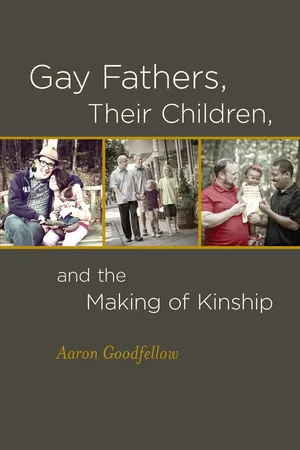
While the topic of gay marriage and families continues to be popular in the media, few scholarly works focus on gay men with children. Based on ten years of fieldwork among gay families living in the rural, suburban, and urban area of the eastern United States, Gay Fathers, Their Children, and the Making of Kinship presents a beautifully written and meticulously argued ethnography of gay men and the families they have formed.
In a culture that places a premium on biology as the founding event of paternity, Aaron Goodfellow poses the question: Can the signing of legal contracts and the public performances of care replace biological birth as the singular event marking the creation of fathers? Beginning with a comprehensive review of the relevant literature in this field, four chapters—each presenting a particular picture of paternity—explore a range of issues, such as interracial adoption, surrogacy, the importance of physical resemblance in familial relationships, single parenthood, delinquency, and the ways in which the state may come to define the norms of health. The author deftly illustrates how fatherhood for gay men draws on established biological, theological, and legal images of the family often thought oppressive to the emergence of queer forms of social life.
Chosen with care and described with great sensitivity, each carefully researched case examines gay fatherhood through life narratives. Painstakingly theorized, Gay Fathers, Their Children, and the Making of Kinship contends that gay families are one of the most important areas to which social scientists might turn in order to understand how law, popular culture, and biology are simultaneously made manifest and interrogated in everyday life. By focusing specifically on gay fathers, Goodfellow produces an anthropological account of how paternity, sexuality, and masculinity are leveraged in relations of care between gay fathers and their children.
- 192 pages
- English
- ePUB (mobile friendly)
- Available on iOS & Android
eBook - ePub
Gay Fathers, Their Children, and the Making of Kinship
About this book
Information
Print ISBN
9780823266043
9780823266036
Subtopic
LGBT Studies1
Sensing Kinship
An anthropological study of queer kinship in the United States that does not draw on David Schneider’s insights into American kinship is hard to imagine. Not only did Schneider (1997) specifically address the topic of gay and lesbian families in one of his final publications, but in his earlier work on kinship he also helped establish queer relations as a valid topic of anthropological inquiry (Carsten 2004; Dean 2009; Weston 1993). Yet Schneider’s work remains problematic because of his basic assumption that the norms structuring family and kin relations in the United States are shared across all social sectors (McKinnon 1994; Yanagisako & Delany 1994). Whether they share generally accepted norms of relatedness and intimacy is not at issue for gay and lesbian families; what is of concern is whether the forms of intimacy and care found among gay families are actively stigmatized in political and public life (Borneman 1996; Butler 2000, 2002).
In this chapter, I ask how gay men who have formed families with children come to acknowledge their family members as kin, given that they must negotiate an environment in which their relationships fall under constant suspicion. The question of acknowledgment is particularly acute for gay men with children, as the experience of William and David shows. Gay men clearly endow terms such as “family,” “marriage,” “father,” and “child” with personal meanings drawn from wider repertoires of affection, intimacy, and desire, yet they are denied the normality indexed by these terms through legal, political, and religious operations. Marilyn Strathern (1992b, 2005), Rayna Rapp and Faye Ginsburg (2001; see also Ginsburg & Rapp 1995), and Sarah Franklin (2001, 2013; see also Franklin & Roberts 2006) have argued that the taken-for-granted quality of kinship relations is constantly being redefined because of the increasing use of new reproductive technologies and the increasing visibility of alternative forms of family in the public sphere. For Strathern, clarification of who is a parent and who qualifies as kin comes to bear on emergent legal judgments and biological science. I argue that these questions are not simply matters decided in the courts of law, and neither are they only raised by the deployment and availability of new reproductive technologies. Rather, the affective qualities of kinship also invite one to consider how parents and children in gay families come to recognize and know each other as kin in the terrains of everyday life. It is in this context that I take up the question of uncertainty in kinship, but rather than turn to biotechnology and the courts for answers, I look at how uncertainties are mediated within everyday family life.
Signe Howell and Diana Marre (2006) argue that achieving a sense of certainty that a child belongs to a family when kin relations are not predicated on a model of shared biological substance entails sensory perception. The cultural assumption that relatives share biological material implies a certain physical resemblance between parents and children, which is a constant source of comment within families. Thus, when families are formed by such alternative means as transnational adoption, resemblance takes on greater salience than biological connection. Criteria such as personality and emotional traits, tendencies, personal interests, or a child’s innate “gifts” define the child’s resemblance and, thus, connection to a parent. This resemblance wards off the possibility that relationships formed outside biological conception and legal marriage are only “fictive” forms of kinship.
In what follows, I describe my encounters with Thomas, Jon, and Tim, three fathers who identify as gay. I trace the implications of a comment Thomas made about uncertainty and examine the importance he placed on conversation as a means of establishing connection, of learning about family relations. I then examine the implications of the anxiety he expressed about how others might receive his family relations, anxiety that resonates in Jon and Tim’s recollections of their experience of founding a family. Thomas, the father of two teenage boys—Andrew and Todd—was a graphic designer and the head of a local gay fathers organization in Washington, D.C. Jon, his partner Tim, and their two children—Josh and Madeline—live outside Baltimore. Tim is a judge, and Jon works in the arts.
Wait and See
It was a warm spring evening in Washington, D.C., and I was sitting in a sidewalk café having dinner with Thomas. Earlier, after I had explained my research interests to him on the telephone, he had expressed an interest in meeting me and taking part in my study because he saw participation in academic research as a means to counter the negative images of same-sex parenting that circulate in public culture. He had already taken part in several academic studies, finding those that deal with the effects of gay parenting on the psychological development of children particularly relevant to his decidedly political goals. Academic research, for Thomas, was not something confined to the ivory towers of universities. It was a means of influencing public opinion and shaping public culture so that his life, his relationships, and his claims to normality might be more readily accepted.
After sitting down to dinner, Thomas asked me two questions: “Are you gay?” to which I answered, “No.” Then, “Do you have kids?” I again said, “No,” and I asked him in return, “Does it matter?” For a moment my question hung in the air. Then Thomas replied, “I’m not sure. You see, I knew I was a father when I was twenty-two and I saw my first child being born. But I didn’t know that I was gay and a father until after I had my second child, was thirty-two, had left my wife, and was dating men. We’ll just have to wait and see.”
Thomas’s words express hope that clarity as to the meaning of these words will arrive in the future and that the uncertainties defining the present as unstable will be transformed into certainties through time. The sentiment found in Thomas’s words reflect the current legal and political status of gay families where the present in which these relations are made and lived is in flux, but the future into which the relations are projected is imagined to be stable. The discordance between the present in which the daily life of family for gay men with children unfolds, the institutional milieu in which gay kinship is made, and the future into which these relations are projected speaks to the untimely quality of kinship. This chapter is devoted to articulating the implications of having to “wait and see” before coming to know how one’s relationships, sexual or otherwise, affect the formation of knowledge.
I took Thomas’s response as an invitation to proceed with what, in my imagination, was an anthropological line of inquiry, steering the conversation away from my own biography and toward his experience of family and kinship. I now realize that my initial interpretation of his questions ignored the importance he placed on time and the difficulty of coming to know the present, or time we live in. It was not until much later, when writing about my research, that I was struck by Thomas’s effort to make me cognizant of the relevance of sensory perception and time for understanding the place of sexuality in notions of fatherhood and the place of fatherhood in notions of sexuality.
His words signal the importance of patience and endurance when it comes to understanding relationships. It is as if we must wait so that the present in which we live and experience others can become the past, thereby allowing us to discern the character of our encounters.
Sensing Uncertainty
My exchange with Thomas evokes the troubling sense of uncertainty (and the importance of addressing its implications) that arises when attempting to understand how one’s relationships might determine knowledge of the self and others. Thomas’s words invite reflection on how questions concerning how we are and are not related shadow the anthropological and philosophical concern with what we can and cannot know about one another (Clifford & Marcus 1986; Geertz 1983). Might they also point to what can and cannot be known about the self?
I understand Thomas’s sense of knowledge and its limits, as well as my own, as motivating our mutual search for biographical and experiential details. We each proceeded as if information about sexuality and kinship could provide us with anchoring points from which to develop a sense of what the other was capable of absorbing, what the other might take for granted, and how each of us might come to learn what the other had to tell.
As the preceding exchange of questions (“Are you gay?” “Do you have kids?” “Does it matter?”) indicates, one’s relationship to the words “gay” and “father” cannot be immediately known by another; it is not self-evident. Expression is needed and solicited to clarify the meaning of one’s present relationships, just as words are needed to address how relationships in the present might be transformed in the future. Yet autobiographical statements such as “I am (not) gay” or “I am (not) a father” may not provide the clarity that is desired, especially when what is at stake is the potential that one’s words might inadvertently cause injury. When Thomas sought these biographical details from me, the burden associated with determining the weight of paternity and sexuality—or, perhaps, the weight of kinship itself—in creating the conditions for knowing became overt and dispersed across the anthropological encounter. As the stories in this chapter demonstrate, words are not enough to generate this knowledge. (In Chapter 3 I address the conundrums that arise from living in kin relations whose meaning arises from the nomination and signatory events of others.)
If the knowledge one seeks and holds is tied to one’s identity, as is assumed in certain forms of politics, then questions of disclosure in anthropological research become very interesting. If I am working with gay fathers, then my hiding my status as a father or hiding my sexual orientation—either of which can be done through declarative statements—might be construed by those men as intentionally misleading and a betrayal. I conducted this research while affiliated with Johns Hopkins University. The university committee overseeing human-subjects research requested that I disclose my sexual orientation to those with whom I worked, a request that marks the institutionalization of these very political and ethical concerns about regulating identity and risk.
The ethics committee did not seem to think that my parental status or my filiation held the same capacity to injure that my sexuality did. Yet, the shadowy presence of uncertainty haunts confessions about fatherhood just as it haunts disclosures about sexuality (Butler 1993; Cavell 1996; Peletz 2001). While it might not seem reasonable for me to be uncertain if I am a man or a woman, as Thomas’s words indicate, the possibility always exists that somebody else might know more about my sex, sexuality, and paternity than I know about myself. It is the possibility that one’s desires and the details of one’s kinship might be hidden, from the public or from one’s self, that permits both kinship and sexuality to function as “closets”: revealing the truth about oneself and one’s relations in these contexts of relating carries the potential to generate disruptive effects (Cavell 1996). It is the possibility of such hidden knowledge, and the multiple meanings attached to paternity, I claim, that makes one vulnerable to kinship. I think Thomas indexed this vulnerability when he said, “We’ll have to wait and see.”
Could the condition of possibility for living in families in which the creation of relatives is not linked to reproductive sexuality reside in developing modes of addressing such uncertainty? In posing this question, I am trying to imagine the implications of switching the perspective of kinship study in the United States from one in which anatomical birth is configured as the point of origin of subjects who give rise to voice and culture (Schneider 1968) to one in which voice is understood as giving birth to culture, as Veena Das (1995) has suggested in a different context. In considering this question, I focus on the place of the senses and of time in creating certainty about the relationships gay men form with their children. Such certainty is especially important given that forms of kinship created by means other then heterosexual conception are routinely greeted with skepticism and violence (Povinelli 2002b; Weston 1999; Yanagisako & Delaney 1995). Does such uncertainty and violence configure sensory knowledge as the most plausible route to belonging in the family? If so, we must recognize that becoming related, just like developing sensory knowledge, requires work and time, and thus endurance—hence, the importance of waiting within the mise-en-scène of seeing.
I am interested in exploring how sensory perception can solidify the meaning of being a relative when kinship is grounded not in a founding event of biology or the signing of a legal contract but in the day-to-day putting together of care through which a sense of belonging emerges (Das 2000). I am not arguing that such forms of caring make gay subjects immune to hurt. Images circulating in the wider culture that represent gay sexuality and gay parenting as pathological strongly influence the way relationships are constructed. I am arguing, rather, that there are productive ways to meet an accusatory gaze.
The Place of Vision
The place of vision in coming to know if one is a relative was made evident to me by my interlocutors’ repeated use of visual tropes in their efforts to fix moments when they felt certain about what it meant to be gay and to be related to one’s child as a father. For instance, Thomas described “knowing” that he had become a father when he gazed on his first child at birth. Yet the same certainty did not materialize in his relationship to the category “gay” until much later, after Thomas had become, and saw himself as being, sexually involved with men.
The strong association between seeing and certainty among the men with whom I worked speaks to how the senses, vision, in particular, are embedded in the...
Table of contents
- Contents
- Introduction: Uncanny Kinship
- 1. Sensing Kinship
- 2. Voicing Kinship
- 3. Suffering Kinship
- 4. Inheriting Kinship
- 5. Precarious Kinship
- Bibliography
- Index
Trusted by 375,005 students
Access to over 1.5 million titles for a fair monthly price.
Study more efficiently using our study tools.
Frequently asked questions
Yes, you can cancel anytime from the Subscription tab in your account settings on the Perlego website. Your subscription will stay active until the end of your current billing period. Learn how to cancel your subscription
No, books cannot be downloaded as external files, such as PDFs, for use outside of Perlego. However, you can download books within the Perlego app for offline reading on mobile or tablet. Learn how to download books offline
Perlego offers two plans: Essential and Complete
- Essential is ideal for learners and professionals who enjoy exploring a wide range of subjects. Access the Essential Library with 800,000+ trusted titles and best-sellers across business, personal growth, and the humanities. Includes unlimited reading time and Standard Read Aloud voice.
- Complete: Perfect for advanced learners and researchers needing full, unrestricted access. Unlock 1.5M+ books across hundreds of subjects, including academic and specialized titles. The Complete Plan also includes advanced features like Premium Read Aloud and Research Assistant.
We are an online textbook subscription service, where you can get access to an entire online library for less than the price of a single book per month. With over 1.5 million books across 990+ topics, we’ve got you covered! Learn about our mission
Look out for the read-aloud symbol on your next book to see if you can listen to it. The read-aloud tool reads text aloud for you, highlighting the text as it is being read. You can pause it, speed it up and slow it down. Learn more about Read Aloud
Yes! You can use the Perlego app on both iOS and Android devices to read anytime, anywhere — even offline. Perfect for commutes or when you’re on the go.
Please note we cannot support devices running on iOS 13 and Android 7 or earlier. Learn more about using the app
Please note we cannot support devices running on iOS 13 and Android 7 or earlier. Learn more about using the app
Yes, you can access Gay Fathers, Their Children, and the Making of Kinship by Aaron Goodfellow in PDF and/or ePUB format. We have over 1.5 million books available in our catalogue for you to explore.