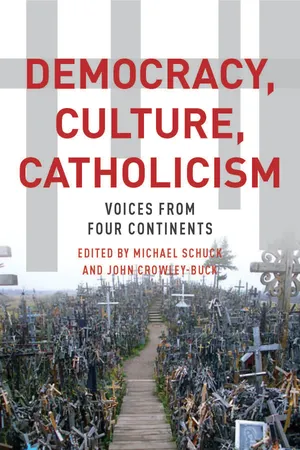
eBook - ePub
Democracy, Culture, Catholicism
Voices from Four Continents
- 360 pages
- English
- ePUB (mobile friendly)
- Available on iOS & Android
eBook - ePub
Democracy, Culture, Catholicism
Voices from Four Continents
About this book
Compiling scholarly essays from a unique three-year Democracy, Culture and Catholicism International Research Project, Democracy, Culture, Catholicism richly articulates the diverse and dynamic interplay of democracy, culture, and Catholicism in the contemporary world. The twenty-five essays from four extremely diverse cultures—those of Indonesia, Lithuania, Peru, and the United States—explore the relationship between democracy and Catholicism from several perspectives, including historical and cultural analysis, political theory and conflict resolution, social movements and Catholic social thought.
Information
Publisher
Fordham University PressYear
2015Print ISBN
9780823268856
9780823267309
eBook ISBN
9780823267316
Topic
Theology & ReligionSubtopic
DemocracyIndonesian Voices
What profoundly marks Catholicism’s relationship to democracy and culture in Indonesia is the fact that Catholics are a minority in a majority Muslim country. Yet, given the profound commitment of Indonesians to the principles of democracy, Catholics have often found themselves at the table of political and civic discourse and involved in the processes of democratization. Nevertheless, the contributions Catholics have made to Indonesian society and government have always remained in the shadow of their minority status. Because of this status, Indonesian Catholics struggle to find their voice and to come to terms with the reality of precisely how effective this voice has been, and can continue to be, in a democratizing Indonesia.
Baskara Wardaya begins this section by articulating the process of democratization in Indonesia, most prominently in the mid- to late twentieth century, and the role of Catholicism, as a minority religion, therein. Catholics in Indonesia played an important role in the Indonesian democratization process but have since become less of a presence in Indonesian political circles. In a nation that has prided itself on being a bastion and exemplar of positive democratizing tendencies, Wardaya notes that Indonesia today is experiencing an increase in inter-religious conflicts. What the results of these conflicts within Indonesia’s democracy will be, and what the future of Catholicism in Indonesia will be, remain ambiguous questions for Wardaya that call for attention and analysis.
Paulus Wiryono Priyotamtama approaches the relationships between democracy, culture, and Catholicism in Indonesia by analyzing the process from which the principles of the social and political order in Indonesia have emerged. Musyawarah is “a traditional system of mutual dialogue, consultation, deliberation, and decision-making based on consensus” that grounds pancasila, the official state philosophy of Indonesia. Wiryono’s task is to evaluate the effectiveness, and continued relevance, of this deliberative process for developing future lay Catholic activists. In the end, Wiryono finds that the process of musyawarah retains its effectiveness in the process of developing such activists, especially when their religious, social, and political commitments are coupled with social entrepreneurship and responsibility.
Francisca Ninik Yudianti takes up the question of social responsibility and democratic practices in Indonesia and asks, with an eye to the Catholic community: Do the principles and frameworks provided by Catholic social teaching have any effect today on the processes of democratic practices and corporate social responsibility in Catholic-owned businesses? The results of Yudianti’s research indicate that, in fact, yes, the democratic practices of Catholic social teaching do have a positive effect on the adoption of corporate social responsibility by businesses in Indonesia, specifically in the Yogyakarta Special Region, whose owners identify as Catholic. What this means for the impact of these practices in other regions of Indonesia, and around the world, remains to be researched, but Yudianti’s contribution to the conversation indicates that such research should be undertaken, since her preliminary findings show positive results.
Albertus Budi Susanto, who takes a more culturally oriented approach via the people’s performing arts (known as kethoprak), draws a connection between the democratizing tendencies of kethoprak and the process of Ignatian spirituality. Kethoprak is subversive and satirical. It looks to the social, political, and religious elites and holds up before them a funhouse mirror of distortion that, not without irony, often exposes their shortcomings and failures to the wider public. More than these results, however, kethoprak is about an interior orientation, about a way of subjectively perceiving and processing the external world. That is to say, kethoprak is about the methodological practice of attuning oneself, and one’s audience, to seeing things differently. It is here that Susanto draws the comparison to Ignatian spirituality. He identifies in both kethoprak and Ignatian spirituality a process whereby one learns to see more clearly and to attend to one’s surroundings more critically. As a result, the relationships between democracy, culture, and Catholicism are intimately tied to the internal movements, and the external experiences, of the performers and audiences and of all Indonesians whose lives take place outside the elite circles of power.
Catholics in Indonesia and the Struggle for Democracy
Baskara T. Wardaya, SJ
Colonized for over 150 years and gaining independence only after World War II, Indonesia is relatively new to the idea and practice of democracy. In the first two decades of Indonesian independence, democracy was difficult to put into practice because the country was undergoing a transitional period from being a colonial territory to an independent nation. Under the threat of domestic rebellion and the impact of the Cold War, Indonesia tried to democratize, but it never fully succeeded.
Beginning in the mid-1960s, Indonesia was ruled by an authoritarian government that paid only lip service to democracy. This facade was used to cover its political and economic interests. It is interesting to note how, as explained in Arūnas Streikus’s earlier chapter in this volume, similar causes and effects were at work during Lithuania’s 1926 slide into authoritarian government. Only after the fall of authoritarianism in 1998 did Indonesia gain the freedom necessary to begin making democracy a reality. As in earlier periods, this attempt has faced many challenges.
As in the case of Lithuanian Catholics, Indonesian Catholics have participated in Indonesia’s struggle for democracy. A major difference between the two, however, is that Indonesian Catholics are a very small religious minority. Nevertheless, the history of this participation has had a powerful impact on both the self-understanding of Indonesian Catholics and the strength of the Indonesian Catholic Church. To grasp the main lines of the story of Catholicism and democracy in Indonesia, a sense of the country’s broad historical context is needed.
Historical Background
Prior to the arrival of Western colonial powers, the area currently known as Indonesia was a vast archipelago made up of politically independent or loosely connected feudalistic sovereignties.1 Each of these sovereignties kept its own traditions regarding politics, culture, language, and beliefs. In the sixteenth century, the Portuguese arrived as the first European colonists. They came after capturing Malacca in 1511 and continued their quest for spices in the eastern part of Indonesia. The islands in the cluster were called the Spice Islands or the Moluccas.
Following the Portuguese, Dutch explorers arrived in the Indonesian ports in 1595. In 1602, Dutch merchants established the Dutch East India Company (Vereenigde Oostindische Compagnie [VOC]). Three years later the company defeated the Portuguese in the Moluccas and took control of the area’s spice trade. In a short time, the VOC exerted economic control over Indonesia’s commercial centers. When the VOC went bankrupt in 1799, control of the islands was assumed by the Dutch colonial government. For the next 150 years, the Indonesian islands were a Dutch colony.
In March 1942, at the height of their power during the Second World War, the Japanese army took over the Dutch East Indies. The Japanese forces easily defeated the Dutch and absorbed all Dutch colonial possessions. The Dutch colonial government fled to Australia and formed a government-in-exile. Following the Japanese surrender on August 15, 1945, Indonesia proclaimed independence. Instead of returning to the precolonial feudal system of government, the Indonesian leaders declared that the new nation would be a democratic republic formed of the entire former Dutch East Indies. Sukarno became the first president.2 The Indonesian leaders declared that the new republic would be based on a commitment to five fundamental values: belief in one God, a just and civilized humanity, the unity of Indonesia, democracy guided by the inner wisdom of unanimity, and social justice. They called this unifying philosophy “Pancasila.”3
Despite this declaration of independence by the Indonesian people, the Dutch government-in-exile sought to reclaim and recolonize Indonesia after the Japanese surrender. This attempt met the fierce resistance of Indonesian freedom fighters. Over the next four years, a bloody conflict waged between the Indonesians and the Dutch colonialists. On December 27, 1949, the Dutch conceded defeat and officially acknowledged Indonesian independence.
As president of the new republic, Sukarno was overwhelmingly popular and revered by Indonesians. In foreign policy, the president was very critical of the developed capitalist nations of the West. In the midst of Cold War tensions, he urged the newly independent nations of Asia and Africa to take neutral positions toward the United States and the Soviet Union. Soon, Sukarno’s anti-capitalist rhetoric and Cold War neutrality were viewed as a threat by anti-Communist circles in Indonesia and around the world. The United States feared that a left-leaning Indonesia would become an ally of the communist bloc and spread communism over Indonesia and other parts of Southeast Asia.
This latter circumstance incited anti-Communist military and civilian groups to launch a brutal anti-Communist purge in 1965 with covert support from Western nations. More than half a million Indonesians were killed during the purge. Many more were imprisoned and exiled. This bloodbath became known as the 1965 Tragedy. In its aftermath, Sukarno’s political power diminished until he was pushed from power and replaced in 1966 by military general Suharto.4
Suharto’s regime was authoritarian and militaristic. As an indication of his intention to reverse Sukarno’s policies, Suharto called his government the “New Order.” The name was meant to suggest that the new government under Suharto would be better than the “old” style of President Sukarno’s rule that was considered inefficient and Communist leaning. As it began to carry out its task of governing the country, however, the New Order government under Suharto demonstrated undemocratic ways of ruling the nation and was gradually subservient to the economic and political interests of many Western governments, especially the United States.5 Pancasila remained the state ideology, but it was used mainly as a political tool to suppress critical voices against the government. This is point is well illustrated by Budi Susanto in his chapter on the role of kethoprak performances in the process of democratization. As Pancasila became co-opted by the powers that be, kethoprak sought to subvert this dominating tendency by offering alternative means for performing social and political democratization in the face of political totalitarianism and widespread human rights violations.
President Suharto himself used a variety of ruthless means to stay in power. For him democracy was merely a formality and was never a true principle on which his government was based. With regard to the presidential elections, for instance, there was indeed a presidential election every five years, but in each of these elections Suharto made himself as the only presidential candidate. If there were any other potential candidates he either would discourage or pressure that person so they would not run for president. As a result, for thirty-two years in every presidential election Suharto was always “elected” president.
In the face of such a political situation religious groups—including the Catholic ones—could not do much to change the situation for fear of political consequences. On the eve of the 1997 presidential election, however, there were some acts of resistance against the government’s policies among some Indonesians, including Catholics. In a pre-Easter pastoral letter signed by the Indonesian Bishop Conference, the bishops bravely stated that if Catholics felt that the existing political parties were not representing their choices and they decided not to cast a vote, they would not commit sin.6 Despite such forms of resistance, Suharto won the 1997 presidential election.
Suharto’s autocratic and ruthless government came undone during the deepening Asian economic crisis of the mid-1990s and the rising student riots against the Suharto regime. As the economic crisis reached Indonesia in 1997, a growing number anti–New Order movements spread, spearheaded by university students in major cities across Indonesia. In the capital Jakarta, demonstrations against the government often turned violent and a number of demonstrators were killed. By the spring of 1998 Suharto and his New Order government were in a politic...
Table of contents
- Cover
- Title Page
- Copyright
- Dedication
- Contents
- Introduction
- Lithuanian Voices
- Indonesian Voices
- Peruvian Voices
- US Voices
- Global Interpretations
- Epilogue on Democracy, Culture, Catholicism
- Acknowledgments
- List of Contributors
- Index
Trusted by 375,005 students
Access to over 1.5 million titles for a fair monthly price.
Study more efficiently using our study tools.
Frequently asked questions
Yes, you can cancel anytime from the Subscription tab in your account settings on the Perlego website. Your subscription will stay active until the end of your current billing period. Learn how to cancel your subscription
No, books cannot be downloaded as external files, such as PDFs, for use outside of Perlego. However, you can download books within the Perlego app for offline reading on mobile or tablet. Learn how to download books offline
Perlego offers two plans: Essential and Complete
- Essential is ideal for learners and professionals who enjoy exploring a wide range of subjects. Access the Essential Library with 800,000+ trusted titles and best-sellers across business, personal growth, and the humanities. Includes unlimited reading time and Standard Read Aloud voice.
- Complete: Perfect for advanced learners and researchers needing full, unrestricted access. Unlock 1.5M+ books across hundreds of subjects, including academic and specialized titles. The Complete Plan also includes advanced features like Premium Read Aloud and Research Assistant.
We are an online textbook subscription service, where you can get access to an entire online library for less than the price of a single book per month. With over 1.5 million books across 990+ topics, we’ve got you covered! Learn about our mission
Look out for the read-aloud symbol on your next book to see if you can listen to it. The read-aloud tool reads text aloud for you, highlighting the text as it is being read. You can pause it, speed it up and slow it down. Learn more about Read Aloud
Yes! You can use the Perlego app on both iOS and Android devices to read anytime, anywhere — even offline. Perfect for commutes or when you’re on the go.
Please note we cannot support devices running on iOS 13 and Android 7 or earlier. Learn more about using the app
Please note we cannot support devices running on iOS 13 and Android 7 or earlier. Learn more about using the app
Yes, you can access Democracy, Culture, Catholicism by Michael J. Schuck,John Crowley-Buck, Michael J. Schuck, John Crowley-Buck in PDF and/or ePUB format, as well as other popular books in Theology & Religion & Democracy. We have over 1.5 million books available in our catalogue for you to explore.