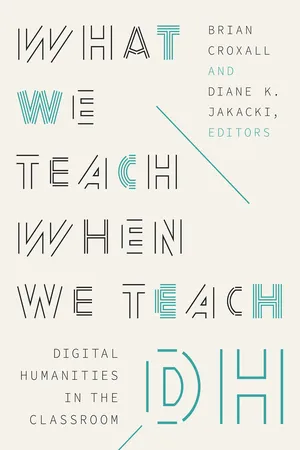
What We Teach When We Teach DH
eBook - PDF

What We Teach When We Teach DH

Digital Humanities in the Classroom

  1. 329 pages
  2. English
  3. PDF
  4. Available on iOS & Android
eBook - PDF

What We Teach When We Teach DH

Digital Humanities in the Classroom

About this book

Exploring how DH shapes and is in turn shaped by the classroom

How has the field of digital humanities (DH) changed as it has moved from the corners of academic research into the classroom? And how has our DH praxis evolved through interactions with our students? This timely volume explores how DH is taught and what that reveals about the field of DH. While institutions are formally integrating DH into the curriculum and granting degrees, many instructors are still almost as new to DH as their students. As colleagues continue to ask what digital humanities is, we have the opportunity to answer them in terms of how we teach DH. 


The contributors to What We Teach When We Teach DH represent a wide range of disciplines, including literary and cultural studies, history, art history, philosophy, and library science. Their essays are organized around four critical topics at the heart of DH pedagogy: teachers, students, classrooms, and collaborations. This book highlights how DH can transform learning across a vast array of curricular structures, institutions, and education levels, from high schools and small liberal arts colleges to research-intensive institutions and postgraduate professional development programs. 


Contributors: Kathi Inman Berens, Portland State U; Jing Chen, Nanjing U; Lauren Coats, Louisiana State U; Scott Cohen, Stonehill College; Laquana Cooke, West Chester U; Rebecca Frost Davis, St. Edward’s U; Catherine DeRose; Quinn Dombrowski, Stanford U; Andrew Famiglietti, West Chester U; Jonathan D. Fitzgerald, Regis College; Emily Gilliland Grover, Notre Dame de Sion High School; Gabriel Hankins, Clemson U; Katherine D. Harris, San José State U; Jacob Heil, Davidson College; Elizabeth Hopwood, Loyola U Chicago; Hannah L. Jacobs, Duke U; Alix Keener, Stanford U; Alison Langmead, U of Pittsburgh; Sheila Liming, Champlain College; Emily McGinn, Princeton U; Nirmala Menon, Indian Institute of Technology; James O’Sullivan, U College Cork; Harvey Quamen, U of Alberta; Lisa Marie Rhody, CUNY Graduate Center; Kyle Roberts, Congregational Library and Archives; W. Russell Robinson, Alabama State U; Chelcie Juliet Rowell, Tufts U; Dibyadyuti Roy, U of Leeds; Asiel Sepúlveda, Simmons U; Andie Silva, York College, CUNY; Victoria Szabo, Duke U; Lik Hang Tsui, City U of Hong Kong; Annette Vee, U of Pittsburgh; Brandon Walsh, U of Virginia; Kalle Westerling, The British Library; Kathryn Wymer, North Carolina Central U; Claudia E. Zapata, UCLA; Benjun Zhu, Peking U.


Retail e-book files for this title are screen-reader friendly.

Information

Year
2023
eBook ISBN
9781452969510

Table of contents

  1. Cover Page
  2. Series Page
  3. Title Page
  4. Copyright Page
  5. Contents
  6. Introduction: What We Teach When We Teach DH
  7. Part I: Teachers
  8. Chapter 1: Born-Pedagogical DH: Learning While Teaching
  9. Chapter 2: What Do We Want from the Standard Core Texts of the Digital Humanities Curriculum?
  10. Chapter 3: Teaching the Digital Humanities to a Broad Undergraduate Population
  11. Chapter 4: Teaching Digital Humanities: Neoliberal Logic, Class, and Social Relevance
  12. Chapter 5: Teaching from the Middle: Positioning the Non–Tenure Track Teacher in the Classroom
  13. Chapter 6: Why (in the World) Teach Digital Humanities at a Teaching-Intensive Institution?
  14. Part II: Students
  15. Chapter 7: Digital Humanities in General Education: Building Bridges among Student Expertise at an Access University
  16. Chapter 8: (Hard and Soft) Skills to Pay the Bills: A Both/And Approach to Teaching DH to Undergraduates
  17. Chapter 9: Digital Humanities across the Curriculum, or How to Wear the Digital Halo
  18. Chapter 10: Rethinking the PhD Exam for the Study of Digital Humanities
  19. Chapter 11: Pedagogy First: A Lab-Led Model for Preparing Graduate Students to Teach DH
  20. Chapter 12: What’s the Value of a Graduate Digital Humanities Degree?
  21. Part III: Classrooms
  22. Chapter 13: Codework: The Pedagogy of DH Programming
  23. Chapter 14: Community-Driven Projects, Intersectional Feminist Praxis, and the Undergraduate DH Classroom
  24. Chapter 15: Bringing Languages into the DH Classroom
  25. Chapter 16: DH Ghost Towns: What Happens When Makers Abandon Their Creations?
  26. Chapter 17: How to Teach DH without Separating New from Old
  27. Chapter 18: The Three-Speed Problem in Digital Humanities Pedagogy
  28. Part IV: Collaborations
  29. Chapter 19: Sharing Authority in Collaborative Digital Humanities Pedagogy: Library Workers’ Perspectives
  30. Chapter 20: K12DH: Precollege DH in Historically Underprivileged Communities
  31. Chapter 21: A Tale of Two Durhams: How Duke University and North Carolina Central University Are Increasing Access and Building Community through DH Pedagogy
  32. Chapter 22: Expanding Communities of Practice through DH Andragogy
  33. Chapter 23: What Is Postcolonial DH Pedagogy, and What Is It Doing in Nonhumanities Institutions?: Case Studies from India
  34. Chapter 24: Finding Flexibility to Teach the “Next Big Thing”: Digital Humanities Pedagogy in China
  35. Chapter 25: What Is Digital Humanities and What’s It Doing in the Classroom?
  36. Acknowledgments
  37. Contributors

Trusted by 375,005 students

Access to over 1.5 million titles for a fair monthly price.

Study more efficiently using our study tools.

Frequently asked questions

Yes, you can cancel anytime from the Subscription tab in your account settings on the Perlego website. Your subscription will stay active until the end of your current billing period. Learn how to cancel your subscription
No, books cannot be downloaded as external files, such as PDFs, for use outside of Perlego. However, you can download books within the Perlego app for offline reading on mobile or tablet. Learn how to download books offline
Perlego offers two plans: Essential and Complete
  • Essential is ideal for learners and professionals who enjoy exploring a wide range of subjects. Access the Essential Library with 800,000+ trusted titles and best-sellers across business, personal growth, and the humanities. Includes unlimited reading time and Standard Read Aloud voice.
  • Complete: Perfect for advanced learners and researchers needing full, unrestricted access. Unlock 1.5M+ books across hundreds of subjects, including academic and specialized titles. The Complete Plan also includes advanced features like Premium Read Aloud and Research Assistant.
Both plans are available with monthly, semester, or annual billing cycles.
We are an online textbook subscription service, where you can get access to an entire online library for less than the price of a single book per month. With over 1.5 million books across 990+ topics, we’ve got you covered! Learn about our mission
Look out for the read-aloud symbol on your next book to see if you can listen to it. The read-aloud tool reads text aloud for you, highlighting the text as it is being read. You can pause it, speed it up and slow it down. Learn more about Read Aloud
Yes! You can use the Perlego app on both iOS and Android devices to read anytime, anywhere — even offline. Perfect for commutes or when you’re on the go.
Please note we cannot support devices running on iOS 13 and Android 7 or earlier. Learn more about using the app
Yes, you can access What We Teach When We Teach DH by Brian Croxall,Diane K. Jakacki,Brian Croxall in PDF and/or ePUB format, as well as other popular books in Social Sciences & Higher Education. We have over 1.5 million books available in our catalogue for you to explore.