The acceleration in science, technology, communication, and production that began in the second half of the twentieth century— developments which make up the concept of the "digital"—has brought us to what might be the most contradictory moment in human history. The digital revolution has made it possible not only to imagine but to actually realize a world in which social inequality and poverty are vanquished. But instead these developments have led to an unprecedented level of accumulation of private profits. Rather than the end of social inequality we are witness to its global expansion.
Recent cultural theory tends to focus on the intricate surface effects of the emerging digital realities, proposing that technological advances effect greater cultural freedom for all, ignoring the underpinning social context. But beneath the surfaces of digital culture are complex social and historical relations that can be understood only from the perspective of a class analysis which explains why the new realities of the "digital condition" are conditioned by the actualities of global class inequalities. It is no longer the case that "technology" can take on the appearance of a simple or neutral aspect of human society. It is time for a critique of the digital times.
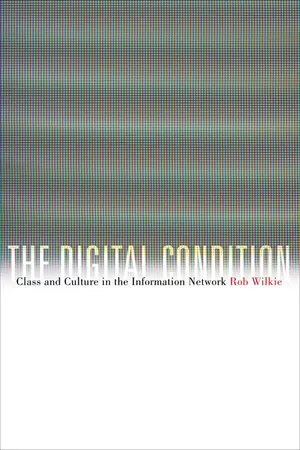
In The Digital Condition, Rob Wilkie advances a groundbreaking analysis of digital culture which argues that the digital geist—which has its genealogy in such concepts as the "body without organs," "spectrality," and "différance"—has obscured the implications of class difference with the phantom of a digital divide. Engaging the writings of Hardt and Negri, Poster, Deleuze and Guattari, Derrida, Haraway, Latour, and Castells, the literature and cinema of cyberpunk, and digital commodities like the iPod, Wilkie initiates a new direction within the field of digital cultural studies by foregrounding the continuing importance of class in shaping the contemporary.
- 260 pages
- English
- ePUB (mobile friendly)
- Available on iOS & Android
eBook - ePub
About this book
Information
Publisher
Fordham University PressYear
2011Print ISBN
9780823234233
9780823234226
eBook ISBN
9780823234240
ONE
The Spirit Technological
Many of today’s theories of digital culture treat digital technologies like a deus ex machina—these technologies seem to appear out of nowhere and yet become the primary means for resolving all social contradictions. According to this model, we are undergoing a fundamental change in how we live and work and we consequently require fundamentally new ways of understanding the world that break with all past models and theories, especially theories that focus on class. Through a close examination that connects some of the core texts and assumptions of digital culture to commodities such as the iPod, I challenge the dominant representations of digital technologies. I argue that most representations disconnect the new technologies and the culture which surrounds them from the economic relations of class and explain why a class theory of digital culture and technology is necessary if we are to understand contemporary society.
Reading Digitally and the Un-Reading of Labor
Reading digitally is the form ideology takes in what might be referred to as the era of the digital condition: a regime of accumulation that emerges in the post–World War II period in which developments in production, communication, and transportation have enabled capitalism to encircle the globe. It is the means by which the exploitation of labor is obscured behind a “spiritual aroma” that suggests that humanity is entering a postcapitalist, postnational, postlabor, posthierarchy, postwork society in which consumption rather than production drives the economy and developments in science and technology have replaced labor as the source of surplus value. What the digital refers to, however, is not simply imaginary or fictional but material developments in the means of production that have heightened the contradictions between capital and labor, putting the question of the future of society at the forefront of cultural theory. In one sense, it corresponds to technological advances in computing, communication, and transportation that have resulted in the tremendous growth in the productivity of labor such that the possibility of meeting the needs of all has perhaps more than ever been materially possible. Yet, insofar as all technological growth under capitalism is subjected to the logic of profit, these developments are restricted in their use to the expansion of the conditions of exploitation and the universalizing of capitalism across the globe. It is for this reason that the digital has become a site of class struggle. That is to say, it is not simply that the digital is plural nor is it that all readings of the digital are equal. In the hands of capital, the concept of the digital has become an example of the way in which this contradiction turns into what Marx calls “an inverted world-consciousness” that is the product of an “inverted world.”1 The digital thus refers both to the process by which capital appropriates the products of labor and turns them into the tools of private accumulation that are then wielded against the working class as a means of extending the capitalist system globally, as well as the way in which this process is naturalized as an inevitable consequence of technological development.
To read the world digitally is another way of saying that the dominant theories of the digital today define the developments of technology in the interests of capital by excluding any understanding of the real possibilities that could be achieved if the private ownership of the means of production were eliminated. Instead, much of what passes for serious thinking about digital technologies is an increasingly celebratory theory that is declared sophisticated because it abandons the “reductive” and “crude” theory of class in favor of a social theory of multiplicity and difference. In this image, digital society is made to appear as the other of class inequality because it is said to be a fundamentally new version of capitalism—a capitalism of digital networks—that suspends all prior economic and social relations by replacing the “hard” world of production with the “soft” world of consumption and exchange. What supposedly differentiates the so-called network capitalism from earlier incarnations of the capitalist mode of production is that “Information, in the form of ideas, concepts, innovation and run-of-the-mill data on every imaginable subject—and replicated as digital bits and bytes through computerization—has replaced labour and the relatively static logic of fixed plant and machinery as the central organizing force of society.”2 In this context, the digital condition is said to refer to a society in which the vertical hierarchies of the industrial system have been replaced with horizontal digital networks of exchange that defy the exploitative logic of earlier modes of capitalism by dematerializing the means of production and thereby erasing the class antagonism of private ownership. As the German sociologist Helmut Willke puts it, “it is not important where you are as long as you are with or within the network.”3 Instead of a system in which the value created by workers flows upward to the owners, network capitalism is defined as a system in which value flows outward to anyone (and everyone) who can access and participate in the circulation of information—a process that occurs after the commodity has been produced, in the realm of consumption.
The problem is that knowledge cannot replace labor as the engine of the economy because it is not the other of labor but the product of labor. Regardless of whether it is the development of a microscope that enables scientists to examine the properties of a virus so as to be able to cure disease or advances in computing that have created the capability of storing and transmitting an entire library for a fraction of what doing so would have cost previously, the ability to expand our understanding of the world around us requires that labor be applied to the development of new technological means for advancing abilities of labor power in the future. But these developments do not occur within a social vacuum. Technology does not have an independent existence from society. As Frederick Engels writes, it is too often the case that the history of technology is presented as if the new technologies had simply “fallen from the sky.” Instead, as he proposes, what drives the development of society is not technology but industry and the needs of labor:
If society has a technical need, that helps science forward more than ten universities. The whole of hydrostatics (Torticelli, etc.) was called forth by the necessity for regulating the mountain streams of Italy in the sixteenth and seventeenth centuries. We have known anything reasonable about electricity only since its technical applicability was discovered.4
Furthermore, insofar as labor does not take place in a social vacuum either, the ends to which labor makes use of technology and knowledge are determined by the relations of production. What is posited as a contradiction between knowledge and labor in digital theory is the effect of the social division of labor that creates the appearance of a conflict between manual and intellectual labor. The real division of the digital condition is not between ideas and things but between the interests of capital and the interests of labor.
In so-called digital theories of the social, however, the transition to a digital economy results in not only a contradiction between ideas and things but a crisis at the level of ideas itself. Whether it is the articulations of a networked economy in high theory or the cultural representations of a cut-and-paste consumer society in the pages of popular magazines and iPod advertisements, the dominant argument is that it has become impossible to understand the world with any certainty because the digital condition represents the fragmentation of society into a thousand different markets with a thousand different desires. Reading digitally therefore means accepting that in an increasingly fragmented world to think means to be aware of the impossibility of understanding beyond the local and the contingent. For example, in defining the role of theory in the digital age, Timothy Druckery writes, “Perception, memory, history, politics, identity, and experience are now mediated through technology in ways that outdistance simple economic or historic analysis.”5 Similarly, Douglas Kellner and Steven Best argue that “contemporary developments exhibit so many twists and turns, and are so highly complex that they elude simply historical sketches, reductive theoretical explanations and facile generalizations” and, as such, “the social maps called classical social theories are to some extent torn, tattered, and fragmented, and in many cases outdated and obsolete.”6
The target of the argument that classical social theories are “outdated and obsolete” and that technological developments undo simple (that is, reductive) “economic or historic analysis” is any theory that attempts to connect the form that capital accumulation takes with the underlying economic logic of capitalism in the exploitation of labor. Instead, the social is read as irreducible to the economic, even as capitalism has reduced the history of class antagonisms from several to two.7 In other words, the digital economy of network capitalism has come to represent the moment when the economic conflicts between capital and labor will be replaced with what Bill Gates calls the “friction-free economy”8 or what Thomas L. Friedman refers to as the “flat world”9—a time when class differences no longer matter because capital will be able to extract tremendous profits from virtually every aspect of daily life without having to exploit labor, and consumers will escape the limits of the working day and shape and reshape their identities at will through access to an ever-expanding global market. As digital enthusiast Nicholas Negroponte exclaims, “Some people worry about the social divide between the information-rich and the information-poor, the haves and the have-nots, the First and Third Worlds. But the real cultural divide is going to be generational.”10 The generational is what replaces class in a progressive theory of history with the perfection of capitalism as its end. In other words, according to the logic of the generational it is only a matter of time before capital finally “gets it right” and succeeds in eliminating all social inequality. In this vision of the world, to raise the question of why inequality exists in the first place and to put forward even the slight possibility that capitalism results in social inequality is not because of a lack of technology but because of the division of ownership that determines to what ends new technological developments are put is to speak in “old” discourses that have no place in the digital celebration.
In reality, the difference between so-called old and new theories is determined not generationally but ideologically. Capital has to regularly reproduce the ideological distinction between the old and the new because as the forces of production develop, they come into conflict with the relations of production. In turn, those concepts that at one moment provide a seamless explanation of the existing at another moment come apart at the seams. At such moments, it becomes necessary to redefine the boundaries of intelligibility so that, in inverted fashion, what is always appears on the side of the new while what could be is always relegated to the side of the old. Fredric Jameson’s theory of the “postmodern turn” is a prime example of the reshuffling of boundaries between the old and the new to accommodate developments in production. Jameson argues that we are entering a new economic regime which necessitates new economic theories that can account for the expanded role of consumption in the determination of value. This is because “aesthetic production today has become integrated into commodity production more generally: the frantic economic urgency of producing fresh waves of ever more novel-seeming goods (from clothing to airplanes), at ever greater rates of turnover, now assigns an increasing essential structural function and position to aesthetic innovation and experimentation.”11 According to Jameson, the incorporation of culture into production means “a prodigious expansion of culture throughout the social realm, to the point at which everything in our social life—from economic value and state power to practices and to the very structure of the psyche itself—can be said to have become ‘cultural’ in some original and yet untheorized sense.”12 In other words, the new is so new that it operates beyond the realm of any prior theories of the relation between the cultural and the economic levels of society. Having displaced any theoretical understanding of culture that seeks out the deep connections between the cultural and economic in favor of a contingent and reversible knowledge that presupposes contemporary culture is somehow so different that it exceeds such theories, Jameson argues that “if the idea of a ruling class were once the dominant (or hegemonic) ideology of bourgeois society, the advanced capitalist countries today are now a field of stylistic and discursive heterogeneity without a norm.”13 What Jameson proposes here is that to read capitalism in terms of class is to impose an old norm onto a new situation that cannot be adequately theorized. Or, rather, it can be theorized only if we accept the argument that capitalism has so fundamentally changed as to have become essentially unrecognizable.
It is in this theorization that we can begin to see why reading digitally has become so useful for capitalism. Reading digitally creates the conditions by which the workforce learns how to think about the complex interactions that a networked economy depends upon, while also learning not to worry about why the networked economy works the way that it does. What passes for theorization is, in other words, the ideological register of capitalist know-how. Even when Jameson argues, “postmodern culture is the internal and superstructural expression of a whole new wave of American military and economic domination throughout the world,”14 following his own logic there is no way of making sense of such a statement. To read the world through a cultural lens, as Jameson proposes, is to read the question of global imperialism as simply one in a multitude of possible discursive formations that, insofar as there is no longer a capitalist norm, can just as easily exist alongside a range of alternative discourses. Without a theory of private property to explain the causes of “military and economic domination,” we are left with only vague impressions as to the meaning of such domination for and impact on working people around the world. We might be outraged at what happens, but we will never be able to understand why it happens and how to transform it. A cultural theory of capitalism thus turns history into a reflection of the marketplace, where the heterogeneity of commodities is a poor substitute for freedom from exploitation.
Property, Class, and Digital Identities
As ideology, popular theories of the digital economy function as...
Table of contents
- Cover Page
- Title Page
- Copyright Page
- Dedication
- Contents
- Acknowledgments
- Introduction
- 1. The Spirit Technological
- 2. Global Networks and the Materiality of Immaterial Labor
- 3. Reading and Writing in the Digital Age
- 4. The Ideology of the Digital Me
- Notes
- Works Cited
- Index
Trusted by 375,005 students
Access to over 1.5 million titles for a fair monthly price.
Study more efficiently using our study tools.
Frequently asked questions
Yes, you can cancel anytime from the Subscription tab in your account settings on the Perlego website. Your subscription will stay active until the end of your current billing period. Learn how to cancel your subscription
No, books cannot be downloaded as external files, such as PDFs, for use outside of Perlego. However, you can download books within the Perlego app for offline reading on mobile or tablet. Learn how to download books offline
Perlego offers two plans: Essential and Complete
- Essential is ideal for learners and professionals who enjoy exploring a wide range of subjects. Access the Essential Library with 800,000+ trusted titles and best-sellers across business, personal growth, and the humanities. Includes unlimited reading time and Standard Read Aloud voice.
- Complete: Perfect for advanced learners and researchers needing full, unrestricted access. Unlock 1.5M+ books across hundreds of subjects, including academic and specialized titles. The Complete Plan also includes advanced features like Premium Read Aloud and Research Assistant.
We are an online textbook subscription service, where you can get access to an entire online library for less than the price of a single book per month. With over 1.5 million books across 990+ topics, we’ve got you covered! Learn about our mission
Look out for the read-aloud symbol on your next book to see if you can listen to it. The read-aloud tool reads text aloud for you, highlighting the text as it is being read. You can pause it, speed it up and slow it down. Learn more about Read Aloud
Yes! You can use the Perlego app on both iOS and Android devices to read anytime, anywhere — even offline. Perfect for commutes or when you’re on the go.
Please note we cannot support devices running on iOS 13 and Android 7 or earlier. Learn more about using the app
Please note we cannot support devices running on iOS 13 and Android 7 or earlier. Learn more about using the app
Yes, you can access The Digital Condition by Robert Wilkie in PDF and/or ePUB format, as well as other popular books in Social Sciences & Social Philosophy. We have over 1.5 million books available in our catalogue for you to explore.