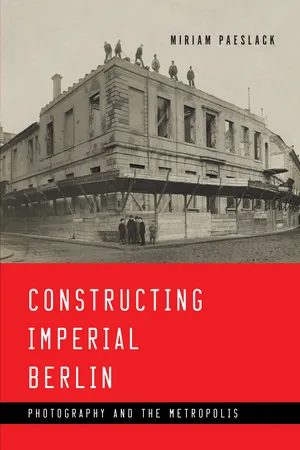
Constructing Imperial Berlin
eBook - ePub

Constructing Imperial Berlin

Photography and the Metropolis

  1. English
  2. ePUB (mobile friendly)
  3. Available on iOS & Android
eBook - ePub

Constructing Imperial Berlin

Photography and the Metropolis

About this book

How photography and a modernizing Berlin informed an urban image—and one another—in the late nineteenth and early twentieth centuries

Since the fall of the Berlin Wall, the city that once visually epitomized a divided Europe has thrived in the international spotlight as an image of reunified statehood and urbanity. Yet research on Berlin’s past has focused on the interwar years of the Weimar Republic or the Cold War era, with much less attention to the crucial Imperial years between 1871 and 1918. 

Constructing Imperial Berlin is the first book to critically assess, contextualize, and frame urban and architectural photographs of that era. Berlin, as it was pronounced Germany’s capital in 1871, was fraught with questions that had previously beset Paris and London. How was urban expansion and transformation to be absorbed? What was the city’s understanding of its comparably short history? Given this short history, how did it embody the idea of a capital? A key theme of this book is the close interrelation of the city’s rapid physical metamorphosis with repercussions on promotional and critical narratives, the emergence of groundbreaking photographic technologies, and novel forms of mass distribution. 

Providing a rare analysis of this significant formative era, Miriam Paeslack shows a city far more complex than the common clichés as a historical and aspiring place suggest. Imperial Berlin emerges as a modern metropolis, only half-heartedly inhibited by urban preservationist concerns and rather more akin to North American cities in their bold industrialization and competing urban expansions than to European counterparts.

Frequently asked questions

Yes, you can cancel anytime from the Subscription tab in your account settings on the Perlego website. Your subscription will stay active until the end of your current billing period. Learn how to cancel your subscription.
No, books cannot be downloaded as external files, such as PDFs, for use outside of Perlego. However, you can download books within the Perlego app for offline reading on mobile or tablet. Learn more here.
Perlego offers two plans: Essential and Complete
  • Essential is ideal for learners and professionals who enjoy exploring a wide range of subjects. Access the Essential Library with 800,000+ trusted titles and best-sellers across business, personal growth, and the humanities. Includes unlimited reading time and Standard Read Aloud voice.
  • Complete: Perfect for advanced learners and researchers needing full, unrestricted access. Unlock 1.4M+ books across hundreds of subjects, including academic and specialized titles. The Complete Plan also includes advanced features like Premium Read Aloud and Research Assistant.
Both plans are available with monthly, semester, or annual billing cycles.
We are an online textbook subscription service, where you can get access to an entire online library for less than the price of a single book per month. With over 1 million books across 1000+ topics, we’ve got you covered! Learn more here.
Look out for the read-aloud symbol on your next book to see if you can listen to it. The read-aloud tool reads text aloud for you, highlighting the text as it is being read. You can pause it, speed it up and slow it down. Learn more here.
Yes! You can use the Perlego app on both iOS or Android devices to read anytime, anywhere — even offline. Perfect for commutes or when you’re on the go.
Please note we cannot support devices running on iOS 13 and Android 7 or earlier. Learn more about using the app.
Yes, you can access Constructing Imperial Berlin by Miriam Paeslack in PDF and/or ePUB format, as well as other popular books in Architecture & History of Architecture. We have over one million books available in our catalogue for you to explore.

Table of contents

  1. Cover
  2. Title Page
  3. Copyright Page
  4. Dedication
  5. Contents
  6. Introduction: A Photographic City Portrait in the Making
  7. 1. Crafting the Metropolis: Photo Panoramas in the Illustrated Journal Berliner Leben
  8. 2. Framing Progress: Ludwig Hoffmann, Ernst von Brauchitsch, and Berlin Architectural Photography, 1902–1912
  9. 3. Tracing Transformation: Berlin’s Urban Palimpsest in Photogrammetry and “Rubble Photography”
  10. 4. Inventing Tradition: The Märkische Museum and Picturesque Berlin
  11. Conclusion: A Fractured and Transitory Urban Imaginary
  12. Acknowledgments
  13. Notes
  14. Index