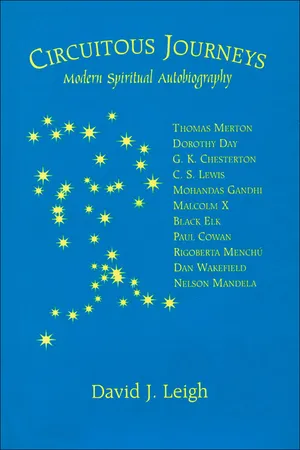
Circuitous Journeys: Modern Spiritual Autobiography provides a close reading and analysis of ten major life stories by twentieth-century leaders and thinkers from a variety of religious and cultural traditions: Mohandas Gandhi, Black Elk, Thomas Merton, Dorothy Day, C. S. Lewis, Malcolm X, Paul Cowan, Rigoberta Menchu, Dan Wakefield, and Nelson Mandela.
The book uses approaches from literary criticism, developmental psychology (influenced by Erik Erikson, James Fowler, and Carol Gilligan), and spirituality (influenced by John S. Donne, Emile Griffin, Walter Conn, and Bernard Lonergan).
Each text is read in the light of the autobiographical tradition begun by St. Augustine's Confessions, but with a focus on distinctively modern and post-modern transformations of the self-writing genre. The twentieth-century context of religious alienation, social autonomy, identity crises and politics, and the search for social justice is examined in each text.
- 259 pages
- English
- ePUB (mobile friendly)
- Available on iOS & Android
eBook - ePub
About this book
Information
Publisher
Fordham University PressYear
2009Print ISBN
9780823219940
9780823219933
eBook ISBN
9780823219957
Topic
Theology & ReligionSubtopic
Christianity1
Thomas Merton’s The Seven Storey Mountain
A HALF-CENTURY after its publication, The Seven Storey Mountain remains the most popular of Merton’s fifty books. Why is this life story, with all its youthful exaggerations, stylistic lapses, and revealing omissions, so readable?1 I would suggest that Merton’s practice as a young novelist and poet helps to explain the power and popularity of his autobiography. The autobiography embodies in a rudimentary but sophisticated narrative Merton’s resolution of a profound personal crisis. In a later book, Conjectures of a Guilty Bystander, he explains that “… a personal crisis is creative and salutory if one can accept the conflict and restore unity on a higher level, incorporating the opposed elements in a higher unity” (189). This literary structure of “incorporating the opposed elements in a higher unity” describes Merton’s version of the circular journey of his life. This picture of a circular journey of “opposed elements” moving up the “seven storey mountain” of his purgatorial life holds the central plot of the autobiography together. It also holds the imagination of the readers as they follow the journey and discover that it contains the major traits of modern spiritual autobiographies—Merton’s directional image, his narrative sections, his parental conflicts, his insights through mediators, his confrontations with death, the sequence of his conversions, and his use of writing.
Unlike the other, middle-aged autobiographers in this study, Merton began writing his life story when he was only in his late twenties. Yet he chose as a title a circular journey form—the spiral seven-storey mountain of the Purgatorio, which describes the middle portion of Dante’s journey. Ironically, or perhaps prophetically, Merton’s age of twenty-nine when he begins his story in 1944 turns out to be just past the midpoint of his life (1915–68). The twenty-seven years of his pre-monastic life narrated in The Seven Storey Mountain make up the first half of his life story. Yet his relative prematurity, both as an autobiographer and as a monk, suggests why many of the “opposed elements” of the narrative are eventually resolved in a “higher unity” that itself will undergo further circling in his subsequent autobiographical writings. In brief, Merton’s early encounters with death precipitate many premature conflicts that lead to a lifelong series of unexpected spirals on his journey.
MERTON’S DIRECTIONAL IMAGE: THE CAPTIVE TRAVELER
Merton’s fundamental childhood experience was one of abandonment to captivity. These feelings derived from the death of his mother when Tom was six, and the frequent travels of his father, leading up to the latter’s death when Tom was sixteen. But the imagery of exile and captivity flowing from the experience of abandonment begins with the opening paragraph. Here Merton describes his birth in the middle of “a great war” where he is a “prisoner of my own violence and my own selfishness, in the image of the world into which I was born,” a world that is “the picture of Hell” full of “self-contradictory hungers.” Thus, he is born not into a purgatory but into a hell, the one place that has abandoned God and feels itself abandoned in turn. This description is followed by a sentence describing soldiers abandoned in trenches of the First World War. This section, in turn, leads into the pages portraying his father and mother, both of whom are simultaneously “captives” of the infernal world and “lifted above” it by their vocation as artists (3). This image of simultaneous captivity and freedom leads into the primary dynamic self-image of Merton himself throughout the autobiography— a traveling prisoner in search of freedom and home. Like his mother, who had journeyed from America, and his father, from New Zealand to Prades in southern France where Tom was born, Merton in the story “began a somewhat long journey” (4). His journey is a variant of Augustine’s running the gamut of experience, for Merton wants “to grab everything and see everything and investigate every experience and then talk about it” (4).
There is no need to recount Merton’s numerous travels in his autobiography, especially in Part One. What is important to note is the tension—”self-contradictory hungers”—in Merton’s feelings and images of himself: an incessant traveler seeking a permanent home, a searcher for freedom always envisioning a permanent relationship. These tensions appear in his earliest drawings. At one time, he draws “a picture of the house, and everybody sitting under the pine trees, on a blanket, on the grass.” But most of the time, he draws “pictures of boats” (9). Later, in describing his reading, Merton tells of playing “prisoner’s base all over those maps” in his geography books and then concludes, “I wanted to become a sailor” (10–11). After listening to stories of Greek mythology, he dreams of traveling with Jason or Theseus “towards the freedom of my own ever-changing horizon” (11). He sums up the tensions of his earliest sense of vocation in a comment on his fascination with an anchor in a stained-glass window in the local Episcopal church: “Strange interpretation of a religious symbol ordinarily taken to signify stability in Hope. … To me it suggested just the opposite. Travel, adventure, the wide sea, and unlimited possibilities of human heroism, with myself as the hero” (13).
After the death of his mother, Tom’s sense of abandonment and his desire for both travel and home become jumbled together by what he calls the “continual rearrangement of our lives and our plans from month to month” (18). He describes the boat and train trip from Long Island to Provincetown (16–17), where he revels in the fishing boats and listens to his father reading out of a John Masefield book “full of pictures of sailing ships” (17). After returning to Long Island, Tom learns “how to draw pictures of schooners and barks and clippers and brigs” (17). From there, when his father returns by boat to Bermuda, Tom is taken along to the island, where he is shuffled from place to place as his father’s painting demands. Finally, his father returns to New York for an exhibition, calls for Tom, but then leaves him and his brother with their grandparents for two years on Long Island. The exits and journeys of this section of the autobiography become paradigms of the overall movement of Merton’s life story: a short-term home, then abandonment, and, finally, reunion, often on a series of islands—Long Island, Bermuda, England, Isle of Wight, Manhattan, Cuba. Eventually Gethsemani monastery itself becomes a sort of spiritual island.
Even during the relative permanence of the years in southern France described in “Our Lady of the Museums,” Merton begins another journey, at age ten, with the arrival at Calais and a long train trip with his father to the Midi, where he says, “I felt at home” (32). In fact, his main desire here is for a “home” with his father and brother (33). Yet in the Lycée where he boards during the week, he writes adventure stories based on travel novels like Westward Hot (52). After describing the relatively stable three years in St. Antonin, where he is once again separated from his father in the detested boarding school, Merton ends this chapter with his father’s announcement that his son is going to England, an event that makes his whole world resound with what Merton calls “liberty, liberty, liberty” (60). Just as his father had completed building their house (composed of fragments of local religious architecture in France), Tom is uprooted from the Midi and sent to live with his Aunt Maud in Ealing near London. In brief, the directional imagery of the first two chapters—the account of his childhood—suggests the inner tension of Merton’s entire life: when he travels, he wants a home; when he finds a home, his father has to move, and so Tom, too, longs to travel. Thus, Tom becomes the captive of his contradictory hungers for both freedom and stability.
Surrounding or supporting this directional image is the major elemental metaphor in the first part of The Seven Storey Mountain —water. It is no coincidence that Merton tells us in the first sentence of the book that he was born under the sign of the Water Bearer, for he mentions water in nearly every episode of his childhood: his father’s birth “beyond many oceans” (4); the return to New York by a “crossing of the sea” (6); his own drawing of ocean liners (9); his desire to be a sailor and “go to sea” (13); the Provincetown trip, when the “waters spoke loudly” (16); life in Bermuda, where “the sun shone on the blue waters of the sea, and on the islands in the bay” (19). Even when he reaches France, the country becomes the “spring of natural waters, … cleansed by grace” (30), where he learns to “drink from fountains of the Middles Ages” (32).
The water metaphor, however, is ambiguous—at times associated with cleansing, at others, with falling into an abyss. These two traditional symbolic meanings of water in literature are not insignificant in Merton’s autobiography. For in each of the three parts of the text, Merton identifies in himself a desire for cleansing and also a fear of the abyss. The word “clean,” for example, is used to describe his father’s painting on the first page of the autobiography and appears dozens of times throughout the text. Similarly, his desire for freedom leads him in Part One across waters of abandonment to various abysses of sin or near madness; in Part Two, he passes through the “Red Sea” of baptism to the abyss of anticlimax in his life of minimal Catholic practice but ends with a description of himself reaching “the edge of an abyss” in his desire for a vocation to the priesthood: “the abyss was an abyss of love and peace, the abyss was God” (255). In Part Three, when he enters the monastery to make a retreat at Gethsemani, he finds the place beneath the sign “God alone” to be “frighteningly clean” (321), and as he arrives, he says, “I stepped into the cloister as if into an abyss” (323). There he sees monks in the liturgy bowing “like white seas” and describes a new monk taking his white habit: “The waters had closed over his head, and he was submerged in the community” (325). During the retreat, Merton experiences “graces that overwhelmed me like a tidal wave, truths that drowned me with the force of their impact” (323). Finally, he addresses, on the last page of the narrative, a poem to his dead brother, “buried at sea” (403). Even the epilogue renews the water imagery by describing Merton’s other self—the writer—as “the old man of the sea” (411).
In effect, the directional image of the “captive traveler” expands through its contradictory associations with both cleansing water and the original abyss to include the conflicts of an upward circular movement in his life story. As sailor and hero, he desires both travel and home, seeks cleansing and experiences the abyss in the same objects, reaches land which often turns out to be an island, and concludes “with these contradictory hungers only tentatively resolved. He recapitulates the travel imagery in the epilogue: “We cannot arrive at the perfect possession of God in this life, and that is why we are travelling and in darkness. But we already possess Him by grace, and therefore in that sense we have arrived and are dwelling in the light” (419).
In brief, he ends his story by transferring to God the contradictions of his circular journey (and simultaneously reminding us of the paradoxical limits of language about God):
I cannot bring any other man on this earth into the cloud where I dwell in Your light, that is, Your darkness, where I am lost and abashed. I cannot explain to any other man the anguish which is Your joy nor the loss which is the Possession of You, nor the distance from all things which is the arrival in You, nor the death which is the birth in You because I do not know anything about it myself and all I know is that I wish it were over—I wish it were begun.
You have contradicted everything. (419–20)
Thus, Merton, following his directional image, ends his journey where Augustine begins his: with the paradoxes of language about the beginning and end of all words.
MERTON’S NARRATIVE STRUCTURE: THE CIRCULAR JOURNEY UPWARD THROUGH CONFLICTS
Even this brief study of the directional imagery of The Seven Storey Mountain suggests that the story combines uneasily the traditional narrative patterns of the journey and the battle. This tension reflects the pattern of the two archetypal religious autobiographies in the West: Augustine’s Confessions, a quest story, and John Bunyan’s Grace Abounding, a psychomachia or “soul struggle.” The tension between these two patterns reflects itself in the very titles of the chapters. In Part One, “Prisoner’s Base” suggests the captivity of the players in this children’s game and their desire for travel. “Our Lady of the Museums” and “The Children in the Market Place” picture the static situation in which the hero is battling with various voices or temptations. “The Harrowing of Hell” recaptures the image of movement again, but a movement that is painful and reluctant on the part of the hero. The last, of course, in tradition recalls the freeing by Christ of ancient captives in the underworld, primarily from purgatory. Thus, the titles of Part One coincide with the circular journey, moving from the hell of the opening scene up the spirals of the mountain of Dante’s Purgatorio in subsequent chapters.
In Part Two, the title of the first chapter, “With a Great Price,” suggests the tension of the sufferings of Christ; the other, “The Waters of Contradiction,” indicates the Exodus movement of the Israelites through the Red Sea into their desert wanderings. Once again, the combination of battle and journey appears in the imagery of the first two titles in Part Three, “Magnetic North” and “True North”; whereas the last two titles point to places of tension and its release: “The Sleeping Volcano” of Harlem and “The Sweet Savor of Liberty” of Gethsemani (the latter a place of inner battle for Christ on his journey to death and resurrection).
What the chapter titles do not indicate, however, is the complexity of narrative patterns in the overall autobiography. A closer analysis of the main events of each of the three parts uncovers a repeated threefold pattern of movement: (1) journey movement forward (upward and centripetal); (2) battle movement back and forth between extremes (sideways and centrifugal); (3) negative journey movements backward or into dead ends (downward and centrifugal). In several parts of the narrative, we discover parallels between the specific events or persons in each of these three movements, thus making it another variant of the circular journey found in other modern spiritual autobiographies. As a realistic writer giving detailed accounts of his journey, with interspersed theological commentaries, Merton uses the symbolic parallels only intermittently, but with enough regularity to remind the reader of Malcolm X or Dorothy Day.
No critic so far has convincingly shown the structural key to The Seven Storey Mountain to be any seven “storeys” or “stories” within the autobiography. But if we focus on the external journey only in Parts One and Three, leaving aside Part Two for analysis later as primarily an internal battle leading to a double conversion, we find a clearer narrative pattern. In the journeys of Parts One and Three, the following seven “stories” emerge, all narratives of the gradual loss of family, home, and identity; then a gradual search through Catholicism for a new family, home, and identity. Part One is a story of descent ending in the subways of New York City; Part Three is a story of ascent ending in the gardens of Gethsemani monastery.
(1) Merton leaves his childhood home with his parents in Douglastown, after the loss of his mother, to wander in Bermuda (I, 1).
(2) Merton settles in his youthful home with his father in St. Antonin, only to travel to stay with his aunt in Ealing near London (1.2).
(3) Merton lives as an adolescent in Oakham and Cambridge, during which period he loses his father, gains worldly godparents, and begins his moral wandering (I, 3).
(4) Merton moves back to New York and finds an intellectual home at Columbia University, only to lose his grandparents and continue his spiritual wandering (I, 4).
After his conversion experiences of Part Two, Merton settles in three new places.
(5) Merton searches for priesthood in Greenwich Village (III, 1).
(6) Merton creates a monastery in the world in Olean (III, 2).
(7) Merton experiments with social involvement at Friendship House in Harlem (III, 3).
However helpful this charting of the seven places of his purgatorial journey might appear, it does not suggest the many parallels between the events of Part One and the events of Part Three. For instance, we find surprising similarities on the train journeys of each of these parts. Both the opening and the closing parts begin with a train journey. Part One opens with his trip across France to a temporary home in New York; Part Three begins with a train trip from New York to the Franciscan seminary where he becomes “vaguely aware of my homelessness” just before he is rejected from any home, parents, or identity with the Franciscans (296–97). The middle of Parts One and Three includes important train trips as well. In fact, the train trips form something of a triangle, in Part One between Paris, southern France, and Rome; in Part Three between New York City, Olean, and Gethsemani. Both sections also include ocean voyages: Part One between England and New York, Part Three between New York and Cuba.
The trip to Rome in I, 3 suddenly becomes an accidental pilgrimage, where Merton visits churches, forms his first image of Christ in the ancient Catholic culture, and experiences a vision of his deceased father that impels him to prayer for the first time in his life (109). The trip to Cuba in III, 1 is also a pilgrimage, this time a deliberate one, where he also visits churches, forms his first image of the Virgin (as Our Lady of Solitude) in a contemporary Catholic culture, and has a “manifestation of God’s presence” during the Mass, an event that impels him to contemplation for the first time (279–85). The former event precedes the first mention of a passing desire “to become a Trappist monk” (114); the latter event leads into his rejection as a Franciscan candidate and eventual desire to become a Trappist. In fact, the first pilgrimage parallels both the Cuban pilgrimage and the pilgrmage to Gethsemani for his first retreat (320ff.).
Both Parts One and Three also end with a train trip. Part One ends with a train taking Merton down into the “tunnel under the river” toward Long Island, the low point of his homeless wanderings when he is suffering a nervous breakdown after the death of his grandparents (161). He calls this experience “the death of the hero” in the “blind alley” of despair which he had reached on his purgatorial descent through Part One. Part Three likewise ends with a train trip (III, 3) which carries him across the river on a bridge to Kentucky, the end of his search for a spiritual home in Gethsemani where, after “a civil, moral death” to the past, he experiences an exultation of joy at entering “the four walls of my new freedom” (369,372).
Thus, as we have noted, the first part of Merton’s captive travels moves from total family home on an island (Douglastown) to a one-parent home first on an island (Bermuda) and then amid monasteries in France (St. Antonin), then to a parentless series of schools in the country (the Lycée, Oakham, Cambridge), and, finally, across an ocean to the city where his grandparen...
Table of contents
- Cover Page
- Title Page
- Copyright Page
- CONTENTS
- ACKNOWLEDGMENT
- PREFACE
- INTRODUCTION
- 1 Thomas Merton’s The Seven Storey Mountain
- 2 Dorothy Day’s The Long Loneliness
- 3 The Psychology of Conversion in G. K. Chesteron and C. S. Lewis
- 4 The Dual Plot of Gandhi’s An Autobiography
- 5 Malcolm X and the Black Muslim Search for the Ultimate
- 6 Black Elk Speaks: A Century Later
- 7 The Remaking of an American Jew: Paul Cowan’s An Orphan in History
- 8 I, Rigoberta Menchú: The Plotting of Liberation
- 9 Dan Wakefield’s Returning
- 10 Retraveling the Century: Nelson Mandela’s Long Walk to Freedom
- CONCLUSION
- INDEX
- Footnotes
Trusted by 375,005 students
Access to over 1.5 million titles for a fair monthly price.
Study more efficiently using our study tools.
Frequently asked questions
Yes, you can cancel anytime from the Subscription tab in your account settings on the Perlego website. Your subscription will stay active until the end of your current billing period. Learn how to cancel your subscription
No, books cannot be downloaded as external files, such as PDFs, for use outside of Perlego. However, you can download books within the Perlego app for offline reading on mobile or tablet. Learn how to download books offline
Perlego offers two plans: Essential and Complete
- Essential is ideal for learners and professionals who enjoy exploring a wide range of subjects. Access the Essential Library with 800,000+ trusted titles and best-sellers across business, personal growth, and the humanities. Includes unlimited reading time and Standard Read Aloud voice.
- Complete: Perfect for advanced learners and researchers needing full, unrestricted access. Unlock 1.5M+ books across hundreds of subjects, including academic and specialized titles. The Complete Plan also includes advanced features like Premium Read Aloud and Research Assistant.
We are an online textbook subscription service, where you can get access to an entire online library for less than the price of a single book per month. With over 1.5 million books across 990+ topics, we’ve got you covered! Learn about our mission
Look out for the read-aloud symbol on your next book to see if you can listen to it. The read-aloud tool reads text aloud for you, highlighting the text as it is being read. You can pause it, speed it up and slow it down. Learn more about Read Aloud
Yes! You can use the Perlego app on both iOS and Android devices to read anytime, anywhere — even offline. Perfect for commutes or when you’re on the go.
Please note we cannot support devices running on iOS 13 and Android 7 or earlier. Learn more about using the app
Please note we cannot support devices running on iOS 13 and Android 7 or earlier. Learn more about using the app
Yes, you can access Circuitous Journeys by David J. Leigh in PDF and/or ePUB format, as well as other popular books in Theology & Religion & Christianity. We have over 1.5 million books available in our catalogue for you to explore.