Identifying African American religiosity as the ingenuity of a people constantly striving to inhabit their humanity and eke out a meaningful existence for themselves amid harrowing circumstances, Black Lives and Sacred Humanity constructs a concept of sacred humanity and grounds it in the writings of Anna Julia Cooper, W. E. B. Du Bois, and James Baldwin. Supported by current theories in science studies, critical theory, and religious naturalism, this concept, as Carol Wayne White demonstrates, offers a capacious view of humans as interconnected, social, value-laden organisms with the capacity to transform themselves and create nobler worlds wherein all sentient creatures flourish.
Acknowledging the great harm wrought by divisive and problematic racial constructions in the United States, this book offers an alternative to theistic models of African American religiosity to inspire newer, conceptually compelling views of spirituality that address a classic, perennial religious question: What does it mean to be fully human and fully alive?
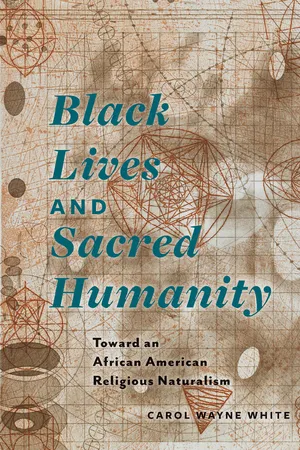
eBook - ePub
Black Lives and Sacred Humanity
Toward an African American Religious Naturalism
- 176 pages
- English
- ePUB (mobile friendly)
- Available on iOS & Android
eBook - ePub
About this book
Information
Publisher
Fordham University PressYear
2016Print ISBN
9780823269822
9780823269815
eBook ISBN
9780823269839
CHAPTER 1
African American Religious Sensibilities and the Question of the Human
We are unknown, we knowers, ourselves to ourselves: this has its own good reason. We have never searched for ourselves—how should it then come to pass, that we should ever find ourselves?
—FRIEDRICH NIETZSCHE
The notion of sacred humanity I explore emerges from a creative synthesis of African American religious and intellectual thought, critical theory, and religious naturalism. Each of these discourses provides important insights that make possible the coherency and intelligibility of the term. I focus on the first two in this chapter, later addressing religious naturalism in chapter 2. To begin my argument, I first provide historical examples of the enduring legacy of African American religiosity as it emerged from the wreckages of slavery, underscoring it as one distinct and critical response by blacks attempting to defy dehumanizing practices and racist rhetoric in the United States. I specifically identify a thematic pattern within black religious thought that illustrates the various ways African Americans have sought to humanize their existence and flourish as a people.1 With these examples, I underscore the functional value of black religiosity and distinguish this humanistic bent as one of the highest aspirations of African American character, namely, its claim on life.
I then set this functionalist approach to black religiosity within a wider conceptual context that renders a sense of its richness and value: a modern Euro-American philosophical trajectory that has shifted attention away from the traditional object of faith (deity) to emphasize human subjectivity. As I suggest, this modernist shift, of which the Enlightenment is a paradigmatic example, failed to live up to its emancipatory aims, ushering in an influential cultural ethos with deficient models of humanity supported by influential forms of racialized reasoning. Key for my purposes are the creative responses from black intellectual culture in the mid–twentieth century in addressing the lethal effects of this “enlightened” humanistic discourse. These critical perspectives provide the backdrop for my development of a new African American religious ideal emerging out of old convictions; in short, these responses help give shape to the view of sacred humanity that I begin constructing in chapter 2.
African American Religious Valuing
In the significant study African American Religious Thought: An Anthology (2003), Cornel West and Eddie S. Glaude, Jr. divided the evolution of African American religious life into five critical phases: 1) African American religion as the problem of slavery (mid–eighteenth century to 1863); 2) African American religion and the problem(s) of emancipation (1864–1903); 3) African American religion, the city, and the challenge to racism (1903–1954); 4) African American religion and the black freedom struggle (1954–1969); 5) the golden age of African American religious studies (1969–present).2
A cursory look at this typology shows African American religiosity evolving historically (and perhaps primarily) as a complex socioethical, political mechanism that has aided African Americans in their myriad struggles against various forms of injustice—a key point expressed by Du Bois in The Souls of Black Folk.
This evolution is not surprising, given the harrowing experiences of Africans on this continent as enslaved subjects whose full humanity was often questioned or denied.3 Once transported onto American shores, the physical color of Africans took on symbolic significance within a cultural system of differentiation that both marked them as slaves and justified negative assessments of their humanity. With the establishment of slave laws during the colonial period, whites were justified in treating blacks as objects or assets to be bought and sold, mortgaged and wagered, devised and condemned. In very few contexts were blacks regarded as human subjects with volition, feeling, and a sense of responsibility. Their slave status stripped them of many civil rights and liberties purportedly granted to all citizens of the nation, such as the right to make contracts or other legally binding choices, to sue or be sued, to acquire property, to marry legally, and (with rare exceptions) to testify against whites.4 Along with other cultural practices, these laws were integral to a white supremacist ideology that systemically devalued black lives and attempted to place blacks outside of the circle of full humanity. Historical records show that this ideological apparatus in the United States has been very hard to dismantle. (In the contemporary era, the development of Critical Race Theory has emerged from legal scholars’ awareness of the power structures based on white privilege and white supremacy that have continued to perpetuate the marginalization of all people of color.5) During the processes of securing legal, social, and political gains in subsequent centuries, people of African descent have continually encountered views of themselves as inferior, as subhuman beasts, outsiders, even as interlopers—even up to the present era.6
Religious expression has been one of the key strategies used by African Americans attempting to free themselves from these conceptions and the problematic cultural practices ensuing from them. While an exhaustive treatise on the complex evolution of black religiosity in this regard falls beyond the scope of this study, there are key moments and a discernible pattern through the years that can be identified. Emerging as it did from the context of slavery, the dominant African American cultural narrative is replete with religious interventions and strategies that provided the necessary ontological justification and ethical reasoning for establishing blacks’ full humanity. For example, the use of spirituals in slave religion represents one of the earliest recorded acts of resistance against an institution that defined blacks fundamentally as property. With these ancient songs, slaves (individually and communally) attempted some measure of freedom in acknowledging a divine presence that affirmed their humanity in ways dominant white culture did not.7
In the process of trying to comprehend the wretched processes of slavery, literate African Americans with rich theological imaginations also employed various forms of biblical hermeneutics directed toward their full emancipation. Varied abolitionists and reformers in the nineteenth century often referenced the Exodus narrative of the ancient Hebrews as a key metaphor for their own sociopolitical activism.8 The exodus event served a broader agenda of assisting influential leaders as they developed a concept of national identity that reflected the black slaves’ unique experience; inspired by the epic narrative of Moses and the Israelites, many blacks looked beyond their oppressed status to a future when they would be authentically free, exercising their rights as complex human beings. Nineteenth-century religious thinkers and visionaries such as Isabella Baumfree (known as Sojourner Truth) and Alexander Crummell reminded the young nation that a fundamental distortion of the value of all human life was operative in the nation’s failure to establish and maintain the proper material conditions and social conventions that would enable African Americans to flourish individually and collectively.9 Together with other iconic figures, they consistently decried the dehumanizing factors embedded in America’s social and legal institutions while addressing the existential and psychological factors that contributed to African Americans’ sense of selfhood and assertions of their humanity.
The use of transcendental theological language was indispensable for many leaders who inspired their communities with a vision of freedom. For example, Maria W. Miller Stewart, a social activist and public speaker during the early nineteenth century, believed her activism was a dimension of divine justice operating in the world—a theme that has consistently resurfaced in subsequent African American religious perspectives. In her speeches and rhetorical gestures as an abolitionist speaking on behalf of the African American Female Intelligence Society of Boston, Stewart appealed to a divine agency—or what she described as the divine “Word” as written in the world through the deeds and actions of the faithful.10 In Stewart’s paradigmatic case, the notion of divine justice provided the quintessential ethical standard for addressing the dehumanizing structures of American culture, and it served to adjudicate internal conflicts (for example, sexism) within black culture. When one of the more influential abolitionist newspapers counseled that “the voice of woman should not be heard in public debates, but there are other ways in which her influences would be beneficial,”11 Stewart bravely declared:
What if I am a woman; is not the God of ancient times the God of these modern days? Did he not raise up Deborah, to be a mother, and a judge in Israel? Did not Queen Esther save the lives of the Jews? And Mary Magdalene first declare the resurrection of Christ from the dead? . . . If such women as are here described have once existed, be no longer astonished then, my brethren and friends, that God at this eventful period should raise up your own females to strive, by their example, both in public and private, to assist those who are endeavoring to stop the current of prejudice that flows so profusely against us at present.12
Stewart’s speeches and activism constituted a critical (albeit early) phase of a distinct cultural trajectory that established an important set of values aimed at dignifying blacks’ humanity and enriching the lives of all, not just a select few.
As the most influential African American religious tradition of that period, Christianity inspired countless blacks in their quests to negate the negation of their precious humanity within exploitative cultural systems.13 In his classic study The Negro Church in America, E. Franklin Frazier described “black” Christianity as “a nation within a nation, espousing racial solidarity for black communities,” and he highlighted the functional role of its symbols among African Americans in establishing their essential value as humans.14 As these and other historical accounts show, many of the newly freed blacks who were introduced to Protestant Christianity saw within its symbolic language and eschatological visions an avenue toward liberation and transformation of self and society on multiple levels. One of the most enduring ideas operative in traditional black Christianity is the biblically inspired view of a personal deity (God) who acts in human history on behalf of the downtrodden and marginalized. The conceptual fullness and complexity of this theological notion within the long history of African American religious culture is impossible to sketch here; suffice it to say that the term God has been directly associated with immanent qualities of goodness, love, mercy, and justice in conjunction with idealized exercises of power and objective knowledge.
In his 1938 study The Negro’s God, Benjamin Mays examined some of the earliest conceptions of God in African American literature written in distinct periods: 1760–1865; the Civil War period to 1914; and 1914–1937.15 According to Mays, from 1760 to 1914 the idea of God developed along two main trajectories: 1) views of God that were used to support or encourage adherence to traditional, compensatory patterns that addressed earthly sufferings; and 2) conceptions of God, whether traditional or otherwise, that were developed and interpreted to support a growing consciousness of social and psychological adjustment needed in the quest for freedom. The sentiments of an anonymous ex-slave appear to illustrate this latter point, as his musings on the concept of God are inextricably tied to his sense of being a reflective, ensouled human: “There is a man in a man. The soul is the medium between God and man. God speaks to us through our conscience, and the reasoning is so loud that we seem to hear a voice.”16 Notwithstanding the shifts in emphasis indicated by these two lines of thought, Mays acknowledges that formative theistic affirmations among African Americans were always firmly situated in the social situation of the people.
Following Mays’ lead in this regard is James Evans, a contemporary theologian, who has recently argued that historically the experience of otherness constituting the lived experiences of black Americans has been inextricably connected to particular conceptions of God. Evans states: “In situations where their humanity is called into question in subtle and not so subtle ways, African Americans cannot talk about God without talking about what it means to be black in the United States. In situations where African Americans affirm their humanity in spite of their dehumanization they cannot talk about what it means to be black without talking about God as the arbiter of human worth.”17 These examples from Mays and Evans help to illustrate, among other things, an important point in grasping the functional value of traditional black religiosity: theistic affirmations have been closely associated with a fundamental epistemic assertion that has, by necessity, been established repeatedly in every generation, that is, the assertion that all humans share in the same ontological reality.18 This truth claim often propels the myriad forms of social and political activism in black culture that have continually challenged our various institutions to enact that principle in earnest.
In the mid–twentieth century, black religious expression took on distinct sociopolitical characteristics as many leaders continued the crucial task of countering racial discrimination and affirming the intrinsic value of black humanity. A key figure in this period was James Cone, whose articulation of a black liberation theology became a standard measure for adopting religious and ethical mandates against white racism. The liberationist paradigm that Cone helped to inaugurate has continued to reinforce black subjectivity as an ontological necessity as it has sought to achieve cultural integrity and wholeness in a race-driven culture.19 Variations of this black theological consciousness have culminated in an influential corpus of African American religious thought and expression up to the present day. Furthermore, in recent decades, scholars have continued exploring the axiological, cultural, and social implications of this liberationist theme in exciting, bold directions, underscoring a black religiosity that addresses the prevalence and pernicious effects of institutionalized racism in the daily lives of African Americans.20 Notable among these new perspectives are womanist religious expressions that have foregrounded black women’s lived experience as a crucial starting point for sustained religious reflection on cultural survival and wholeness. As expressed by many of its proponents, womanist religious thought has emerged as a strategic intervention that focuses primarily on two destructive structures affecting the entire black community: white supremacy that denies full humanity to blacks, and patriarchal systems that obfuscate black women’s humanity. As the pioneering work of Delores Williams indicates, womanist religious thought often evokes a cultural agenda bent on maintaining the integrity of black humanity through a shared struggle with varied marginalized black identities in the ongoing quest to survive and ensure a productive quality of life for all blacks in the United States.21 Along with other contemporary initiatives, womanist reflections show that religious expression remains at the heart of African Americans’ recorded quest for fullness of life in a nation that has often failed to fulfill—and often sadly, compromised on—its duty to secure the highest quality of life for all its denizens.
This thumbnail sketch of an evolving African American religiosity could never capture its full complexity, diversity, and richness; nonetheless, it serves to illuminate a recurrent liberationist theme that was born out of the historical realities of the slave experience and its aftermath. While acknowledging other possible interpretations, I believe this thematic pattern of liberation highlights African Americans’ desire to live fully and with dignity. It also expresses a propensity toward life that is inextricably connected to affirming and establishing blacks’ full humanity in a vexed, race-driven cultural context that has generated dehumanizing forces and structures on ...
Table of contents
- Cover
- Title Page
- Copyright
- Contents
- Preface
- Introduction: In Search of a New Religious Ideal
- 1. African American Religious Sensibilities and the Question of the Human
- 2. Sacred Humanity as Stubborn, Irreducible Materiality
- 3. Anna Julia Cooper: Relational Humanity and the Interplay of One and All
- 4. W. E. B. Du Bois: Humans as Centers of Value and Creativity
- 5. James Baldwin: Religion, Race, and the Love of Humanity
- Conclusion: Toward an African American Religious Naturalism
- Acknowledgments
- Notes
- Index
Trusted by 375,005 students
Access to over 1.5 million titles for a fair monthly price.
Study more efficiently using our study tools.
Frequently asked questions
Yes, you can cancel anytime from the Subscription tab in your account settings on the Perlego website. Your subscription will stay active until the end of your current billing period. Learn how to cancel your subscription
No, books cannot be downloaded as external files, such as PDFs, for use outside of Perlego. However, you can download books within the Perlego app for offline reading on mobile or tablet. Learn how to download books offline
Perlego offers two plans: Essential and Complete
- Essential is ideal for learners and professionals who enjoy exploring a wide range of subjects. Access the Essential Library with 800,000+ trusted titles and best-sellers across business, personal growth, and the humanities. Includes unlimited reading time and Standard Read Aloud voice.
- Complete: Perfect for advanced learners and researchers needing full, unrestricted access. Unlock 1.5M+ books across hundreds of subjects, including academic and specialized titles. The Complete Plan also includes advanced features like Premium Read Aloud and Research Assistant.
We are an online textbook subscription service, where you can get access to an entire online library for less than the price of a single book per month. With over 1.5 million books across 990+ topics, we’ve got you covered! Learn about our mission
Look out for the read-aloud symbol on your next book to see if you can listen to it. The read-aloud tool reads text aloud for you, highlighting the text as it is being read. You can pause it, speed it up and slow it down. Learn more about Read Aloud
Yes! You can use the Perlego app on both iOS and Android devices to read anytime, anywhere — even offline. Perfect for commutes or when you’re on the go.
Please note we cannot support devices running on iOS 13 and Android 7 or earlier. Learn more about using the app
Please note we cannot support devices running on iOS 13 and Android 7 or earlier. Learn more about using the app
Yes, you can access Black Lives and Sacred Humanity by Carol Wayne White in PDF and/or ePUB format, as well as other popular books in Social Sciences & Theology. We have over 1.5 million books available in our catalogue for you to explore.