Winner, French Voices Grand Prize
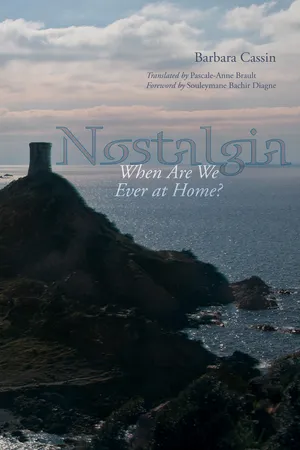
Nostalgia makes claims on us both as individuals and as members of a political community. In this short book, Barbara Cassin provides an eloquent and sophisticated treatment of exile and of desire for a homeland, while showing how it has been possible for many to reimagine home in terms of language rather than territory.
Moving from Homer's and Virgil's foundational accounts of nostalgia to the exilic writings of Hannah Arendt, Cassin revisits the dangerous implications of nostalgia for land and homeland, thinking them anew through questions of exile and language.
Ultimately, Cassin shows how contemporary philosophy opens up the political stakes of rootedness and uprootedness, belonging and foreignness, helping us to reimagine our relations to others in a global and plurilingual world.
- 96 pages
- English
- ePUB (mobile friendly)
- Available on iOS & Android
eBook - ePub
About this book
Information
Publisher
Fordham University PressYear
2016Print ISBN
9780823269518
9780823269501
eBook ISBN
9780823269525
NOTES
OF CORSICAN HOSPITALITY
1. Arthur Rimbaud, “Eternity,” in Rimbaud: Complete Works, Selected Letters: A Bilingual Edition, trans. Wallace Fowlie (Chicago: University of Chicago Press, 2005), 187.
2. René Goscinny and Albert Uderzo, Asterix in Corsica, trans. Anthea Bell and Derek Hockridge (London: Orion, 2004), 20.
3. A Corsican word meaning pointed or high-pitched, pinzutu is used to characterize the accent of the French from the mainland and especially from Paris. —Trans.
4. At the beginning of the twentieth century, Trieste, which had been part of Austria since 1382, became one of the main seats of the “irredentist” movement that sought the annexation to Italy of all lands that had historically been inhabited by Italians. —Trans.
5. See, for example, after Milman Parry, Moses Finley’s The World of Odysseus (New York: NYRB, 2002).
6. La patrie can be translated into English both by homeland or fatherland. Depending on the context, I opt for one or the other. For example, when Aeneas is said to be leaving Troy with his father, Anchises, on his shoulders, la patrie lends itself more readily to fatherland. I also opt for fatherland when langue maternelle (mother tongue) and patrie are being discussed together. —Trans.
7. Jacques Derrida, Learning to Live Finally, trans. Pascale-Anne Brault and Michael Naas (Hoboken, N.J.: Melville House, 2007), 38.
8. The line is from Charles Baudelaire, “The Voyage,” in The Poems and Prose Poems of Charles Baudelaire, trans. Francis Scarfe (New York: Brentano’s, 1919), 88. —Trans.
9. See André Bolzinger, Histoire de la nostalgie (Paris: Éditions Campagne Première, 2007), which shows how Hofer’s thesis (sixteen pages in 1688) was edited and “completed” by Zwinger (1710) and then reedited by Haller (1745), who returns to the original text but with an error in the date (1678 instead of 1688)—whence the hypothesis of a precursor by the name of Harder. See, also, on the relationship to medicine, Jean Starobinski’s article “The Idea of Nostalgia,” trans. William S. Kemp, Diogenes 14 (June 1966): 81–103, which is developed in his chapter “La leçon de la nostalgie” in L’encre et la mélancolie (Paris: Éditions du Seuil, 2012), 257–280.
10. Jean-Jacques Rousseau, A Complete Dictionary of Music, trans. William Warning (New York: AMS, 1975), 266–267.
11. The complete line reads: “Heureux qui comme Ulysse, a fait un beau voyage,” “Happy, the man who finds sweet journey’s end, Like Odysseus.” Joachim du Bellay, The Regrets: A Bilingual Edition, trans. David R. Slavitt (Evanston, Ill.: Northwestern University Press, 2004), Regret 31, 77.
12. Cf. The Dictionary of Untranslatables: A Philosophical Lexicon, ed. Barbara Cassin, trans. Steven Rendall, Christian Hubert, Jeffrey Mehlman, Nathanael Stein, and Michael Syrotinski (Princeton, N.J.: Princeton University Press, 2014), in which all of these words have an entry.
13. Milan Kundera, The Art of the Novel, trans. Linda Asher (New York: Harper & Row, 1988), 128.
ODYSSEUS AND THE DAY OF RETURN
1. Homer, The Odyssey, trans. Richard Lattimore (Chicago: University of Chicago Press, 1951), XIX, 85. It is Odysseus as a foreign beggar who talks about Odysseus to Penelope. The same adjective is used for Telemachus, who has gone in search of his father: he is nostimos (IV, 806). Nostos is the key to the poem: “Glorious Odysseus, what you are after is sweet homecoming,” Tiresias tells him in Hades (XI, 100); Athena says this about Ithaca to Odysseus: “your godlike wife . . . grieves over your homecoming” (XIII, 378–379); the diviner who wanted to marry Penelope sought to keep at bay “the end that sweet homecoming is” (Odysseus kills him with the rest) (XXII, 310). “Have they stopped believing in my return?” is the anguished question Odysseus keeps asking himself.
2. I use, though sometimes with modifications for a more literal rendering, Victor Bérard’s beautiful translation (Paris: Éditions Armand Colin, 1931; Paris: Éditions Les Belles Lettres, 1972), from which Paul Demont and Marie-Pierre Noël have erased the interventionist flights of fancy (Paris: Éditions Livre de Poche, 1996), as well as Philippe Jacottet’s (Paris: Éditions Maspero, 1982). In short, I retranslate.
3. René Char, “Pause at Cloaca Castle,” in The Brittle Age: and, Returning Upland, trans. Gustaf Sobin (Denver, Colo.: Counterpath, 2009), 111. This phrase was written under a small Braque painting that Char described in this way: “Sisyphus as a bird, pushing his cloud of a rock” (Sisyphe oiseau poussant son rocher nuage).
4. Friedrich Nietzsche, Human, All Too Human, I, trans. Gary Handwerk (Stanford, Calif.: Stanford University Press, 1995), 180.
5. Friedrich Nietzsche, The Birth of Tragedy, trans. Douglas Smith (New York: Oxford University Press, 2000), 24–29.
6. To understand the meaning of aiōn, which designates all the vital liquids, tears, blood, sperm, and sweat, and thus also life, time allotted, duration, eternity, see Richard Broxton Onians, “The Stuff of Life,” in Philosophy of Plato and Aristotle (New York: Arno, 1973), 200.
7. Immanuel Kant, Anthropology from a Pragmatic Point of View, ed. Hans H. Rudnick, trans. Victor Lyle Dowdell (Carbondale: Southern Illinois University Press), 69. “Later, when they visit these places, they find their anticipation dampened and even their homesickness cured. They think that everything has drastically changed, but it is that they cannot bring back their youth.”
8. Joachim du Bellay, The Regrets: A Bilingual Edition, trans. David R. Slavitt (Evanston, Ill.: Northwestern University Press, 2004), Regret 31, 77; translation modified. —Trans.
9. I use this scene as my point of departure in Comment faire vraiment des choses avec les mots, forthcoming with Fayard. [See Barbara Cassin, “Sophistics, Rhetorics, and Performance; or, How to Really Do Things with Words,” trans. Andrew Goffey, Philosophy and Rhetoric 42, no. 4 (2009): 349–372. —Trans.]
10. Sigmund Freud, “The Uncanny,” in The Standard Edition of the Complete Psychological Works of Sigmund Freud, vol. 17, 1917–1919: An Infantile Neurosis and Other Works, trans. James Strachey (London: Hogarth, 1958), 219.
11. The Greek terms are quite emphatic: ithakēs hedos, the site of Ithaca (XIII, 344); khthōn, the land (XIII, 352); gaiēi, the earth (XIII, 354); zeidōron arouran, the grain-giving ground (XIII, 354).
12. Cf. the article “Mêtis” in The Dictionary of Untranslatables: A Philosophical Lexicon, ed. Barbara Cassin, trans. Steven Rendall, Christian Hubert, Jeffrey Mehlman, Nathanael Stein, and Michael Syrotinski (Princeton, N.J.: Princeton University Press, 2014), esp. the boxed text “Ulysses: ‘My name is no-body,’ the first dramatization of mêtis,” 658.
13. Parmenides, cited in The Presocratic Philosophers, ed. G. S. Kirk and J. E. Raven (Cambridge: Cambridge University Press, 1957), 276; these lines from Parmenides’ poem (VIII, 26–34) echo the Odyssey, XII, 158–164. I develop this comparison in Parménide, sur la nature ou sur l’étant. Le grec, langue de l’être? (Paris: Éditions du Seuil, 1998), 53–60.
14. Or, rather, one more moment of recognition before the very last one, which is that of Laertes, Odysseus’s father, whom Odysseus will see last in his garden, as flea-ridden as his dog: the sure signs are the thirteen pear trees, the ten apple trees, the forty fig trees, and the vine stocks that the father had given to him as a child.
15. One can hear the echo between the stupor evoked by the tomb, taphos (XXIII, 93), and the blow that strikes Penelope, tethepen (XXIII, 105).
16. The phrase aspasios gē nēkhomenoisi (XIII, 233) was deleted by the French translator Bérard. It is usually the woman who represents the homeland, like Elfriede Heidegger, who laments: “You are looking for your ‘homeland’ [patrie] in other women—alas, Martin—what has become of me?” Cited in Ma chère petite âme: Lettres de Martin Heidegger à sa femme Elfriede: 1915–1970 (Paris: Éditions du Seuil, 2007), 406.
17. André Bolzinger, Histoire de la nostalgie (Paris: Éditions Campagne Première, 2007), 16–17.
18. Odyssey, XI, 121–137, where Odysseus makes Tiresias speak directly; and here, XXIII, 267–284, where Odysseus speaks of this to Penelope.
19. Lattimore too chooses to translate ex halos by “from the sea.” —Trans.
20. Odyssey, III, 266, quoted by Bolzinger (Histoire de la nostalgie, 59), who later warns us that “equating the obsession of the return home when you are elsewhere with the desire to go elsewhere when you are at home is the abstract fruit of a logic born of a library” (213).
21. Parmenides: “[the way] on which mortals wander knowing nothing, two-headed; for helplessness guides the wandering thought in their breasts.” VI, lines 5–6; cited in Kirk and Raven, The Presocratics, 271.
22. Emmanuel Levinas, “The Trace of the Other,” trans. Alphonso Lingis, in Deconstruction in Context, ed. Mark Taylor (Chicago: University of Chicago Press, 1986), 348. Cited by Ruedi Imbach in Dante, la philosophie et les laïcs. Initiation à la philosophie médiévale (Paris: Éditions du Cerf), 216.
23. Imbach, Dante, la philosophie et les laïcs, 244.
24. I am combining in my own way something...
Table of contents
- Cover
- Title Page
- Copyright
- Contents
- Foreword
- Translator’s Note
- Of Corsican Hospitality
- Odysseus and the Day of Return
- Aeneas: From Nostalgia to Exile
- Arendt: To Have One’s Language for a Homeland
- Notes
Trusted by 375,005 students
Access to over 1.5 million titles for a fair monthly price.
Study more efficiently using our study tools.
Frequently asked questions
Yes, you can cancel anytime from the Subscription tab in your account settings on the Perlego website. Your subscription will stay active until the end of your current billing period. Learn how to cancel your subscription
No, books cannot be downloaded as external files, such as PDFs, for use outside of Perlego. However, you can download books within the Perlego app for offline reading on mobile or tablet. Learn how to download books offline
Perlego offers two plans: Essential and Complete
- Essential is ideal for learners and professionals who enjoy exploring a wide range of subjects. Access the Essential Library with 800,000+ trusted titles and best-sellers across business, personal growth, and the humanities. Includes unlimited reading time and Standard Read Aloud voice.
- Complete: Perfect for advanced learners and researchers needing full, unrestricted access. Unlock 1.5M+ books across hundreds of subjects, including academic and specialized titles. The Complete Plan also includes advanced features like Premium Read Aloud and Research Assistant.
We are an online textbook subscription service, where you can get access to an entire online library for less than the price of a single book per month. With over 1.5 million books across 990+ topics, we’ve got you covered! Learn about our mission
Look out for the read-aloud symbol on your next book to see if you can listen to it. The read-aloud tool reads text aloud for you, highlighting the text as it is being read. You can pause it, speed it up and slow it down. Learn more about Read Aloud
Yes! You can use the Perlego app on both iOS and Android devices to read anytime, anywhere — even offline. Perfect for commutes or when you’re on the go.
Please note we cannot support devices running on iOS 13 and Android 7 or earlier. Learn more about using the app
Please note we cannot support devices running on iOS 13 and Android 7 or earlier. Learn more about using the app
Yes, you can access Nostalgia by Barbara Cassin, Pascale-Anne Brault in PDF and/or ePUB format, as well as other popular books in Philosophy & Literary Criticism for Comparative Literature. We have over 1.5 million books available in our catalogue for you to explore.