This book reconstructs the emergence of the phenomenon of "lost time" by engaging with two of the most significant time experts of the nineteenth century: the German physiologist Hermann von Helmholtz and the French writer Marcel Proust.
Its starting point is the archival discovery of curve images that Helmholtz produced in the context of pathbreaking experiments on the temporality of the nervous system in 1851. With a "frog drawing machine," Helmholtz established the temporal gap between stimulus and response that has remained a core issue in debates between neuroscientists and philosophers.
When naming the recorded phenomena, Helmholtz introduced the term temps perdu, or lost time. Proust had excellent contacts with the biomedical world of late-nineteenth-century Paris, and he was familiar with this term and physiological tracing technologies behind it. Drawing on the machine philosophy of Deleuze, Schmidgen highlights the resemblance between the machinic assemblages and rhizomatic networks within which Helmholtz and Proust pursued their respective projects.
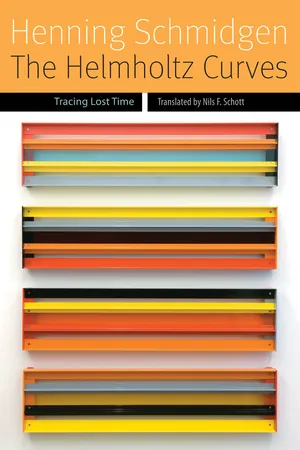
- 248 pages
- English
- ePUB (mobile friendly)
- Available on iOS & Android
eBook - ePub
About this book
Information
Publisher
Fordham University PressYear
2014Print ISBN
9780823261956
9780823261949
eBook ISBN
9780823261963
Topic
PhilosophieSubtopic
Histoire du 19ème siècleNOTES
INTRODUCTION
1. Gaston Bachelard, The Dialectic of Duration, trans. Mary McAllester Jones (Manchester: Clinamen, 2000), 92 [modified].
2. Marta Braun, Picturing Time: The Work of Etienne-Jules Marey (1830–1904) (Chicago: University of Chicago Press, 1992).
3. Daniel Kehlmann, Measuring the World, trans. Carol Browne Janeway (London: Quercus, 2007), 233. On this highly suggestive account, see Ottmar Ette, Alexander von Humboldt und die Globalisierung: Das Mobile des Wissens (Frankfurt and Leipzig: Insel, 2009), 302–18.
4. See Paul F. Cranefield’s classic paper, “The Organic Physics of 1847 and the Biophysics of Today,” Journal of the History of Medicine 12 (1957): 407–23.
5. Bachelard, Dialectic of Duration, 77: “The history of the laboratory phenomenon is very precisely that of its measurement.” From the perspective of the history of science, see Thomas Kuhn, “The Function of Measurement in Modern Physical Science,” The Essential Tension: Selected Studies in Scientific Tradition and Change (Chicago: University of Chicago Press, 1977), 178–224; and the partly iconoclastic chapter on “Measurement” in Ian Hacking, Representing and Intervening: Introductory Topics in the Philosophy of Natural Science (Cambridge: Cambridge University Press, 1983), 233–45.
6. Hebbel E. Hoff and Leslie A. Geddes, “Graphic Registration before Ludwig: The Antecedents of the Kymograph,” Isis 50, no. 159 (1959): 5–21.
7. Etienne-Jules Marey, La méthode graphique dans les sciences expérimentales et particulièrement en physiologie et en médecine (Paris: Masson, 1878), III.
8. Ibid.
9. Carl Ludwig, Lehrbuch der Physiologie des Menschen, vol. 1 (Heidelberg: Winter, 1852), 114.
10. Charles Marx, “Le neurone,” Physiologie, ed. Charles Kayser (Paris: Flammarion, 1969), vol. 2, 7–285, here 16.
11. Kathryn M. Olesko and Frederic L. Holmes, “The Images of Precision: Helmholtz and the Graphical Method in Physiology,” The Values of Precision, ed. Norton Wise (Princeton, NJ: Princeton University Press, 1994), 198–221, here 198; and “Experiment, Quantification, and Discovery: Helmholtz’s Early Physiological Researches, 1843–1850,” Hermann von Helmholtz and the Foundations of Nineteenth-Century Science, ed. David Cahan (Berkeley: University of California Press, 1993), 50–108.
12. On this point, see my extensive study Hirn und Zeit: Die Geschichte eines Experiments, 1800–1950 (Berlin: Matthes & Seitz, in press).
13. Gilles Deleuze, Cinema 1: The Movement-Image, trans. Hugh Tomlinson and Barbara Habberjam (Minneapolis: University of Minnesota Press, 1986), 56.
14. Ibid.
15. Gilles Deleuze, Cinema 2: The Time-Image, trans. Hugh Tomlinson and Robert Galeta (Minneapolis: University of Minnesota Press, 1989), 211. See also Henri Bergson, Matter and Memory, trans. Nancy M. Paul and W. Scott Palmer (New York: Macmillan, 1929), 30. Concerning the interstice, see also Joseph Vogl, On Tarrying, trans. Helmut Müller-Sievers (London: Seagull, 2011), as well as Bernhard J. Dotzler and Henning Schmidgen, eds., Parasiten und Sirenen: Zwischenräume als Orte der materiellen Wissensproduktion (Bielefeld: Transcript, 2008).
16. Justus von Liebig, Familiar Letters on Chemistry, 3rd rev. ed. (London: Taylor, Walton & Maberly, 1851), 272. On analytic experimentation, see Frederic L. Holmes, “The Intake-Output Method of Quantification in Physiology,” Historical Studies in the Physical and Biological Sciences 17 (1987): 235–70; and John V. Pickstone, Ways of Knowing: A New History of Science, Technology and Medicine (Chicago: University of Chicago Press, 2001), 83–134.
17. Bergson, Matter and Memory, 30.
18. Hermann Helmholtz to Olga von Velten, July 18, 1847, Letters of Hermann von Helmholtz to his Wife, ed. Richard L. Kremer (Stuttgart: Steiner, 1990), 43.
19. Sensory nerves [sensible Nerven], in the wide sense, as distinct from the narrow sense [sensorische Nerven], denoting nerves that participate in sense perception.
20. Peter Galison, Image and Logic: The Material Culture of Microphysics (Chicago: University of Chicago Press, 1997).
21. Wolfgang Schivelbusch, The Railway Journey: The Industrialization and Perception of Time and Space in the Nineteenth Century, trans. Anselm Hollo (Berkeley: University of California Press, 1986); Stephen Kern, The Culture of Time and Space, 1880–1918 (Cambridge: Harvard University Press, 2003); Paul Virilio, Negative Horizon: An Essay in Dromoscopy, trans. Michael Degener (London: Continuum, 2005); Peter Weibel, Die Beschleunigung der Bilder in der Chronokratie (Bern: Benteli, 1987); and Edna Duffy, The Speed Handbook: Velocity, Pleasure, Modernism (Durham, NC: Duke University Press, 2009).
22. Robert M. Brain and M. Norton Wise, “Muscles and Engines: Indicator Diagrams and Helmholtz’s Graphical Methods,” Universalgenie Helmholtz: Rückblick nach 100 Jahren, ed. Lorenz Krüger (Berlin: Akademie, 1994), 124–45. More generally, see Horst Bredekamp, The Lure of Antiquity and the Cult of the Machine: The Kunstkammer and the Evolution of Nature, Art and Technology, trans. Allison Brown (Princeton, NJ: Wiener, 1995).
23. Timothy Lenoir, “Helmholtz and the Materiality of Communication,” Osiris 9 (1994): 185–207.
24. The crucial text in this respect is Claude Pouillet, “Note sur un moyen de mesurer des intervalles de temps extrémement courts, comme la durée du choc des corps élastiques, celle du débandement des ressorts, de l’inflammation de la poudre, etc.; et sur un moyen nouveau de comparer les intensités des courants électriques, soit permanents, soit instantanés,” Comptes rendus hebdomadaires des séances de l’Académie des sciences 19 (1844): 1384–89.
25. See Christian Bonah, Les sciences physiologiques en Europe: Analyses comparées du XIXe siècle (Paris: Vrin, 1995). On the role of journals in the life sciences of the nineteenth century, ...
Table of contents
- Cover
- Half Title
- Series Announcement Page
- Title Page
- Copyright
- Contents
- List of Illustrations
- Preface
- Half Title
- Introduction
- One: Curves Regained
- Two: Semiotic Things
- Three: A Research Machine
- Four: Networks of Time, Networks of Knowledge
- Five: Time to Publish
- Six: Messages from the Big Toe
- Seven: The Return of the Line
- Conclusion
- Chronology
- Notes
- Bibliography
- Index
- Series Page
Trusted by 375,005 students
Access to over 1.5 million titles for a fair monthly price.
Study more efficiently using our study tools.
Frequently asked questions
Yes, you can cancel anytime from the Subscription tab in your account settings on the Perlego website. Your subscription will stay active until the end of your current billing period. Learn how to cancel your subscription
No, books cannot be downloaded as external files, such as PDFs, for use outside of Perlego. However, you can download books within the Perlego app for offline reading on mobile or tablet. Learn how to download books offline
Perlego offers two plans: Essential and Complete
- Essential is ideal for learners and professionals who enjoy exploring a wide range of subjects. Access the Essential Library with 800,000+ trusted titles and best-sellers across business, personal growth, and the humanities. Includes unlimited reading time and Standard Read Aloud voice.
- Complete: Perfect for advanced learners and researchers needing full, unrestricted access. Unlock 1.5M+ books across hundreds of subjects, including academic and specialized titles. The Complete Plan also includes advanced features like Premium Read Aloud and Research Assistant.
We are an online textbook subscription service, where you can get access to an entire online library for less than the price of a single book per month. With over 1.5 million books across 990+ topics, we’ve got you covered! Learn about our mission
Look out for the read-aloud symbol on your next book to see if you can listen to it. The read-aloud tool reads text aloud for you, highlighting the text as it is being read. You can pause it, speed it up and slow it down. Learn more about Read Aloud
Yes! You can use the Perlego app on both iOS and Android devices to read anytime, anywhere — even offline. Perfect for commutes or when you’re on the go.
Please note we cannot support devices running on iOS 13 and Android 7 or earlier. Learn more about using the app
Please note we cannot support devices running on iOS 13 and Android 7 or earlier. Learn more about using the app
Yes, you can access The Helmholtz Curves by Henning Schmidgen, Nils F. Schott in PDF and/or ePUB format, as well as other popular books in Philosophie & Histoire du 19ème siècle. We have over 1.5 million books available in our catalogue for you to explore.