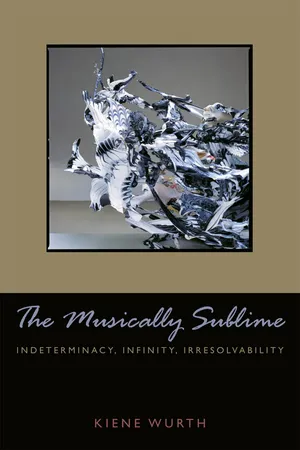
Musically Sublime rewrites musically the history and philosophy of the sublime. Music enables us to reconsider the traditional course of sublime feeling on a track from pain to pleasure. Resisting the notion that there is a single format for sublime feeling, Wurth shows how, from the mid eighteenth century onward, sublime feeling is, instead, constantly rearticulated in a complex interaction with musicality.
Wurth takes as her point of departure Immanuel Kant's Critique of Judgment and Jean-François Lyotard's aesthetic writings of the 1980s and 1990s. Kant framed the sublime narratively as an epic of self-transcendence. By contrast, Lyotard sought to substitute open immanence for Kantian transcendence, yet he failed to deconstruct the Kantian epic. The book performs this deconstruction by juxtaposing eighteenth- and nineteenth-century conceptions of the infinite, Sehnsucht, the divided self, and unconscious drives with contemporary readings of instrumental music.
Critically assessing Edmund Burke, James Usher, E.T.A. Hoffmann, Novalis, Friedrich Hölderlin, Arthur Schopenhauer, Richard Wagner, and Friedrich Nietzsche, this book re-presents the sublime as a feeling that defers resolution and hangs suspended between pain and pleasure. Musically Sublime rewrites the mathematical sublime as différance, while it redresses the dynamical sublime as trauma: unending, undetermined, unresolved.
Whereas most musicological studies in this area have focused on traces of the Kantian sublime in Handel, Haydn, and Beethoven, this book calls on the nineteenth-century theorist Arthur Seidl to analyze the sublime of, rather than in, music. It does so by invoking Seidl's concept of formwidrigkeit ("form-contrariness") in juxtaposition with Romantic piano music, (post)modernist musical minimalisms, and Lyotard's postmodern sublime. It presents a sublime of matter, rather than form-performative rather than representational. In doing so, Musically Sublime shows that the binary distinction Lyotard posits between the postmodern and romantic sublime is finally untenable.
- 234 pages
- English
- ePUB (mobile friendly)
- Available on iOS & Android
eBook - ePub
About this book
Information
Publisher
Fordham University PressYear
2009Print ISBN
9780823230648
9780823230631
eBook ISBN
9780823230655
Topic
PhilosophieTable of contents
- Cover Page
- Title Page
- Copyright Page
- Contents
- Acknowledgments
- List of Abbreviations
- Introduction
- 1 Empty Signs and the Burkean Sublime
- 2 Sehnsucht, Music, and the Sublime
- 3 Ruins and (Un)forgetfulness: A Genealogy of the Musically Sublime
- 4 Sounds Like Now: Form-Contrariness, Romanticism, and the Postmodern Sublime
- 5 Anxiety: The Sublime as Trauma and Repetition
- CODA The Sublime, Intermedially Speaking
- Notes
- Bibliography
Trusted by 375,005 students
Access to over 1.5 million titles for a fair monthly price.
Study more efficiently using our study tools.
Frequently asked questions
Yes, you can cancel anytime from the Subscription tab in your account settings on the Perlego website. Your subscription will stay active until the end of your current billing period. Learn how to cancel your subscription
No, books cannot be downloaded as external files, such as PDFs, for use outside of Perlego. However, you can download books within the Perlego app for offline reading on mobile or tablet. Learn how to download books offline
Perlego offers two plans: Essential and Complete
- Essential is ideal for learners and professionals who enjoy exploring a wide range of subjects. Access the Essential Library with 800,000+ trusted titles and best-sellers across business, personal growth, and the humanities. Includes unlimited reading time and Standard Read Aloud voice.
- Complete: Perfect for advanced learners and researchers needing full, unrestricted access. Unlock 1.5M+ books across hundreds of subjects, including academic and specialized titles. The Complete Plan also includes advanced features like Premium Read Aloud and Research Assistant.
We are an online textbook subscription service, where you can get access to an entire online library for less than the price of a single book per month. With over 1.5 million books across 990+ topics, we’ve got you covered! Learn about our mission
Look out for the read-aloud symbol on your next book to see if you can listen to it. The read-aloud tool reads text aloud for you, highlighting the text as it is being read. You can pause it, speed it up and slow it down. Learn more about Read Aloud
Yes! You can use the Perlego app on both iOS and Android devices to read anytime, anywhere — even offline. Perfect for commutes or when you’re on the go.
Please note we cannot support devices running on iOS 13 and Android 7 or earlier. Learn more about using the app
Please note we cannot support devices running on iOS 13 and Android 7 or earlier. Learn more about using the app
Yes, you can access Musically Sublime by Kiene Brillenburg Wurth in PDF and/or ePUB format, as well as other popular books in Philosophie & Théorie de la critique littéraire. We have over 1.5 million books available in our catalogue for you to explore.