The guiding theme of these essays by aesthetician, musician, and Santayana scholar Morris Grossman is the importance of preserving the tension between what can be unified and what is disorganized, random, and miscellaneous. Grossman described this as the tension between art and morality: Art arrests a sense of change and yields moments of unguarded enjoyment and peace; but soon, shifting circumstances compel evaluation, decision, and action. According to Grossman, the best art preserves the tension between the aesthetic consummation of experience and the press of morality understood as the business of navigating conflicts, making choices, and meeting needs.
This concern was intimately related to his reading of George Santayana. The best philosophy, like the best art, preserves the tension between what can be ordered and what resists assimilation, and Grossman read Santayana as exemplifying this virtue in his embrace of multiple perspectives. Other scholars have noted the multiplicity or irony in Santayana's work, but Grossman was unique in taking such a style to be a substantive part of Santayana's philosophizing.
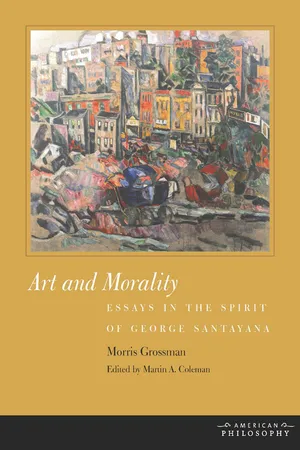
eBook - ePub
Art and Morality
Essays in the Spirit of George Santayana
- 336 pages
- English
- ePUB (mobile friendly)
- Available on iOS & Android
eBook - ePub
Art and Morality
Essays in the Spirit of George Santayana
About this book
Information
Publisher
Fordham University PressYear
2014Print ISBN
9780823257232
9780823257225
eBook ISBN
9780823257942
Topic
PhilosophySubtopic
Aesthetics in PhilosophyPART ONE
ART AND MORALITY
ONE
ART AND MORALITY
On the Ambiguity of a Distinction
1973
There is a tension between art and its seemingly anti-aesthetic moral thrust that prompts inquiry into the relation of art and life. Life lacks the organization and direction of art, and art is born when the waste and distraction of life are discarded. Reconciliation with these inartistic moments gives rise to tragedy and shows that humans prefer to give “pain aesthetic and moral dimensions [rather] than be … alienated from what counts.” Some thinkers have suggested that art transcends life while others have seen aesthetic experience as continuous with other life experience. To separate art and life in a clear and definite way leads to “a morally negligent life spiced by aesthetic kicks.… mak[ing] art vicious and … life hypocritical.” To see art as continuous with life can add to the glory of being alive, and the moral thrust of art can be a reminder of this and indicate the larger context of human life lying beyond the artwork.
What is the full import of the moral thrust of art? This thrust is found in much art, yet it is sometimes held to be unaesthetic; righteous indignation may be a culminating satisfaction for some, yet its function is to undeliver us from the “consummatory” contentment of actual art works, and from our isolation in those works. What, in brief, is the larger relationship between art and life that the morality of art presses us to examine?
Let us approach this theme by way of the idea of treating life itself, total life, as an aesthetic project or work of art. It is an old idea, as old as the Greeks, but fallen into disrepute. We still occasionally acknowledge that some people live more artfully than others, and when we are enthusiastic we might refer to a singularly successful career—some man’s life—as a work of art. But we feel the metaphorical exaggeration of such talk and on more prosaic occasions flinch from it. Art may heighten life and elevate some of its many moments but, just as surely, life eludes art and refuses to turn into an experiential unity or a singular accomplishment. Life cannot be art and, in its totality, is not even good material for art. As Aristotle and others have argued, any life is too full of irrelevancy to make a good story. Its beginning is chance-like and not of our making; its middle is likely a muddle; its end is often curtailed, more like a preposition than a noun. Abrupt, codaless exits leave us unreconciled. Put simply, life is too disorganized, random, and miscellaneous to admit of overarching direction and control.
We might even press the distinction between life and art to the point of coming up with definitional criteria that would guarantee their separateness. Is it not the case that aesthetic creation always seems to involve a pruning, a separation of art from life so that art will be art by virtue of the separation? Do we not excise those aspects of life that cannot be brought into aesthetic purview and remove them from the canvas or the story? Is not art essentially such selection and excision?
Consider the painter’s workshop when his masterpiece is completed. Around the painting, separated from it, are the messy palette, the dirty smock, the dingy garret, the unpaid rent, the vulgar liaisons—and everything else that is material waste or spiritual distraction. The painting is perfect, better than life, and set off against it like a flawless gem in a tawdry case. And it is perfect because it is less than all of life; indeed, it is said to redeem life (strange redemption) by making part of life better than all of it and by vaunting the aloofness of that moment of separation.
But what kind of predicament are we describing? The part and the whole that we are here dealing with remain fundamentally estranged and violently disconnected. The awareness of this makes the moralist, the artist of life, discontent. (There is nothing that brings things together so much as the poignancy of their separation, suitably sensed.) The moralist is pressed to question the nature of the artistic achievement, the masterpiece, which heightens disconnectedness, and the definition and conception of art that gives intellectual fortification to that disconnectedness.
Just what are we about when we turn parts of life into art, separate art and life practically, and distinguish between them theoretically? Are we sacrificing man for his art or saving man from his life? In choosing to perfect art at the expense of life, does it perfect man to make this choice, or only his art? Though we can conceal the clutter of the workshop from others, can we conceal it from ourselves? Where are the parings we omit from our purview, the unorganized residue that does not get into our art? What remains of the large substance of an artist’s, or any man’s, life that never hangs in a museum or sounds in a concert hall or gets into a novel, or is simply never an occasion for worthwhile remembrances?
These are difficult questions, but once we know the agony of the quandary the answers will come forth of themselves. If an artist is an artist by virtue of what he can discard, a man remains a man by virtue of what he cannot discard, and this is always the bulkier, the more challenging, the more problematic part of himself. What remains is the hair and the dirt and the ugliness of existence, the rubbish he knows is under the rug, the bugs in hiding, the guilts that burgeon from buried places, the boredom and the pain, the waste and the claptrap of life, and its oppressive and random and sheer et ceteras. Here is what waits to be reckoned with, not colors to be squeezed from tubes, not tones to be plectrumed and plucked, not words to be rhymed and cadenced. There is a vale of soul-making that is beyond all media, that symphonies and canvases and poems barely touch. It is a vale in which we are pressed beyond mere arts to where art and life fuse in a single strategy and a total task.
In plainer language we can say that the materials discarded in fashioning art are no loss to the art, and yet they remain a continuing burden. With respect to life there is no context, no place for waste, no way of getting rid of what might metaphorically be called the radioactive debris and the black oil slicks. Man’s condition is like Earth’s condition—limited, closed in, contaminable. There can only be arrangements and rearrangements of what there is, total manipulations of total accumulations, a voluminous burden that must be carried and projected to an uncertain end.
Life apart from art—and there would be no apartness apart from the following considerations—consists of opposites unseen and conflicts unreconciled. It consists of moments that are not reflected upon and assimilated, that intrude on us when we do not want them to, that randomly distract and oppress. They are our accumulating but unaccumulated selves. We cannot shed them; because we cannot use them positively, they weigh on us negatively. Life apart from art, inartistic life, is the negative weight, the tiresome burden, the existential stress of being, the tragic sense of the unencompassed.
The tragic sense, tragedy understood this way, is not, as it is so often taken to be, a reconciliation with death, or a reconciliation of specific moral claims. Tragedy, rather, is a reconciliation with those moments of life that resist a coming together in some organizing purpose. Tragedy is the sense of, and the ideal victory over, the living dissolution that continuously pervades us, not victory over the actual extinction that eventually terminates us. Termination and extinction are no great loss when they come in due time. The silence at the end of a symphony is as necessary as any other part of it; indeed, it is sometimes the best part of it and a great relief. Dissolution and disconnectedness are the real tragic losses. The tragic sense reaches out to those intransigent elements of our being that otherwise resist containment, and they become contaminated morally and ideally in the pathos of the awareness of failure.
Tragedy binds wounds but cannot perforce heal them. They remain bound wounds, the more painful because the more conspicuous. But bound and comprehended pain is preferred to the deeper pain, that is, anxiety, of anaesthetized and purposeless moments. It is astonishing how much sadness and suffering a man will embrace unto himself to avoid disconnectedness, and to satisfy his organizing and time-binding self. Even the words of a popular song tell us that “Loneliness remembers what happiness forgets.”1 Movement without direction, process without contour, suffering without redemption, are all there is to ugliness and hell.
Tragedy and the tragic sense are the evidence that man refuses to be the patient etherized on the table. He would rather give his pain aesthetic and moral dimension than be sundered in his being and alienated from what counts. The search for wholeness and completion is a formidable principle. Organizing around some biological purpose from the start, we remain organizational to the end. And every accomplishment, sweet as it may be, must partly sour on itself as it looks to the task of some larger project.
Our view then has been that aesthetic experience is not, and ought not to be, separated from other life experience. In the tradition of aesthetic theory some writers (e.g., Dewey) have defended this view, and other writers (e.g., Pater) have defended the view that art is something special, distinctive, exalted, and different in kind from the life experience out of which it emerges and departs.
These alternatives hardly admit of theoretical resolution. Like most distinctions based on a high order of metaphysical generality, the distinction between life and art can be seen as a difference of degree or as a difference of kind. Like many other such distinctions, there is a “sense” in which it is warranted and a “sense” in which it is not. Any difference in degree can be converted into a difference in kind by a philosopher with appropriate, or inappropriate, labels to hand.
But the making of philosophical distinctions is not without practical consequences, and what concerns us here is the moral effect of each of the alternatives. The effect of separating art and life, definitively rather than tentatively, clearly rather than ambiguously, is to give to art a premature elevation. This ultra-laudatory conception of art, which sees it as so many nodules of perfection, so many gemlike inflammatory moments, in a life that is otherwise dull, drab and dubious—this conception turns our thoughts away from the larger task of composing life, and of bringing to that larger task and art a modicum of order and sequence and contoured joy. It is a conception that leads toward aestheticism (in the worst sense of that word)—a morally negligent life spiced by aesthetic kicks. To view art and life thus, to separate them in contentment and to be content in their separation, is to make art vicious and to make life hypocritical. At its worst it is to enjoy without reference to consequences, to be righteous without reference to joy, to fiddle while Rome burns, and to raise flowers alongside crematoria.
The purpose in seeing art as continuous with other life activities is not to debunk or degrade art but hopefully to glorify and elevate life. The moral aspect of art, insofar as it overflows art, is a reminder of this and points to needs and predicaments beyond the obvious confines of the art work. It is a reminder that the perfection of art is purchased at a price, that a gain here is a neglect there, and that there is inadequacy in the life in which the art work is embedded. It is a reminder that much needs to be done, that a larger project waits, and that to rest in temporary conditions of seeming permanence is a permanent condition of unrecognized failure.
There are certain artists we might call upon who strongly and specifically convey the tragic sense of the unfinished and unfinishable quality of works of art. They refuse, by repeated shows of reluctance, to make that separation of art and life which tends to be manifested in the fait accompli of the finished and presented art work. For them the art work is never an isolable thing but always a work in progress, always in need of revision, always modifiable in the direction of an unrealized and unrealizable goal. These men invite the force of life, with its raging fires and its unshored fragments, to overwhelm the temporary ramparts of the art medium. They are writers like Proust, for whom a proof sheet was simply an occasion for ever-renewed correction and expansion. They are sculptors like Giacometti, who was always “failing” and destroying what he did, and for whom it was apparent agony to face the false finality of allowing a work to be exhibited. “There is no hope of achieving what I want, of expressing my vision of reality,” said Giacometti. “I go on painting and sculpting because I am curious to know why I fail.”2
For these artists, the separation of art and life is “performatively” denied by virtue of the way in which ongoing artistic activity (not a mere series of art works) is a conscious grappling with life. All glimpses of reality are repudiated for being glimpses, discrete perspectives: for being less than unitary visions and unitary accomplishments. The various pieces Giacometti produced, the fragments of his life, will make their way into various hands, never to be shored up or united. And yet this knowledge of failure, this tragic sense constantly alive, is success beyond all art. The best art, the best artists are pervaded by the tragic sense, which is awareness of the sort of defeat and recalcitrance that life itself has always imposed upon the living of it. And so artists love to leave loose ends, ambiguities, elements of randomness, as a tribute and echo and reminder of what life is like and what needs to be done.
Art is better than life, and should be; but not so much better that it neglects life’s challenges or departs life’s memories. The task of great art has always been to transcend life but to remain relevant to it, to focus enjoyment but not to forget sorrow, to surmount the futility of blind righteousness but not to be blind to prevailing evil. This too has been the task of the good life, which is a self-regenerative process in which art is that part which is also the ongoing measure of the whole. Yeats’s poem “The Choice” sets out two alternatives: “Perfection of the life, or of the work.”3 To care about the choice and to sense its poignancy is all the response that it needs.
TWO
MORALITY BOUND AND UNBOUND
Some Parameters of Literary Art
1972
Moral claims in an artwork might be of two kinds: bound and unbound. When moral claims in an artwork serve a certain aesthetic effect, morality may be said to be bound to that artwork. When moral claims in an artwork are identified with the purposes of the artist in shaping actual living, such morality escapes the confines of the art form and may be said to be unbound. Here “the moral thrust breaks all bonds of aesthetic constraint and propriety, at least as these have sometimes been known.” The categories of morality bound and unbound do not define artworks absolutely. An artwork may oscillate between them or fall into them ambiguously. “These perspectives are shiftable and almost compresent—as in those pictures of adjacent cubes, or duck-rabbits, which can be seen in one way or suddenly in another way.” Art, in maintaining these contrary perspectives, exhibits “the ulterior drama of art;” that is, the “very rivalry between art and life” in which the desire to rest in contemplation of the ideal contends with the desire for involvement with the larger living context and the tasks at hand.
Art, especially literary art, has traditionally dealt with moral matters. Dramatic literature is essentially about choice and conflict, characters placed in situations in which they reveal—and perhaps even recommend—the values for which they are willing to live, to suffer, and to die. Whether what the cha...
Table of contents
- Cover
- Half Title
- Series Announcement Page
- Title Page
- Copyright
- Dedication
- Contents
- Acknowledgments
- Editor’s Preface
- Half Title
- Introduction
- Part I: Art and Morality
- Part II: Artistic Philosophers and Philosophical Artists
- Part III: Santayana
- Notes
- Index
- Series Page
Trusted by 375,005 students
Access to over 1.5 million titles for a fair monthly price.
Study more efficiently using our study tools.
Frequently asked questions
Yes, you can cancel anytime from the Subscription tab in your account settings on the Perlego website. Your subscription will stay active until the end of your current billing period. Learn how to cancel your subscription
No, books cannot be downloaded as external files, such as PDFs, for use outside of Perlego. However, you can download books within the Perlego app for offline reading on mobile or tablet. Learn how to download books offline
Perlego offers two plans: Essential and Complete
- Essential is ideal for learners and professionals who enjoy exploring a wide range of subjects. Access the Essential Library with 800,000+ trusted titles and best-sellers across business, personal growth, and the humanities. Includes unlimited reading time and Standard Read Aloud voice.
- Complete: Perfect for advanced learners and researchers needing full, unrestricted access. Unlock 1.5M+ books across hundreds of subjects, including academic and specialized titles. The Complete Plan also includes advanced features like Premium Read Aloud and Research Assistant.
We are an online textbook subscription service, where you can get access to an entire online library for less than the price of a single book per month. With over 1.5 million books across 990+ topics, we’ve got you covered! Learn about our mission
Look out for the read-aloud symbol on your next book to see if you can listen to it. The read-aloud tool reads text aloud for you, highlighting the text as it is being read. You can pause it, speed it up and slow it down. Learn more about Read Aloud
Yes! You can use the Perlego app on both iOS and Android devices to read anytime, anywhere — even offline. Perfect for commutes or when you’re on the go.
Please note we cannot support devices running on iOS 13 and Android 7 or earlier. Learn more about using the app
Please note we cannot support devices running on iOS 13 and Android 7 or earlier. Learn more about using the app
Yes, you can access Art and Morality by Morris Grossman,Martin A. Coleman, Martin A. Coleman in PDF and/or ePUB format, as well as other popular books in Philosophy & Aesthetics in Philosophy. We have over 1.5 million books available in our catalogue for you to explore.