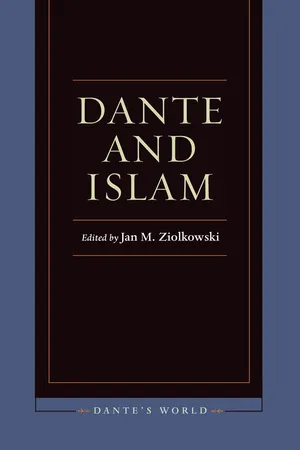
Dante put Muhammad in one of the lowest circles of Hell. At the same time, the medieval Christian poet placed several Islamic philosophers much more honorably in Limbo. Furthermore, it has long been suggested that for much of the basic framework of the Divine Comedy Dante was indebted to apocryphal traditions about a "night journey" taken by Muhammad.
Dante scholars have increasingly returned to the question of Islam to explore the often surprising encounters among religious traditions that the Middle Ages afforded. This collection of essays works through what was known of the Qur'an and of Islamic philosophy and science in Dante's day and explores the bases for Dante's images of Muhammad and Ali. It further compels us to look at key instances of engagement among Muslims, Jews, and Christians.
- 384 pages
- English
- ePUB (mobile friendly)
- Available on iOS & Android
eBook - ePub
Dante and Islam
About this book
Information
Publisher
Fordham University PressYear
2014Print ISBN
9780823263875
9780823263868
eBook ISBN
9780823263882
Notes
INTRODUCTION
Jan M. Ziolkowski
1. For publications with the Spanish title, see Miguel Asín Palacios, Dante y el Islam, Colección de manuales Hispania, serie B:1 (Madrid: Editorial Voluntad, 1927); and Ricardo Horacio Shamsuddín Elía, Dante y el islam: El pensamiento musulmán en la Europa del siglo XIV (Buenos Aires, Argentina: Ediciones Mezquita At-Tauhid, 1998). With the Italian title, see Giuseppe Gabrieli, Dante e l’Islam: Contro la memoria di Mig. Asin interno alla Escatalogia musulmana nella Divina Commedia (Varallo Sesia: Unione tipografica valsesiana, 1921); Enrico Cerulli, “Dante e l’Islam,” published in similar forms in Convegno di scienze morali, storiche e filologiche, 27 maggio–10 giugno 1956. Tema: Oriente ed Occidente nel Medio Evo (Rome: Accademia nazionale dei Lincei, 1957), 275–94, and Al-Andalus 21 (1956): 229–53; Peter Russell, Dante e l’Islam (Terranuova Bracciolini: Biblioteca comunale, Assessorato alla cultura, 1991); Peter Russell, “Dante e l’Islam: Una introduzione generale,” “Dante e l’Islam oggi,” and “Assunzione celeste: Quarta conferenza su Dante e l’Islam,” in Poetic Asides, 2 vols., Salzburg Studies in English Literature: Poetic Drama & Poetic Theory 77:3, Outsiders 5–6 (Salzburg: Institut für Anglistik und Amerikanistik, Universität Salzburg, 1992–1993), 2:5–23, 24–33, and 34–51, respectively. Miguel Asín Palacios, Dante e l’Islam, trans. Roberto Rossi Testa e Younis Tawfik, introduction by Carlo Ossola, 2 vols., Nuovi saggi 94 (Parma: Pratiche 1994; repr., Milan: NET, 2005); and Karla Mallette, “Dante e l’Islam: sul canto III del Purgatorio,” Rivista di storia e letteratura religiosa 41 (2005): 39–62. With the French title, see Werner Söderhjelm, “Dante et l’Islam,” Neuphilologische Mitteilungen (1921); and Giorgio Levi della Vida, “Dante et l’Islam: d’apre‘s de nouveaux documents,” Revue de la Méditerranée no. 60 (1954). With the English title, see Thomas Walker Arnold, “Dante and Islam” (review of Asín Palacios), Contemporary Review (August 1921); and Fuat Sezgin, ed. Dante and Islam: Texts and Studies, Publications of the Institute for the History of Arabic-Islamic Science at the Johann Wolfgang Goethe University: Islamic philosophy 119 (Frankfurt am Main: Institute for the History of Arabic-Islamic Science, 2000).
2. If there is need to demonstrate that the Commedia passes muster as a summa, consider the title of Dante, Summa medievalis: Proceedings of the Symposium of the Center for Italian Studies, SUNY Stony Brook, ed. Charles Franco and Leslie Morgan, Filibrary 9 (Stony Brook, N.Y.: Forum Italicum, 1995). On Dante as a Catholic author, see J.F. Makepeace, “The Dante Sexcentenary,” New Blackfriars 2, no. 14 (1921): 92: “For Dante was, first and foremost, a Catholic and regarded everything from a Catholic standpoint.”
3. Paul A. Cantor, “The Uncanonical Dante: The Divine Comedy and Islamic Philosophy,” Philosophy and Literature 20, no. 1 (1996): 138–53.
4. Teodolinda Barolini, The Undivine Comedy: Detheologizing Dante (Princeton, N.J.: Princeton University Press, 1992), 6 (on the Dominicans, especially Guido Vernani) and 267–68 n. 9 (cited by Cantor). For a fuller exploration of the topic, see James Miller, editor, Dante and the Unorthodox: The Aesthetics of Transgression (Waterloo, Ont.: Wilfrid Laurier University Press, 2005).
5. The incident has been discussed by Jeffrey Einboden, “Voicing an Islamic Dante: The Problem of Translating the Commedia into Arabic,” Neophilologus 92 (2008): 77. For original reporting, see for example Philip Willan, “Al-Qaida Plot to Blow Up Bologna Church Fresco,” in The Guardian (London), June 24, 2002, Guardian Foreign Pages, 13.
6. Richard Owen, “Muslims Say Fresco Must Be Destroyed,” The Times (London), June 9, 2001, Overseas News.
7. The term “clash of civilization” owes its vogue to an article that appeared first in 1993, the title of which had lost its concluding interrogative and had been transformed into a slogan for future political conduct by the time the book by the same author was published in 1996: Samuel P. Huntington, “The Clash of Civilizations?” Foreign Affairs 72, no. 3 (Summer 1993): 22–49; and Huntington, The Clash of Civilizations and the Remaking of World Order (New York: Simon & Schuster, 1996). The “pushback” both from within Near Eastern studies and from those allied with the theory of Orientalism was strong. For two instances, see Roy P. Mottahedeh, “The Clash of Civilizations: An Islamicist’s Critique,” Harvard Middle Eastern and Islamic Review 2, no. 2 (1996): 1–26; and Edward W. Said, “The Clash of Ignorance,” The Nation 273, no. 12 (October 22, 2001): 11–13.
8. A classic tallying of debts to Islam is The Legacy of Islam, ed. Joseph Schacht, 2nd ed. (Oxford: Clarendon Press, 1974). Specifically focused upon the Middle Ages are Norman Daniel, The Arabs and Mediaeval Europe (London: Longman, 1975); Norman Daniel, Islam and the West: The Making of an Image (Edinburgh: University Press, 1960); and W. Montgomery Watt, The Influence of Islam on Medieval Europe (Edinburgh: University Press, 1972).
9. Gregory B. Stone, Dante’s Pluralism and the Islamic Philosophy of Religion (New York: Palgrave Macmillan, 2006), 54. Stone has contributed to this issue an essay entitled “Dante and the Falasifa: Religion as Imagination.”
10. By referring to pluralism, I draw attention once again to Stone, Dante’s Pluralism, but I hasten to point out that he does not use the term convivencia in his book. Nor does María Rosa Menocal, the most prominent exponent in the Anglophone world of the idea that Dante was heavily influenced by Arabic culture, in her earliest major treatment of Dante, although she does emphasize medieval connections between al-Andalus and Italy. See The Arabic Role in Medieval Literary History: A Forgotten Heritage (Philadelphia: University of Pennsylvania Press, 1987), esp. 115–35.
11. Jonathan Ray, “Beyond Tolerance and Persecution: Reassessing our Approach to Medieval Convivencia,” Jewish Social Studies 11, no. 2 (Winter 2005): 1–18.
12. For examples, see David L. Lewis, God’s Crucible: Islam and the Making of Europe, 570 to 1215 (New York: W.W. Norton, 2008); Chris Lowney, A Vanished World: Medieval Spain’s Golden Age of Enlightenment (New York: Free Press, 2005); Vivian B. Mann, Thomas F. Glick, and Jerrilynn D. Dodds, eds., Convivencia: Jews, Muslims, and Christians in Medieval Spain (New York: G. Braziller in association with the Jewish Museum, 1992); María Rosa Menocal, The Ornament of the World: How Muslims, Jews, and Christians Created a Culture of Tolerance in Medieval Spain (Boston: Little, Brown, 2002); and Lucy K. Pick, Conflict and Coexistence: Archbishop Rodrigo and the Muslims and Jews in Medieval Spain (Ann Arbor: University of Michigan, 2004).
13. For a broad consideration of the Arab contribution to Italian culture in the Middle Ages, see Francesco Gabrieli and Umberto Scerrato, Li Arabi in Italia: Cultura, contatti e tradizioni (Milan: Garzanti/Scheiwiller, 1979). With particular attention to literary history, see Karla Mallette, The Kingdom of Sicily, 1100–1250: A Literary History (Philadelphia: University of Pennsylvania Press, 2005).
14. (New York: Pantheon Books, 1978), 70. Said’s views on Dante have been critiqued in two essays (the interrelationship of which resists easy disentanglement) by Kathleen Biddick, “Coming Out of Exile: Dante on the Orient(alism) Express,” The American Historical Review, 105 (2000): 1234–49, and “Coming Out of Exile: Dante on the Orient Express,” in The Postcolonial Middle Ages, ed. Jeffrey Jerome Cohen (New York: St. Martin’s Press, 2000), 35–52; as well as by Elizabeth A. Coggeshall, “Dante, Islam, and Edward Said,” Telos 139 (Summer 2007): 133–51. They are also discussed in the present volume by Maria Esposito Frank, “Dante’s Muḥammad.”
15. See (though without any particular reference to medieval studies) Occidentalism: Images of the West, ed. James G. Carrier (Oxford: Clarendon Press, 1995).
16. For convivencia, see Américo Castro, España en su historia: Cristianos, moros y judíos (Buenos Aires: Editorial Losada, 1948), 198–202. On recent turns in the application of the term, see Jonathan Ray, “Beyond Tolerance and Persecution: Reassessing our Approach to Medieval Convivencia,” Jewish Social Studies 11, no. 2 (Winter 2005): 1–18. For Orientalism, the earliest citation in any sense in the Oxford English Dictionary is dated to 1769.
17. On the place of the Orient in Dante’s geography, see Brenda Deen Schildgen, Dante and the Orient (Urbana: University of Illinois Press, 2002), 19–44.
18. María Rosa Menocal, The Arabic Role, 127, 130.
19. See Alessandro Niccoli, “Saracino,” Enciclopedia dantesca, 5:30–31.
20. On the chansons de geste, see C. Meredith Jones, “The Conventional Saracen of the Songs of Geste,” Speculum 17 (1942): 204–6. In Dante, see Convivio 2.8...
Table of contents
- Cover
- Half Title
- Series Announcement Page
- Title Page
- Copyright
- Contents
- Half Title
- Introduction
- Approaches to a Controversy
- Dante and Knowledge of the Qur’an
- Images of Islamic Philosophy and Learning in Dante
- Images of Muhammad in Dante
- Islam in Dante’s Italy
- Notes
- Bibliography
- List of Contributors
- Index of References to Dante’s Major Works
- General Index
Trusted by 375,005 students
Access to over 1.5 million titles for a fair monthly price.
Study more efficiently using our study tools.
Frequently asked questions
Yes, you can cancel anytime from the Subscription tab in your account settings on the Perlego website. Your subscription will stay active until the end of your current billing period. Learn how to cancel your subscription
No, books cannot be downloaded as external files, such as PDFs, for use outside of Perlego. However, you can download books within the Perlego app for offline reading on mobile or tablet. Learn how to download books offline
Perlego offers two plans: Essential and Complete
- Essential is ideal for learners and professionals who enjoy exploring a wide range of subjects. Access the Essential Library with 800,000+ trusted titles and best-sellers across business, personal growth, and the humanities. Includes unlimited reading time and Standard Read Aloud voice.
- Complete: Perfect for advanced learners and researchers needing full, unrestricted access. Unlock 1.5M+ books across hundreds of subjects, including academic and specialized titles. The Complete Plan also includes advanced features like Premium Read Aloud and Research Assistant.
We are an online textbook subscription service, where you can get access to an entire online library for less than the price of a single book per month. With over 1.5 million books across 990+ topics, we’ve got you covered! Learn about our mission
Look out for the read-aloud symbol on your next book to see if you can listen to it. The read-aloud tool reads text aloud for you, highlighting the text as it is being read. You can pause it, speed it up and slow it down. Learn more about Read Aloud
Yes! You can use the Perlego app on both iOS and Android devices to read anytime, anywhere — even offline. Perfect for commutes or when you’re on the go.
Please note we cannot support devices running on iOS 13 and Android 7 or earlier. Learn more about using the app
Please note we cannot support devices running on iOS 13 and Android 7 or earlier. Learn more about using the app
Yes, you can access Dante and Islam by Jan M. Ziolkowski in PDF and/or ePUB format, as well as other popular books in Literature & Italian Literary Criticism. We have over 1.5 million books available in our catalogue for you to explore.