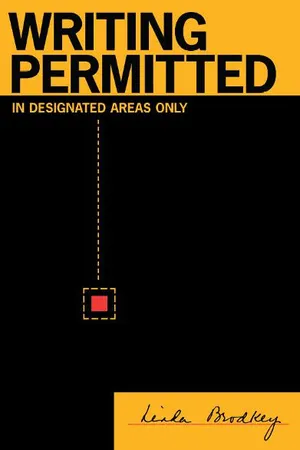
In the early 1990s, Linda Brodkey ended up on the front page of the New York Times and in the columns of George Will and other conservative pundits. The furor was over the "Writing about Difference" syllabus she helped create at the University of Texas, an effort that came to be one more casualty in the debate over multiculturalism in the academy. Writing Permitted in Designated Areas Only is made up of Brodkey's dispatches from the front lines of the culture wars. The essays in this book raise provocative questions about the way writing is taught in the United States. Brodkey lambastes conventional composition courses, which since their inception in the mid-nineteenth century have been the site of conflict over what "literacy" really means. She argues that such courses have institutionalized the practice of separating form and content, relegating teachers to the tasks of policing grammar and patrolling the borders of style and literature. Ultimately, this separation of structure and meaning depoliticizes the act of writing, creating an artificial distinction between what is being said and how it is expressed. Comprising specific examples of student work in addition to Brodkey's own essays, Writing Permitted in Designated Areas Only works against this dynamic. Ranging from personal essay ("Writing on the Bias") to hard-hitting polemic ("Writing Permitted in Designated Areas Only") and touching on many of the major issues in the teaching of writing today, this volume explores alternatives to the standard methods for teaching composition. The result is a passionate plea for the loosing of writing to achieve its full power and potential; to unharness writing—and its teachers—from the institutional strictures that stifle both creativity and independent thought.
- 335 pages
- English
- PDF
- Available on iOS & Android
eBook - PDF
Writing Permitted in Designated Areas Only
About this book
Information
Subtopic
Physical AnthropologyIndex
Social SciencesTable of contents
- Contents
- Preface
- Introduction: Poststructural Theories, Methods, and Practices
- PART I. EDUCATION
- PART II. PUBLICATIONS
- PART Ill. PRESENTATIONS
- PART IV. TEACHING
- Index
Trusted by 375,005 students
Access to over 1.5 million titles for a fair monthly price.
Study more efficiently using our study tools.
Frequently asked questions
Yes, you can cancel anytime from the Subscription tab in your account settings on the Perlego website. Your subscription will stay active until the end of your current billing period. Learn how to cancel your subscription
No, books cannot be downloaded as external files, such as PDFs, for use outside of Perlego. However, you can download books within the Perlego app for offline reading on mobile or tablet. Learn how to download books offline
Perlego offers two plans: Essential and Complete
- Essential is ideal for learners and professionals who enjoy exploring a wide range of subjects. Access the Essential Library with 800,000+ trusted titles and best-sellers across business, personal growth, and the humanities. Includes unlimited reading time and Standard Read Aloud voice.
- Complete: Perfect for advanced learners and researchers needing full, unrestricted access. Unlock 1.5M+ books across hundreds of subjects, including academic and specialized titles. The Complete Plan also includes advanced features like Premium Read Aloud and Research Assistant.
We are an online textbook subscription service, where you can get access to an entire online library for less than the price of a single book per month. With over 1.5 million books across 990+ topics, we’ve got you covered! Learn about our mission
Look out for the read-aloud symbol on your next book to see if you can listen to it. The read-aloud tool reads text aloud for you, highlighting the text as it is being read. You can pause it, speed it up and slow it down. Learn more about Read Aloud
Yes! You can use the Perlego app on both iOS and Android devices to read anytime, anywhere — even offline. Perfect for commutes or when you’re on the go.
Please note we cannot support devices running on iOS 13 and Android 7 or earlier. Learn more about using the app
Please note we cannot support devices running on iOS 13 and Android 7 or earlier. Learn more about using the app
Yes, you can access Writing Permitted in Designated Areas Only by Linda Brodkey in PDF and/or ePUB format, as well as other popular books in Social Sciences & Physical Anthropology. We have over 1.5 million books available in our catalogue for you to explore.