We live in an increasingly global, interconnected, and interdependent world, in which various forms of systemic imbalance in power have given birth to a growing demand for genuine pluralism and democracy. As befits a world so interconnected, this book presents a comparative theological and philosophical attempt to construct new underpinnings for the idea of democracy by bringing the Western concept of spirit into dialogue with the East Asian nondualistic and nonhierarchical notion of qi.
The book follows the historical adventures of the idea of qi through some of its Confucian and Daoist textual histories in East Asia, mainly Laozi, Zhu Xi, Toegye, Nongmun, and Su-un, and compares them with analogous conceptualizations of the ultimate creative and spiritual power found in the intellectual constellations of Western and/or Christian thought—namely, Whitehead's Creativity, Hegel's Geist, Deleuze's chaosmos, and Catherine Keller's Tehom.
The book adds to the growing body of pneumatocentric (Spirit-centered), panentheistic Christian theologies that emphasize God's liberating, equalizing, and pluralizing immanence in the cosmos. Furthermore, it injects into the theological and philosophical dialogue between the West and Confucian and Daoist East Asia, which has heretofore been dominated by the American pragmatist and process traditions, a fresh voice shaped by Hegelian, postmodern, and postcolonial thought. This enriches the ways in which the pluralistic and democratic implications of the notion of qi may be articulated. In addition, by offering a valuable introduction to some representative Korean thinkers who are largely unknown to Western scholars, the book advances the study of East Asia and Neo-Confucianism in particular.
Last but not least, the book provides a model of Asian contextual theology that draws on the religious and philosophical resources of East Asia to offer a vision of pluralism and democracy. A reader interested in the conversation between the East and West in light of the global reality of political oppression, economic exploitation, and cultural marginalization will find this book informative, engaging, and enlightening.
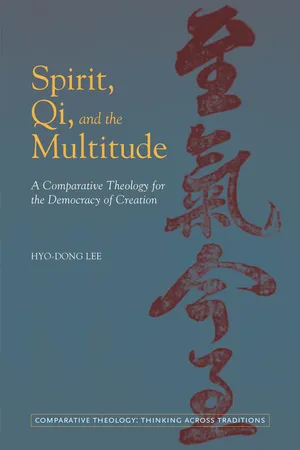
eBook - ePub
Spirit, Qi, and the Multitude
A Comparative Theology for the Democracy of Creation
- 376 pages
- English
- ePUB (mobile friendly)
- Available on iOS & Android
eBook - ePub
About this book
Information
Publisher
Fordham University PressYear
2013Print ISBN
9780823255023
9780823255016
eBook ISBN
9780823255030
Topic
Ciencias socialesSubtopic
Historia y teoría filosóficas1 The Psychophysical Energy of the Way in Daoist Thought
What is psychophysical energy(氣 gi/qi)? Etymologically rooted in the words “steam,” “breath,” and “wind,” and variously translated as “material force,” “vital energy,” or “psychophysical stuff,”1 gi/qi is an idea for world-explanation ubiquitously found in East Asian cultures and religions and philosophically developed in the two great traditions of Daoism and Confucianism.2 Perhaps owing to its metaphoric roots in the animistic indigenous cultures of preclassical East Asia,3 gi/qi in its original meaning encompasses both nonphysical and physical, mind and body, macro-cosmic and microcosmic, and sacred and secular. In that sense, it is similar to the Semitic ruach and the Greek pneuma with their own roots in the polytheistic and/or pantheistic myths of the pre-Axial Age cultures of West Asia.4
Psychophysical Energy as Nature and Spirit
Psychophysical energy is the primordial energy of the universe that constitutes whatever exists—visible and invisible, with form and without form, nonliving and living, and material and ideal. The entities that appear to be solid and unchanging are in fact temporary coalescences or harmonies of psychophysical energy’s own bifurcated and mutually complementary modalities of the receptive force (陰氣 eum gi/yin qi) and the active force (陽氣 yang gi/yang qi), which are themselves in a constant process of following and turning into each other. The creatively harmonizing operations of the two modalities of psychophysical energy is captured by the symbol of the Great Ultimate (太極 taegeuk/taiji) that depicts a ceaseless dynamic union of complementary opposites.5

The binary of receptive and active forces (which represents and includes the binaries of soft and hard, cold and hot, dark and light, rest and movement, female and male, earth and heaven) constitutes complementary opposites, because each pole of the binary always includes the other within itself and depends on the other for its own coming into being. The receptive force harbors and grows the seed of the other within itself until it is itself “taken over” and turned into the other, the active force, which in turn nurtures the seed of the receptive force within itself until it becomes its opposite. Furthermore, this relation of mutually dependent coming into being has a “fractal” structure in which each pole of the binary reproduces within itself the polarity of the whole: The receptive force always carries within itself the seed of the active force, which always carries within itself the seed of the receptive force, which always carries within itself the seed of active force … and so on and on.6 In other words, the Great Ultimate has a dynamically fractal structure of constantly self-differentiating opposites that come into being and cease to be in and through an unending process of one differentiating itself from itself by having the other within to negate itself.
Because the “logic” of psychophysical energy’s movement as symbolized by the Great Ultimate configures all coalescences or harmonies of psychophysical energy, any construal of them as unchanging essences or permanent substances is to be seen as a product of optical illusion and wishful thin king. As confirmed by the universal phenomena of birth, growth, decay, and death, one particular configuration of psychophysical energy continuously transforms itself into another as its balance of the receptive and the active within shifts in response to and in communication with other similarly dynamic and changing coalescences of psychophysical energy.7 The fact that all things—or rather, thing-events8—in the universe are various configurations of the same shared psychophysical energy does not mean that the latter functions as some kind of immutable substance underlying mutable phenomena. Rather, it serves as the field (場 jang/chang) and medium of interaction among all thing-events, enabling their synchronic “correlativity” prior to and beyond their diachronic causal relations.9 Furthermore, as a continuous movement it constitutes the essence of time, its incessantly changing combinations of the active and the receptive being the qualitatively different, “kairotic” markers of time.10
In this vision of the cosmos there is little space for the kind of metacosmic/cosmic distinction, based on the binaries of one and many, ideal and material, and substance and phenomena, that characterizes many predominant cultures of West Asia or South Asia. Admittedly, the creative and transformative operations of psychophysical energy can be extraordinarily subtle, mysterious, and marvelous—as, for example, in the operations of human consciousness such as deliberation and imagination—to the point of appearing almost “otherworldly” and thereby attaining a measure of numinous transcendence. In such occasions, psychophysical energy is said to have become 神 (sin/shen), usually translated as “spiritual” or “divine.”11 Nevertheless, even as sacrifices have been offered and homage paid in East Asian cultures to anthropomorphically envisaged spirits and deities, ranging from the Lord on High (上帝 sangje/shangdi) and Heaven (天 cheon/tian)12 to the spirits of ancestors, natural features, and various locales, they are all understood to be especially fine, ethereal, and invisible coalescences of psychophysical energy, not “supernatural” and metacosmic entities totally independent of the exigencies of the temporal and physical.13 Even the revered Lord on High or Heaven is regarded as the wisest and most powerful member of the one shared cosmos, not an outsider.14 In sum, psychophysical energy is what underlies and constitutes the dynamic, creative becoming that is the universe, encompassing both one and many, transcendent and immanent, object and event, organic and inorganic, ideal and material, mind and body, spirit and nature, and natura naturans and natura naturata.15
Whereas the category of psychophysical energy thus captures an essentially and ultimately nondualistic worldview shaping the cultures of East Asia, its conceptual and philosophical developments have by and large taken place within intellectual frameworks that affirm the existence of a fundamental duality characterizing the overarching structure of all that is and becomes. One of the earliest and historically most influential formulations of this duality is found in the Appended Remarks (繫辭傳 xicizhuan) of the Classic of Change (易經 yijing), a Warring States period (475–221 B.C.E.) text allegedly of a Confucian lineage but containing a classical paradigm of thought shared by the Confucian and Daoist traditions: “That which is above physical form—it is called the Way [道 dao]; that which is with physical form—it is called the vessel [器 qi].”16 The saying makes a distinction between what is above or without physical form and what has physical form, naming them, respectively, “the Way” and “the vessel.” The vessel points to the myriad thing-events of the universe that have determinate shapes and concrete physical existence, such as the sun, moon, and stars in heaven and mountains, rivers, plants, animals, and humans on earth. The Way, by contrast, has no concrete existence of its own, having no determinate physical form, yet at the same time is “contained” in the myriad “vessels” of the visible universe.
What is the Way, then? The Appended Remarks of the Classic of Change has its own answer: “The successive movement of the receptive and the active is called the Way” (一陰一陽之謂道 yiyin yiyang zhiweidao).17 Although psychophysical energy and the binary of the receptive and the active are explicitly mentioned rather sparsely in the Appended Remarks, this remark provides a clear and succinct articulation of the implied understanding of the Way: The Way is none other than the regularity or order observed in the creative and transformative operations of the two modes of psychophysical energy, as it is captured by the symbol of the Great Ultimate.18 When the Appended Remarks says, “Giving birth again and again is called Change [易 yi],” and “Change has the Great Ultimate; the Great Ultimate generates two Modes [兩儀 liangyi]; two Modes generate four Figures [四象 sixiang]; four Figures generate eight Trigrams [八卦 bagua],”19 it is symbolically describing the observed pattern of the creative Becoming or Change in terms of the constantly shifting combinations of the active and receptive forces which produce the myriad formed “vessels” of the visible universe. If the Way is merely the orderliness of the creatively harmonizing operations of psychophysical energy, then the duality of the formless Way and the formed vessel in fact means the duality of the abstract “logic” of psychophysical energy’s movement apart from its concrete coalescing, on the one hand, and the particular configurations of the two modes of psychophysical energy, on the other. In other words, psychophysical energy functions here as a third, mediating term between the formless Way and the formed vessel, preventing their duality from becoming a dualism of two independent principles.
The rendition of the Way in the Appended Remarks thus interprets the classical dyadic paradigm of the Way and the vessel as an articulation of the fundamentally nondualistic worldview of East Asian cultures centered on the boundary-transcending category of psychophysical energy. At the same time, the history of its interpretive traditions, including both Confucian and Daoist, has exhibited tendencies either to drive the poles of the duality further apart or bring them closer to each other. The Daoist tradition is significant in that it could be read as doing both at the same time. Its predominant classical interpretation of the duality of the formless Way and the formed vessel in terms of the triad of the Way (道)—psychophysical energy (氣)—the myriad thing-events (萬物) can be viewed in such a manner that the Way acquires an ontological depth verging on the classical Western conception of the metaphysical transcending the physical. At the same time, the classical Daoist construal of the Way has enough of what in the vocabulary of Christian theology may be called an “apophatic” tendency to make the ontological depth given to the Way an-archic (i.e., without origin and rule) and chaophilic (i.e., chaos-loving). Given the wide-ranging historical influence exerted by the Daoist triadic articulation of the duality of the Way and the vessel, it is imperative that the classical Daoist understanding of the Way be examined.
The Psychophysical Energy of the Way: An Anarchic and Chaophilic Development in Daoist Thought
To understand the Daoist understanding of the Way, it is apropos to examine the Laozi (老子), alternatively called the Daodejing (道德經), which is the earliest and foundational text of the Daoist tradition, either predating the above passage from the Classic of Change by about a century or two, or roughly contemporaneous with it.20 Its understanding of the Way has been extremely influential not only in the Daoist tradition but also in the cultures of East Asia in general. In chapter 25, the Laozi gives a poetic description of the Way:21
There is a thing confusedly formed,
Born before heaven and earth.
Silent and void
It stands alone and does not change,
Goes round and does not weary.
It is capable of being the mother of the world.
I know not its name
So I style it “the way.” (25.56)
If forced to make up a name for it
I call it “the great.”22
Being great, it is further described as moving on,23
Moving on, it is described as far away,
Being far away, it is described as turning back. (2 5.56a)
There are a couple of things to be noted about the Way as described in this passage. First of all, the Way is like a chaos. It is “confusedly formed,” “silent,” and “void.” This indeterminate, ineffable, and empty nature of the Way is repeatedly expressed by the Laozi: “indistinct and shadowy” (14.33; 21.49); “dim and dark” (21.49); “deep” (4.11); “empty” (4.11; 5.3); “evanescent (or invisible),” “rarefied (or inaudible),” “minute (or imperceptible)” (14.32); “darkly visible, it only seems as if it were there” (4.13); “a shape that is of no-shape, an image t...
Table of contents
- Cover
- Half title
- Series Page
- Title
- Copyright
- Dedication
- Contents
- Preface
- Prologue: A Meeting of Two Stories
- Introduction: A Decolonizing Asian Theology of Spirit as a Comparative Theology of Spirit-Qi
- 1. The Psychophysical Energy of the Way in Daoist Thought
- 2. The Psychophysical Energy of the Great Ultimate: A Neo-Confucian Adventure of the Idea in Zhu Xi
- 3. Creativity and a Democracy of Fellow Creatures: The Challenge of Whitehead’s Radical Ontological Pluralism
- 4. The Great Ultimate as Primordial Manyone: The Promise and Peril of Toegye’s Neo-Confucian “Heterodoxy”
- 5. From the Divine Idea to the Concrete Unity of the Spirit: Hegel’s Shapes of Freedom and the Domination of Nature
- 6. Pattern and Psychophysical Energy Are Equally Actual: The Empathetic Plurisingularity of the Great Ultimate in Nongmun’s Thought
- 7. The Chaosmos and the Great Ultimate: A Neo-Confucian Trinity in Conversation with Deleuze and Keller
- 8. The Democracy of Numinous Spirits: The Panentheism of “Subaltern” Ultimate Energy in Donghak
- Epilogue: The Spirit-Qi of the Multitude under the Cross of Empire
- Notes
- Bibliography
- Index
Trusted by 375,005 students
Access to over 1.5 million titles for a fair monthly price.
Study more efficiently using our study tools.
Frequently asked questions
Yes, you can cancel anytime from the Subscription tab in your account settings on the Perlego website. Your subscription will stay active until the end of your current billing period. Learn how to cancel your subscription
No, books cannot be downloaded as external files, such as PDFs, for use outside of Perlego. However, you can download books within the Perlego app for offline reading on mobile or tablet. Learn how to download books offline
Perlego offers two plans: Essential and Complete
- Essential is ideal for learners and professionals who enjoy exploring a wide range of subjects. Access the Essential Library with 800,000+ trusted titles and best-sellers across business, personal growth, and the humanities. Includes unlimited reading time and Standard Read Aloud voice.
- Complete: Perfect for advanced learners and researchers needing full, unrestricted access. Unlock 1.5M+ books across hundreds of subjects, including academic and specialized titles. The Complete Plan also includes advanced features like Premium Read Aloud and Research Assistant.
We are an online textbook subscription service, where you can get access to an entire online library for less than the price of a single book per month. With over 1.5 million books across 990+ topics, we’ve got you covered! Learn about our mission
Look out for the read-aloud symbol on your next book to see if you can listen to it. The read-aloud tool reads text aloud for you, highlighting the text as it is being read. You can pause it, speed it up and slow it down. Learn more about Read Aloud
Yes! You can use the Perlego app on both iOS and Android devices to read anytime, anywhere — even offline. Perfect for commutes or when you’re on the go.
Please note we cannot support devices running on iOS 13 and Android 7 or earlier. Learn more about using the app
Please note we cannot support devices running on iOS 13 and Android 7 or earlier. Learn more about using the app
Yes, you can access Spirit, Qi, and the Multitude by Hyo-Dong Lee in PDF and/or ePUB format, as well as other popular books in Ciencias sociales & Historia y teoría filosóficas. We have over 1.5 million books available in our catalogue for you to explore.