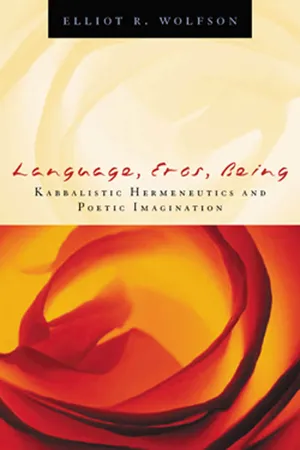
This long-awaited, magisterial study-an unparalleled blend of philosophy, poetry, and philology-draws on theories of sexuality, phenomenology, comparative religion, philological writings on Kabbalah, Russian formalism, Wittgenstein, Rosenzweig, William Blake, and the very physics of the time-space continuum to establish what will surely be a highwater mark in work on Kabbalah. Not only a study of texts, Language, Eros, Being is perhaps the fullest confrontation of the body in Jewish studies, if not in religious studies as a whole.
Elliot R. Wolfson explores the complex gender symbolism that permeates Kabbalistic literature. Focusing on the nexus of asceticism and eroticism, he seeks to define the role of symbolic and poetically charged language in the erotically configured visionary imagination of the medieval Kabbalists. He demonstrates that the traditional Kabbalistic view of gender was a monolithic and androcentric one, in which the feminine was conceived as being derived from the masculine. He does not shrink from the negative implications of this doctrine, but seeks to make an honest acknowledgment of it as the first step toward the redemption of an ancient wisdom.
Comparisons with other mystical traditions-including those in Christianity, Buddhism, and Islam-are a remarkable feature throughout the book. They will make it important well beyond Jewish studies, indeed, a must for historians of comparative religion, in particular of comparative mysticism.
Praise for Elliot R. Wolfson: "Through a Speculum That Shines is an important and provocative contribution to the study of Jewish mysticism by one of the major scholars now working in this field."-Speculum
For every philosophical work, if it is a philosophical work, drives philosophy beyond the standpoint taken in the work. The meaning of a philosophical work lies precisely in opening a new realm, setting new beginnings and impulses by means of which the work’s own means and paths are shown to be overcome and insufficient.
—Martin Heidegger, Schelling’s Treatise on the Essence of Human Freedom
Geneaological Mis/givings
In this book I set out once again to expose the veil of poetic imagination woven within the fabric of the Jewish esoteric tradition, demarcated generically by scholar and adept as “kabbalah.” The semantic range of the term encompasses practice and theory, in Western philosophical jargon, or, in rabbinic locution, ma‘aseh and talmud, a way of doing and a way of thinking. To speak of one is not to exclude the other, a perspective that has been enhanced by a critique of the so-called Scholemian school for focusing more on the speculative dimensions of kabbalah to the detriment of the existential, an orientation that has been traced to the influence of Christian kabbalah, and in particular the work of Johannes Reuchlin, on Scholem.1 Leaving aside both the accuracy of this charge against Scholem and the validity of characterizing the ruminations of Renaissance Christian kabbalists as nontheurgical,2 the main point to emphasize here is that I do not accept the conceptual split between the practical and theoretical, and thus when I speak of a theosophic structure, the performative gesture is implied, and conversely, when I speak of a performative gesture, the theosophic structure is implied. Indeed, the redemptive nature of kabbalistic esotericism ensues from the inextricable reciprocity of doing and knowing: mystical knowledge is a corollary of contemplative practice, contemplative practice a corollary of mystical knowledge.3 In the balance of this chapter, I will offer some preliminary observations regarding hermeneutical assumptions that undergird the path and regarding the methodological steps necessary to walk the path, as these will help orient the reader to the twists and turns that will be encountered in the effort to undo the interpretative lattice of language, eros, and being, a threefold chord enfolded in the wisdom of kabbalah.
First, a word about the term “kabbalah.” It is not my concern or interest at the moment to discuss the long and diverse philological history of the term, though surely it is reasonable to assume that attunement to philology is a critical tool in historiographical reconstruction.4 Even when focusing more finely on the limited semantic role of this term to denote esoteric gnosis, it must be acknowledged that “kabbalah” linguistically is multivalent and perhaps even—at the root—unstable, indeterminate, rootless.
How does one classify a historical phenomenon as multifaceted as kabbalah? Scholem remarked in the first of his ten “unhistorical aphorisms” on kabbalah, published in 1958, that a genuine esoteric tradition could not be divulged by the historian or philologist seeking to present the “mystical discipline of kabbalah” for, ironically, if it were divulged, it would not be the esoteric tradition it purported to be.5 Those familiar with my work know full well that Scholem’s ironic understanding of secrecy has served as a springboard for my own incursions into the hermeneutical duplicity of secrecy: to be a secret, the secret cannot be disclosed as the secret it purports to be, but if the secret is not disclosed as the secret it secretly cannot be, it cannot be the secret it exposes itself not to be.6 The caution Scholem offers regarding the possibility of an adequate scholarly presentation of kabbalistic esotericism seems well placed.
Even if one were not convinced by the double bind of secrecy, intricacies of kabbalah, ideational and practical, would preclude the possibility of proffering an adequate taxonomy, let alone an acceptable account of origins. These limitations notwithstanding, the duty of the scholar is to provide explanatory models that may be applied to texts morphologically. By “texts” I have in mind manifold cultural markings, ranging from literary artifacts to bodily gestures, but something still distinctively human in the domain of sentient animal beings. The matter of morphology is derived from the science of linguistics, the study of verbal forms that are likened to branches one pursues in search of the root, though coming to root does not mean one comes to rock bottom but rather to a ground that sways.
In Foucauldian terms, scholars are faced with the constrictive function of controlling discourses through ordering systems of classification. All such systems are subject to their own dismantling, as any appropriate method of interpretation must be attentive to discontinuities and irregularities that interrupt and constrain the production of a particular archaeology of knowledge seeking to explain the past. The corpus of material studied under the rubric of kabbalah is no exception. Indeed, the quest for “origins” of kabbalah, paradoxically, obfuscates the possibility of comprehending the historical emergence of the phenomenon, as the notion of “origin” logically entails the proposition that every moment is a homogeneous totality, manifesting a unique confluence of events the significance of which is charted in predominantly spatial and temporal terms, but at the same time the moment evolves in an uninterrupted flow that allows one to identify something as cause engendering effect in temporal succession and spatial extension. The search for origins accordingly masks both the discontinuity and continuity necessary to (mis)apprehend beginnings.
We would do better to replace the modernist notion of origin with the idea of genealogy articulated by Foucault, a tracing of lineage that recognizes ruptures and divergences in the process of extending the line, an orientation that disturbs what was considered stable, fragmenting what was thought unified, picturing heterogeneity in what was imagined hegemonic.7 Utilizing the genealogical approach we may chart an “effective history,” in contrast to the more traditional history of ideas, which demarcates the inception of a phenomenon, always a “singular event” destabilizing taxonomy and defying thematization in a manner comparable to Heidegger’s deconstruction of the ontotheological tradition by affirming ontological difference (the forerunner of Derrida’s différance),8 as a merging of multiple forces rather than a discrete entity emerging at a particular time and place.9 Genealogy is a pursuit of beginnings without assuming an origin to be found; there is no /thing in the beginning but a commingling of events that will be interpreted anew repeatedly in variable historical and cultural contexts, a sequence of enfolding resisting the attempt to unfold the beginning, a complex image of simplicity. “Where the soul pretends unification or the self fabricates a coherent identity, the genealogist sets out to study the beginning—numberless beginnings whose faint traces and hints of color are readily seen by an historical eye. The analysis of descent permits the dissociation of the self, its recognition and displacement as an empty synthesis, in liberating a profusion of lost events.”10
Having this goal in mind, we can say that a major current of Jewish esotericism—in the accepted but questionable taxonomy of contemporary scholarship, “theosophic” in contrast to “ecstatic” kabbalah—is focused principally on the imaginary envisioning of ten luminous emanations that reveal the light that must remain hidden if it is to be revealed.11 A variety of terms are used to name these emanations, but the one that became most emblematic was sefirot, an idiom initially employed in the first section of an older, multilayered anthology of cosmological speculation, Sefer Ye
irah, the “Book of Formation.”12 In the course of generations, allegedly new and more intricate images have been deployed by kabbalists in the poetic envisioning, but these have been in great measure based on principles already at work in earlier sources, albeit reticently, such as the idea that each of the sefirot reflects all the others, or the even more arcane notion that there is a decade of potencies either above or within the first of the sefirot that parallel the ten regular gradations, a philosophical idea imaged mythically as the primal human form perched above a second human form, perhaps the symbolic locus of the secret of the androgyne, to be discussed in more detail in the following chapters.13
In spite of the evolving complexity of kabbalistic theosophy, the sefirot remained structurally at the core of the contemplative visualization that characterizes the way of wisdom, the life experience, transmitted by masters of tradition. Solomon Rubin, a nineteenth-century scholar whose works have unfortunately been summarily dismissed or completely ignored in contemporary scholarship, offered an impressive delineation of the semantic range of this term.14 In his Heidenthum und Kabbala, published in 1893, Rubin specified (in German and what he proposed as its Hebrew equivalent) eight con notations of the term sefirot: divine essence (Götter; a
mut), heavenly spheres (Gestirne; galgalim), mysterious circles (geheimnissvolle Zirkel; agulim), beams of light (Lichtstrahlen; orot), mystical colors (Farben-Mystik; livnat ha-sappir), numbers (Zahlen; misparim), primal ideas or ten utterances (Urideen oder zehneiniger Logos; ma’amarot), and pious-ethical attributes (göttlich-ethische Attribute; middot).15
To do justice to Rubin’s insights we would need to discourse lengthily about each of the items on his list, but that undertaking clearly would take us too far off course. Suffice it to note that implicit in Rubin’s account is a recognition of what Scholem himself later identified as the two main “symbolic structures” by which the process of the “manifestation of God, his stepping outside” was understood, the “symbolism of light and the symbolism of language.”16 Wit...
Table of contents
Cover Page
Title Page
Copyright Page
Dedication
Contents
Preface
Prologue: Timeswerve/Hermeneutic Reversibility
1 Showing the Saying: Laying Interpretative Ground
2 Differentiating (In)Difference: Heresy, Gender, and Kabbalah Study
5 Flesh Become Word: Textual Embodiment and Poetic Incarnation
6 Envisioning Eros: Poiesis and Heeding Silence
7 Eunuchs Who Keep Sabbath: Erotic Asceticism / Ascetic Eroticism
8 Coming-to-Head, Returning-to-Womb: (E)Soteric Gnosis and Overcoming Gender Dimorphism
Epilogue
Notes
Bibliography
Index of Names and Book Titles
Index of Subjects and Terms
Trusted by 375,005 students
Access to over 1.5 million titles for a fair monthly price.
Study more efficiently using our study tools.
Frequently asked questions
Yes, you can cancel anytime from the Subscription tab in your account settings on the Perlego website. Your subscription will stay active until the end of your current billing period. Learn how to cancel your subscription
No, books cannot be downloaded as external files, such as PDFs, for use outside of Perlego. However, you can download books within the Perlego app for offline reading on mobile or tablet. Learn how to download books offline
Perlego offers two plans: Essential and Complete
Essential is ideal for learners and professionals who enjoy exploring a wide range of subjects. Access the Essential Library with 800,000+ trusted titles and best-sellers across business, personal growth, and the humanities. Includes unlimited reading time and Standard Read Aloud voice.
Complete: Perfect for advanced learners and researchers needing full, unrestricted access. Unlock 1.5M+ books across hundreds of subjects, including academic and specialized titles. The Complete Plan also includes advanced features like Premium Read Aloud and Research Assistant.
Both plans are available with monthly, semester, or annual billing cycles.
We are an online textbook subscription service, where you can get access to an entire online library for less than the price of a single book per month. With over 1.5 million books across 990+ topics, we’ve got you covered! Learn about our mission
Look out for the read-aloud symbol on your next book to see if you can listen to it. The read-aloud tool reads text aloud for you, highlighting the text as it is being read. You can pause it, speed it up and slow it down. Learn more about Read Aloud
Yes! You can use the Perlego app on both iOS and Android devices to read anytime, anywhere — even offline. Perfect for commutes or when you’re on the go. Please note we cannot support devices running on iOS 13 and Android 7 or earlier. Learn more about using the app
Yes, you can access Language, Eros, Being by Elliot R. Wolfson in PDF and/or ePUB format, as well as other popular books in Theology & Religion & Jewish Theology. We have over 1.5 million books available in our catalogue for you to explore.