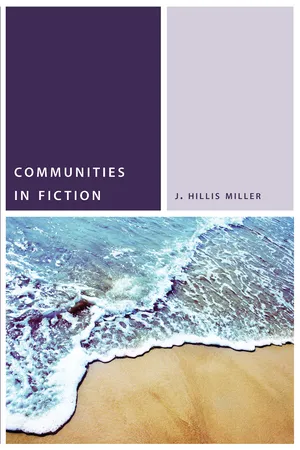
Communities in Fiction reads six novels or stories (one each by Trollope, Hardy, Conrad, Woolf, Pynchon, and Cervantes) in the light of theories of community worked out (contradictorily) by Raymond Williams, Martin Heidegger, and Jean- Luc Nancy.
The book's topic is the question of how communities or noncommunities are represented in fictional works. Such fictional communities help the reader understand real communities, including those in which the reader lives. As against the presumption that the trajectory in literature from Victorian to modern to postmodern is the story of a gradual loss of belief in the possibility of community, this book demonstrates that communities have always been presented in fiction as precarious and fractured. Moreover, the juxtaposition of Pynchon and Cervantes in the last chapter demonstrates that period characterizations are never to be trusted. All the features both thematic and formal that recent critics and theorists such as Fredric Jameson and many others have found to characterize postmodern fiction are already present in Cervantes's wonderful early-seventeenth-century "Exemplary Story," "The Dogs' Colloquy." All the themes and narrative devices of Western fiction from the beginning of the print era to the present were there at the beginning, in Cervantes
Most of all, however, Communities in Fiction looks in detail at its six fictions, striving to see just what they say, what stories they tell, and what narratological and rhetorical devices they use to say what they do say and to tell the stories they do tell. The book attempts to communicate to its readers the joy of reading these works and to argue for the exemplary insight they provide into what Heidegger called Mitsein— being together in communities that are always problematic and unstable.
- 352 pages
- English
- ePUB (mobile friendly)
- Available on iOS & Android
eBook - ePub
Communities in Fiction
About this book
Information
Publisher
Fordham University PressYear
2014Print ISBN
9780823263110
9780823263103
eBook ISBN
9780823263127
1
THEORIES OF COMMUNITY
Williams, Heidegger, and Others
Raymond Williams’s entry for “community” in Keywords1 is straightforward enough, though it is characteristically succinct, comprehensive, and subtle. He gives a brief history of the etymology of the word and of the different meanings the word has had since it entered the English language in the fourteenth century. He also sets “community” against two French and German words, commune and Gemeinde. He refers to Tönnies’s influential contrast (1887) between Gemeinschaft and Gesellschaft: an organic community, on the one hand, and an impersonal organization or corporation, on the other. Though Williams distinguishes five senses of “community,” the essence of his definition is expressed in the following phrases: “a sense of common identity and characteristics,” and “the body of direct relationships” as opposed to “the organized establishment of realm or state.” A community is “relatively small,” with a “sense of immediacy or locality.” Williams stresses the affective aspect of the word and its performative power: “Community can be the warmly persuasive word to describe an existing set of relationships, or the warmly persuasive word to describe an alternative set of relationships.”
What Williams meant by “community” is developed more circumstantially in The Country and the City, especially in Chapters 10, 16, and 18 of that book: “Enclosures, Commons and Communities,” “Knowable Communities,” and “Wessex and the Border.”2 The last two are on George Eliot and Thomas Hardy, respectively. Williams does not wholly admire George Eliot, nor Jane Austen, whereas Hardy gets his more or less complete approval. What is the difference? “Jane Austen,” says Williams, “had been prying and analytic, but into a limited group of people in their relations with each other” (168). Eliot, according to Williams, was, like Jane Austen before her, more or less limited in her comprehension of people to members of the gentry. The latter formed her “knowable community.” She did not really understand the common people: rural farmers, laborers, servants, and tradesmen. They and their community were “unknowable” to her. In Williams’s view, Eliot projected her own inner life into working class people in her novels. She was consistently condescending to such people. “George Eliot,” says Williams, “gives her own consciousness, often disguised as a personal dialect, to the characters with whom she does really feel; but the strain of the impersonation is usually evident—in Adam, Daniel, Maggie, or Felix Holt” (169).
The latter judgment, by the way, seems questionable. Hetty Sorrel in Adam Bede, for example, seems to me a plausible characterization of someone to a considerable degree unlike George Eliot herself. Like Williams, I come from a rural background, though at the distance of an extra generation, so, like Williams, I too can speak from direct experience about this. Can it be that there is a trace of misogyny in Williams’s put-down of Austen and Eliot, in favor of male novelists like Hardy and Lawrence? “Prying and analytic” is a really nasty epithet, and what worse can one say of a supposedly objective realist novelist than that all her protagonists are versions of herself? Eliot, it happens, had had a lot of direct experience with rural people as a child, for example by traveling around the neighborhood with her father in his carriage. He was an estate agent, neither peasant nor aristocrat, but located at an in-between class site well suited to comparative observation by an astute and sharp-eyed daughter who shared his class placement. In my judgment, Williams is, as we say, shooting from the hip in his put-down of Eliot.
Williams’s judgment of Hardy is quite different. Hardy, he says, truly understood the rural personages and communities he represents in his novels. He understood them because he had experienced rural life first hand as a child. He also had a sharp eye for what rural life is really like. Hardy’s “essential position and attribute” are his “intensity and precision of observation” (205). Hardy’s great subject is the displacement of such rural people by education or migration, or both. More precisely, Hardy focuses on the resulting alienation, even if such displaced persons try to go home again, as Clym Yeobright does in The Return of the Native. Hardy’s goal was “to describe and value a way of life with which he was closely yet uncertainly connected” (200). The perspective expressed in his novels is that of someone who was inside and outside at once (just like George Eliot, by the way!). This is because such a position was Hardy’s own life situation:
In becoming an architect and a friend of the family of a vicar (the kind of family, also, from which his wife came) Hardy moved to a different point in the social structure, with connections to the educated but not the owning class, and yet also with connections through his family to that shifting body of small employers, dealers, craftsmen, and cottagers who were themselves never wholly distinct, in family, from the laborers. (200)
Nowhere does Williams say in so many words why it is better to describe accurately a rural community than to describe accurately the disasters of courtship and marriage among the gentry, as Eliot did in Middlemarch and Daniel Deronda, or as did Henry James, whom Williams also does not much like. He just takes it for granted that Hardy’s subject matter is better, perhaps because Williams thought “real history” was taking place among rural people, not among the gentry. His panoramic chapter in The Country and the City, on “Enclosures, Commons and Communities,” supports that view. For Williams, the essential action of English history from the eighteenth century to the present is the gradual rise of capitalism and its destruction of rural community life. He calls this the “increasing penetration by capitalist social relations and the dominance of the market” (98). His view of this is quite different from that of Americans today, such as Francis Fukuyama, or George W. Bush, or Paul Ryan. Williams sees the rise of capitalism as pretty much an unmitigated disaster, a “crisis.” Industrialization, he argues, is only part of the story. “By the late eighteenth century,” he asserts, “we can properly speak of an organized capitalist society, in which what happened to the market, anywhere, whether in industrial or agricultural production, worked its way through to town and country alike, as parts of a single crisis” (98). The increasing dominance of the capitalist system led to mass displacement and alienation, as rural laborers and tenant farmers were forcibly dispossessed and large landed estates established. Enclosure was only one aspect of this process. An equally important factor was the importation of a rigid class system whose material sign was the immense number of large country houses built during the period.
A true community, Williams assumes, is classless. He celebrates the precarious remnants of such communities in remote villages that have no local country house, for example on the Welsh border where Williams himself grew up. He recognizes, however, that even there some invidious class structure exists. It will not do, he recognizes, to idealize these communities, but they are the nearest thing we have in these bad days to true communities. An attractive warmth and enthusiasm pervades Williams’s description of such communities:
In some places still, an effective community, of a local kind, can survive in older terms, where small freeholders, tenants, craftsmen and laborers can succeed in being neighbors first and social classes only second. This must never be idealized, for at the points of decision, now as then, the class realities usually show through. But in many intervals, many periods of settlement, there is a kindness, a mutuality, that still manages to flow. (106)
The only alternative to these rapidly vanishing communities, Williams holds, is those groups of the oppressed bonding together to fight capitalism and the evils of an “ownership society,” as George W. Bush called it, in what for him was a term of praise. The last sentence of Williams’s chapter is: “Community, to survive, had then to change its terms” (107). This is another way of saying, I take it, “Comes the Revolution!” I share Williams’s utopian hope, his belief in what Jacques Derrida calls “the democracy to come,” for which we all should work, however distant its horizon, or however much it may even be permanently over the horizon, always still à venir, to come.
Several basic features of Williams’s assumptions about community emerge in The Country and the City. One is the assumption that a true community is not just a relatively small group of people living together in the same place and sharing the same immemorial assumptions in kindness and mutuality. A true community must also be classless. Class structures, particularly those generated by capitalism, destroy community.
A second, crucial, assumption, never stated in so many words, but fundamental to Williams’s thinking about community, is that the individual is and should be his social placement, with no residue or leftover that is not determined by the surrounding culture. A small freeholder is a small freeholder through and through. I am my subject position. I raise wheat or brussel sprouts, or make shoes, or work as a carpenter, or milk cows, therefore I am. I am the Archdeacon of Barchester Cathedral, therefore, I am. Among the things that must be represented accurately in good realist fiction, according to Williams, is the way the nature and fates of the characters are determined more or less completely by their relations to the surrounding community or lack of it. “As in all major realist fiction,” says Williams, “the quality and destiny of persons and the quality and destiny of a whole way of life are seen in the same dimension and not as separable issues” (201). This is, of course, a version of Marxist materialist determinism.
Williams’s third essential assumption is that the warmth and mutuality of a true community depends on the ways I know my neighbor. My social placement exposes me entirely to other people, with no corner of private subjectivity hidden away from them. I understand my neighbor or am understood by him or her, in kindness and mutuality, because he or she is, through and through, his or her social role in a small group. This happy intersubjectivity works because all members of the group have in common a set of traditional habits and beliefs that thoroughly determines what they are. This makes the ideal classless rural community a true Gemeinschaft.
Williams, for the most part, takes it for granted that belonging to a community is proper and good. For him, a genuine community, if there ever were such a thing, would be characterized by a “tolerant neighborliness” and “traditional mutuality” among equals. The polemical side of Williams’s book is the argument that the rise of capitalism, including agrarian capitalism in rural places all over England, has made community there less and less possible. Community may perhaps still remain only in remote pockets sequestered from the landowners’ big country houses. In those hidden places, a genuine community of laborers, tenant farmers, craftsmen, and small free-holding farmers may even now still exist.
Agrarian capitalism, not enclosure as such, Williams argues, more or less completely destroyed the possibility of community in England: “The economic system of landlord, tenant and laborer, which had been extending its hold since the sixteenth century, was now [by the early nineteenth century, with the walls, fences, and “paper rights” of enclosure] in explicit and assertive control. Community, to survive, had then to change its terms” (107). What Williams means by that last sentence, as other earlier remarks in the chapter make clear, is that community can now only exist as the coalition, the solidarity, of the oppressed in opposition to their masters. Though I accept Williams’s picture of the evils of the capitalist system in England, it is still reasonable to ask why a small village where everyone accepts class distinctions, goes to the same church, takes care of the sick and the poor, lives by the same laws, and accepts the same social conventions, inequitable though they may be, should be denied the name “community,” even though we might call it a bad one. Williams would probably respond by asking,
What true sharing, or having in common, or mutuality, or neighborliness, or kindness can there be between the rich landlord and the tenant farmers he rack-rents and oppresses? Only a small group of families living in the same place in a more or less classless society, or a society in which class distinctions are minimized, can justifiably be called a community.3
Little or no countenance is given by Williams to the idea that a novel may be an imaginary world, a counter world, a heterotopia with its own somewhat idiosyncratic laws and features. Such a heterotopia is made, no doubt, by a transformation into words of the “real world” as the author saw it. This transformation is brought about through the performative felicity of fictive language. It is, however, by no means a mirror image to be judged solely by the accuracy of its reflection of the phenomenal world, including social phenomena, according to a mistaken ideological assumption that Williams shares with so many critics and teachers of the novel. Nor does Williams give much value to the margin in subjectivity of independence, individuality, idiosyncrasy, or secrecy. Such singularity detaches fictive characters, and perhaps real persons, in part at least, from their circumambient communities. That, for example, is one of Hardy’s main assumptions.
Williams disvalues such detachment under negative names like “alienation,” “separation,” and “exposure.” Destructive uprooting i...
Table of contents
- Cover
- Half Title
- Series Announcement Page
- Title Page
- Copyright
- Dedication
- Contents
- List of Illustrations
- Acknowledgments
- Half Title
- 1. Theories of Community: Williams, Heidegger, and Others
- 2. Trollope’s The Last Chronicle of Barset as a Model of Victorian Community
- 3. Individual and Community in The Return of the Native
- 4. Conrad’s Colonial (Non)Community: Nostromo
- 5. Waves Theory: An Anachronistic Reading
- 6. Postmodern Communities in Pynchon and Cervantes
- Coda
- Notes
- Index
- Series Page
Trusted by 375,005 students
Access to over 1.5 million titles for a fair monthly price.
Study more efficiently using our study tools.
Frequently asked questions
Yes, you can cancel anytime from the Subscription tab in your account settings on the Perlego website. Your subscription will stay active until the end of your current billing period. Learn how to cancel your subscription
No, books cannot be downloaded as external files, such as PDFs, for use outside of Perlego. However, you can download books within the Perlego app for offline reading on mobile or tablet. Learn how to download books offline
Perlego offers two plans: Essential and Complete
- Essential is ideal for learners and professionals who enjoy exploring a wide range of subjects. Access the Essential Library with 800,000+ trusted titles and best-sellers across business, personal growth, and the humanities. Includes unlimited reading time and Standard Read Aloud voice.
- Complete: Perfect for advanced learners and researchers needing full, unrestricted access. Unlock 1.5M+ books across hundreds of subjects, including academic and specialized titles. The Complete Plan also includes advanced features like Premium Read Aloud and Research Assistant.
We are an online textbook subscription service, where you can get access to an entire online library for less than the price of a single book per month. With over 1.5 million books across 990+ topics, we’ve got you covered! Learn about our mission
Look out for the read-aloud symbol on your next book to see if you can listen to it. The read-aloud tool reads text aloud for you, highlighting the text as it is being read. You can pause it, speed it up and slow it down. Learn more about Read Aloud
Yes! You can use the Perlego app on both iOS and Android devices to read anytime, anywhere — even offline. Perfect for commutes or when you’re on the go.
Please note we cannot support devices running on iOS 13 and Android 7 or earlier. Learn more about using the app
Please note we cannot support devices running on iOS 13 and Android 7 or earlier. Learn more about using the app
Yes, you can access Communities in Fiction by J. Hillis Miller in PDF and/or ePUB format, as well as other popular books in Literature & English Literary Criticism. We have over 1.5 million books available in our catalogue for you to explore.