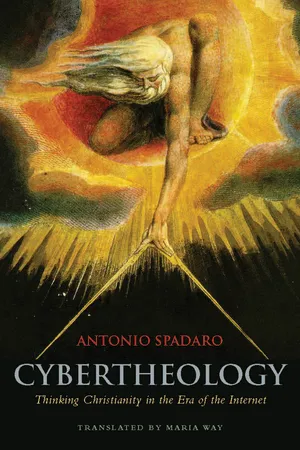
Because the Internet has changed and is changing the ways in which we think and act, it must also be changing the ways in which we think Christianity and its theology. Cybertheology is the first book to explore this process from a Catholic point of view. Drawing on the theoretical work of authors such as Marshall McLuhan, Peter Levy, and Teilhard de Chardin, it questions how technologies redefine not only the ways in which we do things but also our being and therefore the way we perceive reality, the world, others, and God. "Does the digital revolution affect faith in any sense?" Spadaro asks. His answer is an emphatic Yes. But how, then, are we to live well in the age of the Internet?
Spadaro delves deeply into various dimensions of the impact of the Net on the Church and its organization, on our understanding of revelation, grace, liturgy, the sacraments, and other classical theological themes. He rightly points out that the digital environment is not merely an external instrument that facilitates human communication or a purely virtual world, but part of the daily experience of many people, a new "anthropological space" that is reshaping the way we think, know, and express ourselves. Naturally, this calls for a new understanding of faith so that it makes sense to people who live and work in the digital media environment. In developing the notion of cybertheology, Spadaro seeks to propose an intelligence of faith (intellectus fidei) in the era of the Internet.
The book's chapters include reflections on man the decoder and the search engines of God, networked existence and the mystical body, hacker ethics and Christian vision, sacraments and "virtual presence," and the theological challenges of collective intelligence.
- 160 pages
- English
- ePUB (mobile friendly)
- Available on iOS & Android
eBook - ePub
About this book
Information
Publisher
Fordham University PressYear
2014Print ISBN
9780823257003
9780823256990
eBook ISBN
9780823257027
Topic
Teologia e religioneSubtopic
Studi sulla comunicazioneTable of contents
- Cover
- Half Title
- Title Page
- Copyright
- Contents
- Preface
- Half Title
- 1. The Internet: Between Theology and Technology
- 2. The Human Being: Decoder and Search Engine for God
- 3. The Mystical and Connective Body
- 4. Hacker Ethics and Christian Vision
- 5. Liturgy, Sacraments, and Virtual Presence
- 6. The Technological Tasks of Collective Intelligence
- Notes
- Works Cited
- Index of Names
Trusted by 375,005 students
Access to over 1.5 million titles for a fair monthly price.
Study more efficiently using our study tools.
Frequently asked questions
Yes, you can cancel anytime from the Subscription tab in your account settings on the Perlego website. Your subscription will stay active until the end of your current billing period. Learn how to cancel your subscription
No, books cannot be downloaded as external files, such as PDFs, for use outside of Perlego. However, you can download books within the Perlego app for offline reading on mobile or tablet. Learn how to download books offline
Perlego offers two plans: Essential and Complete
- Essential is ideal for learners and professionals who enjoy exploring a wide range of subjects. Access the Essential Library with 800,000+ trusted titles and best-sellers across business, personal growth, and the humanities. Includes unlimited reading time and Standard Read Aloud voice.
- Complete: Perfect for advanced learners and researchers needing full, unrestricted access. Unlock 1.5M+ books across hundreds of subjects, including academic and specialized titles. The Complete Plan also includes advanced features like Premium Read Aloud and Research Assistant.
We are an online textbook subscription service, where you can get access to an entire online library for less than the price of a single book per month. With over 1.5 million books across 990+ topics, we’ve got you covered! Learn about our mission
Look out for the read-aloud symbol on your next book to see if you can listen to it. The read-aloud tool reads text aloud for you, highlighting the text as it is being read. You can pause it, speed it up and slow it down. Learn more about Read Aloud
Yes! You can use the Perlego app on both iOS and Android devices to read anytime, anywhere — even offline. Perfect for commutes or when you’re on the go.
Please note we cannot support devices running on iOS 13 and Android 7 or earlier. Learn more about using the app
Please note we cannot support devices running on iOS 13 and Android 7 or earlier. Learn more about using the app
Yes, you can access Cybertheology by Antonio Spadaro, Maria Way in PDF and/or ePUB format, as well as other popular books in Teologia e religione & Studi sulla comunicazione. We have over 1.5 million books available in our catalogue for you to explore.