From Slave Ship to Harvard is the true story of an African American family in Maryland over six generations. The author has reconstructed a unique narrative of black struggle and achievement from paintings, photographs, books, diaries, court records, legal documents, and oral histories. From Slave Ship to Harvard traces the family from the colonial period and the American Revolution through the Civil War to Harvard and finally today.
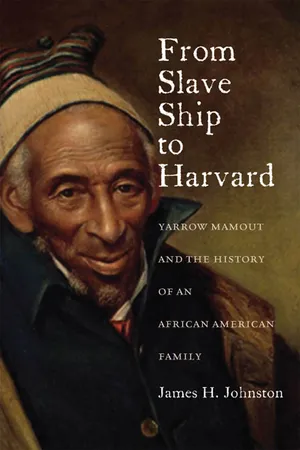
Yarrow Mamout, the first of the family in America, was an educated Muslim from Guinea. He was brought to Maryland on the slave ship Elijah and gained his freedom forty-four years later. By then, Yarrow had become so well known in the Georgetown section of Washington, D.C., that he attracted the attention of the eminent American portrait painter Charles Willson Peale, who captured Yarrow's visage in the painting that appears on the cover of this book. The author here reveals that Yarrow's immediate relatives—his sister, niece, wife, and son—were notable in their own right. His son married into the neighboring Turner family, and the farm community in western Maryland called Yarrowsburg was named for Yarrow Mamout's daughter-in-law, Mary "Polly" Turner Yarrow. The Turner line ultimately produced Robert Turner Ford, who graduated from Harvard University in 1927.
Just as Peale painted the portrait of Yarrow, James H. Johnston's new book puts a face on slavery and paints the history of race in Maryland. It is a different picture from what most of us imagine. Relationships between blacks and whites were far more complex, and the races more dependent on each other. Fortunately, as this one family's experience shows, individuals of both races repeatedly stepped forward to lessen divisions and to move America toward the diverse society of today.
eBook - ePub
From Slave Ship to Harvard
Yarrow Mamout and the History of an African American Family
- 310 pages
- English
- ePUB (mobile friendly)
- Available on iOS & Android
eBook - ePub
From Slave Ship to Harvard
Yarrow Mamout and the History of an African American Family
About this book
Information
Publisher
Fordham University PressYear
2012Print ISBN
9780823239511
9780823239504
eBook ISBN
9780823239528
Chapter 1: Yarrow Mamout, a West African Muslim Slave
Yarrow Mamout was born in West Africa in 1736 and brought to America as a slave in 1752. He was Fulani, also called Fulbe and Peul, a nomadic people that had converted to Islam. Although the Fulani were associated with West Africa in Yarrow’s time, today they may be found as far east in Africa as Sudan. They are a minority in all countries in which they live except Guinea, where they are the largest ethnic group.i
The Fulani were originally from what is now the country of Mali, but by the time Yarrow was born, they had migrated southward into the region known as Futa Jallon. That highland has been called the Switzerland of West Africa even though the highest spot is only 4,790 feet above sea level. Futa Jallon receives a great deal of rainfall and is the headwater for three major rivers, the Gambia, Senegal, and Niger. It was also called Senegambia historically, and sometimes simply Guinea. It lies within the eastern sections of today’s Guinea and Senegal.
There is more to Yarrow’s name than meets the eye. The spelling Yarrow Mamout in America would have been Yero Mamadou in Africa. The Fulani usually consulted an Islamic holy man when a child was born for guidance in choosing a name, and Yero was one of several male names for a woman’s fourth child. Mamadou, a variation of Mohammed, could be selected for a boy born on a Monday. In other words, the name Yarrow Mamout tells us that he was his mother’s fourth child and was born on a Monday. However, consulting a holy man was not mandatory, and Yarrow’s parents may have had other reasons for choosing these names.ii In any event, since he went by Yarrow Mamout most of his life and used Yarrow as his last name—even though both Yarrow and Mamout were given names—this is how he will be referred to in this book.
Yarrow would have had a Fulani surname and possibly a nickname, but neither of these is known. There were four basic surnames in Futa Jallon: Diallo, Bah, Sow, and Barry.iii Conceivably, the name Yarrow was not derived from Yero but rather was a misheard rendering of Diallo. This seems unlikely, though.iv Even today, surnames are infrequently used in this part of West Africa and, when they are, it is only for formalities such as financial and government records.v
Yarrow had a sister who was enslaved at the same time he was. Her African name is not known, but it is believed that she was known variously as Hannah, Free Hannah, and Hannah Peale in America. What is known for sure about her is that after Yarrow died, a woman named Nancy Hillman brought suit in court claiming she was entitled to inherit from Yarrow as the daughter of this sister. A judge found this to be true. For this reason, her mother is said to be Yarrow’s sister and is called Hannah in this book, although in West Africa the concept of a sister might include a cousin or a close female friend.vi
Fulani Muslims as Slaves
Yarrow, who was sixteen at the time he was enslaved, was neither the first Fulani nor the first Muslim to be brought to America as a slave. Still, Muslim slaves were uncommon. In early America, literate men knew Shakespeare’s Othello and tended to think of black Muslims in Shakespearean terms, distinguishing them from other Africans. Shakespeare’s Othello was not Fulani, but white Americans in colonial times did not make such fine distinctions. They were intrigued by these educated, black Muslims and referred to them as Mahometans or, perhaps through Shakespeare’s influence, Moors, and they tended to treat them better than uneducated slaves. In Africa, Muslims were typically the ones who owned slaves and sold them to traders for transport to America.
The circumstances surrounding Yarrow’s capture and enslavement are unknown, but they were probably similar to those of two other Muslims from Futa Jallon, whose stories are known. In early June 1731, twenty-one years before Yarrow arrived, a Maryland attorney named Thomas Bluett was attending court in Kent County, Delaware, when he heard of one such unusual slave. Bluett was told that the slave had escaped from his owner and was being held at the jail.vii The local tavern doubled as the jail, so, curious, Bluett went there to interview the man. He later wrote his story.
The jailed slave was Ayuba Suleiman Diallo.viii He was a Fulani from Futa Jallon, and Bluett took care to learn his full name. Diallo’s father was an imam and an important man in Futa Jallon. Diallo was educated in the Quran and learned to read and write in Arabic. In February 1730, his father gave him two slaves and told him to sell them to Captain Stephen Pike aboard the slave ship Arabella, anchored in the Gambia River. Servants went along as guards. Captain Pike did not offer enough money, though, so Diallo broke off negotiations and found a better deal by exchanging the slaves for cattle in a nearby village.
Diallo made the mistake of sending the servants home while he stopped to visit a friend. His father had warned him to avoid the Mandingo people, but they found him while he was at his friend’s and took him prisoner. They then sold him as a slave to the same Captain Pike with whom he had been negotiating. Pike seemed unfazed by this turnabout, and he enslaved the man with whom he had recently been haggling. Pike made one concession and allowed Diallo to write his father for help, yet Pike sailed before receiving an answer. Hence, Diallo found himself on board a slave ship bound for Annapolis, Maryland. He heard later that upon receiving his letter, his father dispatched a party with slaves to exchange for him, but the Arabella was gone by the time the delegation reached the river. Diallo also heard that the king of Futa Jallon retaliated against the Mandingo and “cut off great numbers of them.”ix
Pike’s slave voyage was financed by men in England whose representative in Annapolis was Vachel Denton. He was a lawyer and seemed to be the man to call when there were slaves to be dealt with. For example, according to The Maryland Gazette of January 21, 1729, a slave named William Robinson was brought before Denton, the city magistrate, and charged with striking a white man in an argument over a fight between their dogs. Denton ordered that one of Robinson’s ears be cropped.x Several years later, the Gazette contained a notice from Denton that Mrs. Elizabeth Beale had two Negroes for sale.xi He was presumably acting as her attorney. Even later, the paper announced that he was attorney for William Hunt, a merchant in London, and had slaves for sale at Hunt’s plantation in Maryland.xii Thus, when Captain Pike arrived in Annapolis with his cargo of slaves in the Arabella in 1730, the London sponsors of the voyage chose Denton as the man to sell the cargo.
Denton sold Diallo to a planter on Kent Island across the Chesapeake Bay from Annapolis. Initially, Diallo was put to work in the tobacco fields. However, the young, aristocratic Fulani proved unsuited to hard field labor and so was assigned the easier job of tending cattle. The Muslim later told Bluett he “would often leave the Cattle, and withdraw into the Woods to pray; but a white Boy frequently watched him, and whilst he was at his Devotion would mock him, and throw Dirt in his Face.”xiii
Diallo’s loneliness and unhappiness were made worse by the fact he could not yet speak English, and finally he ran away from the plantation. He only made it as far as the next county, in Delaware, before being arrested. This is where Bluett went to the tavern to meet and talk with him.
Bluett offered Diallo a glass of wine. Diallo refused. Instead, as Bluett described, “he wrote a Line or two before us [in Arabic], and when he read it, pronounced the Words Allah and Mahommed.”xiv From these actions of refusing alcohol and writing and speaking a strange language, Bluett concluded Diallo was a “Mahometan.”
After release from jail, Diallo was sent back to his owner. Once again he sought his father’s help and wrote a letter to him in Africa. The letter was delivered first to Denton, since he represented the slave traders in England. He forwarded it to his principals in London. Eventually the letter worked its way into the hands of James Oglethorpe, who was in the process of setting up the colony of Georgia. Oglethorpe was intrigued by what he heard of this educated Muslim slave. Therefore, he arranged, probably through Denton, for Diallo to sail to London, accompanied by Bluett.
When the two arrived, Bluett set about finding a publisher for his book about the Muslim, Some Memoirs of the Life of Job Son of Solomon. Diallo, meanwhile, became a celebrity, or at least a novelty. He was persuaded to sit for a formal portrait by the English artist William Hoare.
Diallo then returned to Africa, and the English public soon lost interest in him. He supposedly helped the British, who were competing for colonies with the French, before being captured by the French and dying in a French prison somewhere in West Africa.
Another Muslim slave to have his history recorded was Abdul Rahman Ibrahima Ibn Sori, a name shortened to Abdul-Rahman. He too was Fulani, born in 1762 in Timbo, the largest town in Futa Jallon. As a young man, he was sent to Macina and Timbuktu in Mali to study.xv Upon returning to Timbo, he served in his father’s army. Abdul-Rahman was captured in a battle in 1788, sold to slave traders in Africa, and transported to America, where he ended up as a slave on a cotton plantation near Natchez, Mississippi.
Through luck, Abdul-Rahman was eventually freed and went back to Africa. The process began when he was in town on his owner’s business. There he ran into an Irish doctor who remembered meeting him in Africa years earlier. The doctor had fallen ill there, and Abdul-Rahman’s family had nursed him back to health. Now, to return the favor, the doctor tried to buy the slave’s freedom, but to no avail. After the doctor died, Abdul-Rahman set about the task himself but was also unsuccessful.
Finally, a local newspaperman took up his cause and got the attention of a United States senator from New York. The newspaperman mistakenly concluded that because Abdul-Rahman could speak Arabic, he was a Moor from Morocco, and he conveyed this mistake to the senator.
The upshot of this comedy of errors was that senator turned to the sultan of Morocco for help. The sultan petitioned President John Quincy Adams to let Abdul-Rahman return to Africa, and Adams agreed. Abdul-Rahman became a celebrity in America, much as Diallo had been in England. He and his wife toured several states and were feted in Washington. After that, he sailed to Monrovia, Liberia. However, within six months of his arrival in Africa, Abdul-Rahman died of fever at the age of sixty-seven. He never made it back to Futa Jallon—or to Morocco, for that matter.
Thus, although no one recorded how Yarrow Mamout became a slave, it was probably in a fashion similar to Diallo’s or Abdul-Rahman’s. Yarrow’s sister must have been brought to America on the same ship. That both Yarrow and she were captured at the same time suggests that the capture came after a battle or by stealth, or, conceivably, that Yarrow’s family was the loser in a power struggle.
Stinking Slave Ships
Going from freedom and a position of wealth and education in Futa Jallon to slave and confinement on a filthy slave ship was a tremendous emotional and physical shock. Yarrow left no record of what his voyage was like, but the renowned John Newton did. He captained a “snow” or “snau” in the slave trade at this time.xvi The ship was of the same design as the one that brought Yarrow. The shallow-draft, two-masted vessel displaced one hundred tons and held about two hundred slaves, packed tightly below deck. The ship’s shallow draft allowed it to sail up the rivers of Africa to collect slaves but caused it to roll on the high seas.
So awful were the slave ships that Newton soon lost his stomach for the job. He left the sea to take up the ministry, penned the hymn “Amazing Grace” to celebrate this remarkable conversion, and became an outspoken opponent of slavery. In fact, Rev. John Newton was the driving religious force behind the movement in England that eventually abolished the slave trade.xvii He wrote this firsthand account of conditions on a slave ship for the human beings who were the cargo:
[T]he great object is, to be full. . . . The cargo of a vessel of a hundred tons, or little more, is calculated to purchase from two hundred and twenty to two hundred and fifty slaves. Their lodging-rooms below the deck . . . are sometimes more than five feet high, and sometimes less; and this height is divided towards the middle, for the slaves lie in two rows, one above the other, on each side of the ship, close to each other, like books upon a shelf. I have known them so close that the shelf would not, easily, contain one more. . . .
[T]he poor creatures, thus cramped for want of room, are likewise in irons, for the most part both hands and feet, and two together, which makes it difficult for them to turn or move, to attempt either to rise or to lie down, without hurting themselves, or each other. Nor is the motion of the ship, especially her heeling, or stoop on one side, when under sail, to be omitted; for this, as they lie athwart, or cross the ship, adds to the uncomfortableness of their lodging, especially to those who lie on the leeward or leaning side of the vessel.xviii
In his book The Slave Ship, Marcus Rediker calls the ships floating prisons, with the slaves being the inmates and the crew being the guards. A snow, like Newton’s Duke of Argyle and Yarrow’s Elijah, with 200 to 250 slaves would have a crew of about thirty sailors. Outnumbered seven-to-one by its captives, the crew took a number of precautions. When below deck, each male slave was shackled to another man, thus limiting his ability to move. Even if he remained motionless, the rocking of the ship caused the shackles to dig into his flesh.xix
Buckets and tubs served as toilets on the rolling ships if the men and women were able to get to them, which was often not the case. The stench was overpowering. Because of the smell, other vessels, spotting a slave ship, gave them a wide berth even on the open ocean. A slave ship, it was said, could be smelled a mile away.
Disease and death stalked the ships. The crew and the slaves themselves brought illnesses aboard. What is more, bacteria and viruses left behind from the previous voyage stayed aboard and looked for new hosts. Once disease did break out, it spread rapidly in the cramped, unsanitary conditions.
Slave ships also had to contend with the perils of the sea, which were often greater for cargo than for crew. In 1762, ten years after Yarrow’s voyage, the slave ship Phoenix was bound for Annapolis when she sailed into a storm that knocked her on her side. The crew righted the prophetically named ship, but the food and fresh water were lost. While the crew supposedly surv...
Table of contents
- Cover Page
- Title Page
- Copyright Page
- Dedication
- Contents
- Introduction
- 1. Yarrow Mamout, a West African Muslim Slave
- 2. Tobacco and the Importation of a Labor Force
- 3. Welcome to America
- 4. Slavery and Revolution
- 5. Yarrow of Georgetown
- 6. The Portraits: Peale, Yarrow, and Simpson
- 7. Free Hannah, Yarrow’s Sister
- 8. Nancy Hillman, Yarrow’s Niece
- 9. Aquilla Yarrow
- 10. Mary “Polly” Turner Yarrow
- 11. Aquilla and Polly in Pleasant Valley 000
- 12. Traces of Yarrow
- 13. Unpleasant Valley
- 14. Freedom
- 15. From Harvard to Today
- 16. Epilogue: Guide to the Yarrows’ and Turners’ World Today
- Notes
- Bibliography
- Acknowledgments
- Index
Trusted by 375,005 students
Access to over 1.5 million titles for a fair monthly price.
Study more efficiently using our study tools.
Frequently asked questions
Yes, you can cancel anytime from the Subscription tab in your account settings on the Perlego website. Your subscription will stay active until the end of your current billing period. Learn how to cancel your subscription
No, books cannot be downloaded as external files, such as PDFs, for use outside of Perlego. However, you can download books within the Perlego app for offline reading on mobile or tablet. Learn how to download books offline
Perlego offers two plans: Essential and Complete
- Essential is ideal for learners and professionals who enjoy exploring a wide range of subjects. Access the Essential Library with 800,000+ trusted titles and best-sellers across business, personal growth, and the humanities. Includes unlimited reading time and Standard Read Aloud voice.
- Complete: Perfect for advanced learners and researchers needing full, unrestricted access. Unlock 1.5M+ books across hundreds of subjects, including academic and specialized titles. The Complete Plan also includes advanced features like Premium Read Aloud and Research Assistant.
We are an online textbook subscription service, where you can get access to an entire online library for less than the price of a single book per month. With over 1.5 million books across 990+ topics, we’ve got you covered! Learn about our mission
Look out for the read-aloud symbol on your next book to see if you can listen to it. The read-aloud tool reads text aloud for you, highlighting the text as it is being read. You can pause it, speed it up and slow it down. Learn more about Read Aloud
Yes! You can use the Perlego app on both iOS and Android devices to read anytime, anywhere — even offline. Perfect for commutes or when you’re on the go.
Please note we cannot support devices running on iOS 13 and Android 7 or earlier. Learn more about using the app
Please note we cannot support devices running on iOS 13 and Android 7 or earlier. Learn more about using the app
Yes, you can access From Slave Ship to Harvard by James H. Johnston in PDF and/or ePUB format, as well as other popular books in Social Sciences & Historical Biographies. We have over 1.5 million books available in our catalogue for you to explore.