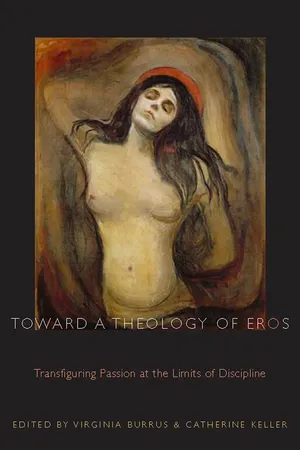
What does theology have to say about the place of eroticism in the salvific transformation of men and women, even of the cosmos itself? How, in turn, does eros infuse theological practice and transfigure doctrinal tropes? Avoiding the well-worn path of sexual moralizing while also departing decisively from Anders Nygren's influential insistence that Christian agape must have nothing to do with worldly eros, this book explores what is still largely uncharted territory in the realm of theological erotics. The ascetic, the mystical, the seductive, the ecstatic—these are the places where the divine and the erotic may be seen to converge and love and desire to commingle.
Inviting and performing a mutual seduction of disciplines, the volume brings philosophers, historians, biblical scholars, and theologians into a spirited conversation that traverses the limits of conventional orthodoxies, whether doctrinal or disciplinary. It seeks new openings for the emergence of desire, love, and pleasure, while challenging common understandings of these terms. It engages risk at the point where the hope for salvation paradoxically endangers the safety of subjects—in particular, of theological subjects—by opening them to those transgressions of eros in which boundaries, once exceeded, become places of emerging possibility.
The eighteen chapters, arranged in thematic clusters, move fluidly among and between premodern and postmodern textual traditions—from Plato to Emerson, Augustine to Kristeva, Mechthild to Mattoso, the Shulammite to Molly Bloom, the Zohar to the Da Vinci Code. In so doing, they link the sublime reaches of theory with the gritty realities of politics, the boundless transcendence of God with the poignant transience of materiality.
What Do We Talk About When We Talk About Platonic Love?
DANIEL BOYARIN
In his celebrated study of Christian love, Anders Nygren identifies the emergence of heresy with the perversion of agape: “Agape loses its original meaning and is transformed into Eros; not, however, be it observed, into the sublimated ‘heavenly Eros’ of which Plato and his followers speak, but into that despised variety, ‘vulgar Eros.’”1 The implications of this framing require unpacking. To do so, we must return to Plato’s Symposium, where the term “heavenly Eros” occurs in the discourse of Pausanias, signifying a practice of desire that begins with physical love but ultimately transcends the physical. Yet Pausanias is not the only, or even the most privileged, speaker in the Symposium. The famous speech of Diotima, cited by Socrates, arguably lays greater claim to representing Plato’s definitive views on love. Thus, in referring to “heavenly Eros” as that “of which Plato and his followers speak,” Nygren erases any difference between the Pausanian ideology of eros and that of Diotima/Socrates—the latter of which I take to be Platonic love.2 Indeed, Nygren makes this conflation quite explicit: “In the Symposium Plato feels no necessity to make Socrates or Diotima speak about it, but entrusts to Pausanias the task of explaining the difference between what he calls ‘vulgar (pandēmos) Eros’ and ‘heavenly (ouranios) Eros.’”3 For Nygren there is, then, no difference at all between Pausanian heavenly love and Platonic love. For me this distinction makes all the difference. In Pausanian heavenly love, there is room (to be sure at the bottom) for sex, a point glossed over by Nygren, while Platonic love deems all physical sex vulgar.4 As we shall see, what is at stake is not only a sexual but also an epistemological and, finally, a political difference: Pausanias speaks not only for sex but also for the city—that is, for democratic Athens—while Plato, via Diotima/Socrates, advocates a philosophical flight not only from carnal sex but also from the indeterminacies of truth and power inherent to the politics of democracy.
Nygren is, of course, not the only one to have collapsed this distinction. For Michel Foucault, for example, there is also little difference between Pausanian heavenly love and Platonic love, though his reasoning is almost the opposite: “One should keep in mind that [Platonic] ‘asceticism’ was not a means of disqualifying the love of boys; on the contrary, it was a means of stylizing it and hence, by giving it shape and form, of valorizing it.”5 Where Nygren obscured the difference between Pausanias and Plato by denying the physicality of Pausanias’s ideal, Foucault obscures that difference by downplaying the radicality of Plato’s asceticizing of eros.
Kenneth Dover, in contrast, does make clear distinctions between Plato’s Pausanias (as the representative of the “best” of Athenian eros) and his Diotima (as the conveyer of Plato’s own views), arguing that in Plato’s writings “heterosexual eros is treated on the same basis as homosexual copulation, a pursuit of bodily pleasure which leads no further . . . and in Symposium it is sub-rational, an expression of the eros that works in animals.”6 Dover thus discriminates plainly between the sexual practices of Athenians in general—even in their most high-minded, heavenly form—and Plato’s disdain for all physical sex. Below I will affirm and develop Dover’s views on this issue, departing from the legacies represented by both Nygren and Foucault. Plato, I will suggest, promotes an erotics that is almost in binary opposition to the erotics of Athens as best represented in Pausanias’s speech, and this is consistent with, indeed part and parcel of, Plato’s whole stance vis-à-vis the life of the polis itself.
In Platonic love, queerness itself is queered. Heavenly (Pausanian) pederastic homoeroticism may (not unlike gay marriage) inscribe a realm of male relationality that is deemed superior to but still comparable with marital heteroeroticism. In contrast, Platonic eros sets itself against both pederasty and marriage in resistance to the conventions of the ancient city (and perhaps to sociopolitical “convention” per se) while at the same time disrupting the boy-versus-woman binary via the insertion of fictive female figures (Diotima, Philosophia) into the male-male erotic economy. Here, I suggest, we may find a genealogy for Christian sex: what Plato frames as the resistance of philosophy to rhetoric, late ancient Christians represent as the resistance of the ascetic to the everyday; for both, a celibate sex life is positioned in opposition to the domesticized eros (gay and straight) of the city.
Peter Brown has written, “Like long-familiar music, the ideés recues of the ancient world filled the minds of educated Christians when they, in their turn, came to write on marriage and on sexual desire.”7 Surely, then, one of the most important tasks in constructing a genealogy of late ancient writings on sex and sexuality would be to achieve the most nuanced understanding possible of those ideés recues themselves, and, in particular, of their conflictual dynamics. Here I would like to present a reading of the Symposium that points up the radical difference between Platonic and Pausanian love, disrupting not only Nygren’s view but also a more recent (Foucauldian) scholarly consensus inclined to place Plato’s theory of eros on a continuum with (rather than in opposition to) classical Athenian pederastic practice.8 Such a reading leads to a suggestion that some aspects of early Christian thought about eros were even closer to Plato than is generally recognized now. In arguing thus, I reinstate a certain very traditional reading of Platonic love as a forerunner of the wholly celibate erotics of ancient Christianity9—as a Christian eroticism before Christianity, so to speak.10
PLATO AS AN EARLY PLATONIST
In recent years it is certainly the speech of Aristophanes concerning the spherical people of three sexes that has excited the most interest in scholarship of the Symposium centered on the history of sexuality or queer studies. However, Socrates’s recounting of Diotima’s speech is at least equally important, especially if we are seeking better understanding of the continuities between ancient Greek and late ancient Judeo-Christian cultural formations.11 One of the most important of questions, as David M. Halperin has realized, has to do with the question of Diotima’s sex. In a compelling discussion, Halperin has argued that Diotima is a woman because she represents or substitutes for a “real” woman, Aspasia (the much cherished lover of Pericles), about whom there was a strong, persistent pre-Platonic tradition that she had been Socrates’s instructor in matters erotic. While I endorse Halperin’s account of Diotima as a “cover” for Aspasia and his perhaps startling conclusion that she is a prophetess because she is a woman (and not the other way around), I think that this conclusion could helpfully be restated more trenchantly. Halperin puts it this way: “[Aspasia] would be quite out of place in the Symposium, where Plato clearly wants to put some distance between his own outlook on erōs and the customary approach to that topic characteristic of the Athenian demimonde.”12 Although I agree with the first clause, I quite sharply disagree with the last: It is not the Athenian demimonde from which Plato wishes to distance himself (or not only that) but the Athenian polis and its everyday life of marrying, having sex (with boys and wives), procreating, and being involved in politics. It is trivial for Plato to distinguish himself from the eros of the demimonde or even from what Pausanias dubs “vulgar” eros, but Plato is going for more here. He is putting some distance, on my reading, between his own eros and all eros that includes physical sex, and especially Athenian heavenly eros. It is not so much Aspasia as hetaira or courtesan that would be so problematic for Plato as Aspasia as the “wife” and the mother of Pericles’s child, Pericles Junior (ultimately granted Athenian citizenship).13 To be sure, “Plato had a primary reason for preferring a woman, any woman, to be the mouthpiece of his erotic theory.” So far, so good. However Halperin goes on to say: “But in order to replace Aspasia with another woman who was not a hetaira, Plato had to find an alternate source of erotic authority, another means of sustaining his candidate’s claim to be able to pronounce on the subject of erotics. . . . In the Symposium, however, he looks to religious sources of authority, to which some Greek women were believed by the Greeks to have access.”14 Although going on to more complex explanations of Diotima, Halperin does not reject so much as supplement the Diotima as Aspasia in priestess-drag account, allowing, rather, that the Diotima replaces Aspasia substitution may be true enough, but maintaining at the same time that it does not at all explain why Plato remains invested in that tradition.15 For my part, I want to dwell on this account a bit longer.
On my reading, the relationship to Aspasia is crucial for understanding the counter-political eros of the Symposium.16 Not only is Diotima a prophetess from Prophetville (in Halperin’s delightful translation of Mantinea) and thus a source of authority but also, as such, she is totally out of the corporal politico-erotic economy of the city. Her Peloponnesian origin is not beside the point. This notion of Diotima as doubly marked “outsider” (as an apparently celibate woman17 and as a non-Athenian) is key to my reading of the Symposium.18 If, following Halperin’s attractive suggestion, Diotima is a replacement for Aspasia, more of an attempt to account for Aspasia’s place in Platonic discourse seems necessary in order to understand Diotima. One important clue to this location is Plato’s dialogue, the Menexenus, in which Aspasia is presented ironically as a sort of teacher of rhetoric and the producer of a funeral oration that is a parody of Pericles’s as given by Thucydides.19
Thucydides’s original and Plato’s lampoon are both marked by their close approximations (one serious and one parodic) of Gorgias’s high style, a point of some importance since, for Plato, the theory of erotics and the theory of rhetorics are closely aligned. Socrates, throughout the corpus, has only two female teachers, Aspasia and Diotima. In the Menexenus, in a context in which Socrates is openly mocking rhetoric and speechmaking, he cites Aspasia as his teacher in rhetorics. In the Symposium, when Socrates wishes to laud dialogue over rhetoric, it is Diotima, his teacher in erotics, who represents dialogue, for Plato the very antithesis of rhetoric. Rhetoric and dialogue are, for Plato, positioned in an absolute binary opposition, with the former marked negatively and the latter positively. “Bad erotics” are associated with “bad” speech practice, rhetoric, and “good” erotics with “good” speech forms, dialectic. When we remember, once again, that according to more ancient tradition it was Aspasia who was Socrates’s instructor in erotics, I think we are not meant to miss this binary opposition, the seductive, flattering, lying funeral oration (Menexenus 234c–235a) taught and given by the beautiful, sexual, political Athenian Aspasia versus the true dialogue of the holy alien Peloponnesian prophetess, Diotima.
Both Aspasia and Diotima are presented as having taught Socrates some technē in the form of a discourse. Both discourses are indicated, within the dialogues themselves, as not truly simply the products of these women—Aspasia speaks for Pericles, and Socrates will deliver Diotima’s speech—so we are surely meant to look for significance here. Aspasia, Socrates’s traditional instructor in erotics, becomes his instructor in rhetoric, while a new woman is produced to teach him proper erotics. As Allen, with his characteristic perspicacity puts it: “We know where we are [in the Menexenus ]. Socrates in the Gorgias distinguishes two kinds of rhetoric. There is philosophical rhetoric, aimed at truth and the good of the soul, whether it gives pleasure or pain to the hearer, and organized like the work of an artist to attain its aim. Then there is base rhetoric, aimed at gratification and pleasure, organized randomly according to knack and experience, a species of flattery; its effect on the hearer is like witchcraft or enchantment.”20 The analogy (or better, homology) in the realm of erotics is only too clear. Aspasia can teach only the false use of language, just as she would have been able to teach only the lower erotics that pursue pleasure, procreation, and political power, while Diotima can teach true erotics, because her sexuality is entirely out of all of these realms, and thus, to complete the ratio, she teaches true speaking (dialectic), as well.
This reading is strongly consonant with but expands the scope of Halperin’s second major point as to the femaleness of Diotima, namely that since Plato has supplanted the Athenian “male” model of eros as acquisition of the beautiful with a “female” one of procreation of the beautiful, it is appropriate that the “mouthpiece” be a woman. Halperin writes: “What Plato did was to take an embedded habit of speech (and thought) that seems to have become detached from a specific referent in the female body and, first to reembody it as ‘feminine’ by associating it with the female person of Diotima through her extended use of gender-specific language, then to disembody it once again, to turn ‘pregnancy’ into a mere image of (male) spiritual labor, just as Socrates’s male voice at once embodies and disembodies Diotima’s female presence.”21 The precise choice of woman, or better put, the remarkably absent woman, the absent real woman, Aspasia, the woman who wasn’t there, as it were, is an essential aspect of the overall rhetoric of the piece. Since Plato is adopting a procreative model of erotic desire, but contemptuous of the physical procreation of corporeal children, the teacher cannot be a gyne (woman, wife) but must be a parthenos (virgin). Diotima may be a female, but in Greek, I think, she is not quite a woman. She is, however, on this reading a real, if fictional, female.
The substitution of the Mantinean mantic for the Athenian partner, lover, politician, mother (not demimondaine), was a very marked one indeed. If Aspasia is the female version of Pericles, Diotima makes the perfect female version of Socrates, the anti-Pericles. Diotima has to be a woman, on this account, in order to negate Aspasia and all that she means.
THE PHILOSOPHER AGAINST THE POLIS
A somewhat more detailed reading of the Symposium will, I hope, further sharpen these points and also raise others. As a motto for a jumping off point for the following discussion, an oft-cited text of Socrates’s speaking is apt:
That leaves only a very small fraction, Ademantus, of those who spend their time on philosophy as of right. Some character of noble birth and good upbringing, perhaps, whose career has been interrupted by exile, and who for want of corrupting influences has followed his nature and remained with philosophy. Or a great mind born in a small city, who thinks the political affairs of his city beneath him, and has no time for them. . . . Our friend Theages has a bridle which is quite good at keeping people in check. Theages has all the qualifications for dropping out of philosophy, but physical ill-health keeps him in check, and stops him going into politics. . . . Those who have become members of this small group have tasted how sweet and blessed a possession is philosophy. They can also, by contrast, see quite clearly the madness of the many. They can see that virtually nothing anyone in politics does is in any way healthy. (Republic 496a–c)22
The opposition between the life of a philosopher and the life of the polis could not possibly be clearer than it is in this passage. The philosopher is an alien by birth or even by virtue of his ill-formed body that keeps him out of the erotic and political commerce desc...
Table of contents
Cover Page
Title Page
Copyright Page
Contents
Acknowledgments
Introduction: Theology and Eros after Nygren Virginia Burrus
PART I. RESTAGING THE SYMPOSIUM ON LOVE
PART II. QUEER DESIRES
PART III. SACRED SUFFERING, SUBLIME SEDUCTION
PART IV. COSMOS, EROS, CREATIVITY
PART V. REREADING THE SONG OF SONGS
Afterword: A Theology of Eros, After Transfiguring Passion | Catherine Keller
Notes
Contributors
Trusted by 375,005 students
Access to over 1.5 million titles for a fair monthly price.
Study more efficiently using our study tools.
Frequently asked questions
Yes, you can cancel anytime from the Subscription tab in your account settings on the Perlego website. Your subscription will stay active until the end of your current billing period. Learn how to cancel your subscription
No, books cannot be downloaded as external files, such as PDFs, for use outside of Perlego. However, you can download books within the Perlego app for offline reading on mobile or tablet. Learn how to download books offline
Perlego offers two plans: Essential and Complete
Essential is ideal for learners and professionals who enjoy exploring a wide range of subjects. Access the Essential Library with 800,000+ trusted titles and best-sellers across business, personal growth, and the humanities. Includes unlimited reading time and Standard Read Aloud voice.
Complete: Perfect for advanced learners and researchers needing full, unrestricted access. Unlock 1.5M+ books across hundreds of subjects, including academic and specialized titles. The Complete Plan also includes advanced features like Premium Read Aloud and Research Assistant.
Both plans are available with monthly, semester, or annual billing cycles.
We are an online textbook subscription service, where you can get access to an entire online library for less than the price of a single book per month. With over 1.5 million books across 990+ topics, we’ve got you covered! Learn about our mission
Look out for the read-aloud symbol on your next book to see if you can listen to it. The read-aloud tool reads text aloud for you, highlighting the text as it is being read. You can pause it, speed it up and slow it down. Learn more about Read Aloud
Yes! You can use the Perlego app on both iOS and Android devices to read anytime, anywhere — even offline. Perfect for commutes or when you’re on the go. Please note we cannot support devices running on iOS 13 and Android 7 or earlier. Learn more about using the app
Yes, you can access Toward a Theology of Eros by Virginia Burrus, Catherine Keller, Virginia Burrus,Catherine Keller in PDF and/or ePUB format, as well as other popular books in Theology & Religion & Christian Theology. We have over 1.5 million books available in our catalogue for you to explore.