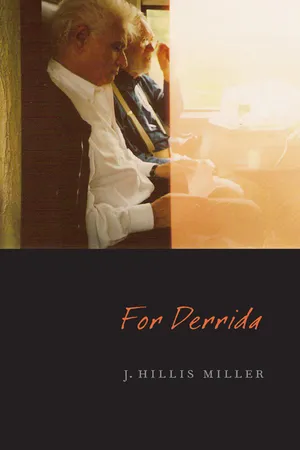
This book—the culmination of forty years of friendship between J. Hillis Miller and Jacques Derrida, during which Miller also closely followed all Derrida's writings and seminars—is "for Derrida" in two senses. It is "for him," dedicated to his memory. The chapters also speak, in acts of reading, as advocates for Derrida's work. They focus especially on Derrida's late work, including passages from the last, as yet unpublished, seminars. The chapters are "partial to Derrida," on his side, taking his part, gratefully submitting themselves to the demand made by Derrida's writings to be read—slowly, carefully, faithfully, with close attention to semantic detail.
The chapters do not progress forward to tell a sequential story. They are, rather, a series of perspectives on the heterogeneity of Derrida's work, or forays into that heterogeneity.
The chief goal has been, to borrow a phrase from Wallace Stevens, "plainly to propound" what Derrida says. The book aims, above all, to render Derrida's writings justice. It should be remembered, however, that, according to Derrida himself, every rendering of justice is also a transformative interpretation. A book like this one is not a substitute for reading Derrida for oneself. It is to be hoped that it will encourage readers to do just that.
- 384 pages
- English
- ePUB (mobile friendly)
- Available on iOS & Android
eBook - ePub
For Derrida
About this book
Information
Publisher
Fordham University PressYear
2009Print ISBN
9780823230341
9780823230334
eBook ISBN
9780823230358
Topic
PhilosophySubtopic
Literary CriticismCHAPTER 1
A Profession of Faith
My first encounter with Jacques Derrida was a decisive moment in my life.1 I met him at the famous Johns Hopkins University international colloquium The Languages of Criticism and the Sciences of Man, in October 1966. I missed his lecture “Structure, Sign, and Play in the Discourse of the Human Sciences” (“La structure, le signe et le jeu dans le discours des sciences humaines”) (SSP, also in WD, 278–93; ED, 409–18). I could not go because I had a class to teach at that hour. I did hear, however, Derrida’s interventions in the discussions of other papers. I also read later, in the translated and published papers and discussions from the conference, his shocking (to me then) assertion, after his paper, in response to a challenge from a phenomenologist, Serge Doubrovsky, that “I don’t believe that anything like perception exists. … I don’t believe that there is any perception” (SSP, 272).
I met my colleague and friend Georges Poulet in the Hopkins quadrangle just after Derrida’s lecture. Poulet told me that Derrida’s lecture was opposed to everything to which his own work (that is, Poulet’s) was committed. Poulet at that time was writing on circles and centers, whereas Derrida’s talk was about decentering. Nevertheless, said Poulet, it was the most important lecture of the conference by far, even though Jacques Lacan, Roland Barthes, and many other distinguished intellectuals were also giving papers. I have always remembered Poulet’s insight and generosity in saying that. He was right. Derrida’s lecture marked the moment of the entry of so-called deconstruction into U.S. intellectual life. I had already, however, begun to read Derrida, on Eugenio Donato’s recommendation: the long, two-part essay published in Critique in December 1965 and January 1966 that was developed into the first part of Of Grammatology (De la grammatologie).
When Derrida came a couple of years later as a visiting professor to Hopkins, I went to his first seminar. I went just to see whether I could understand his spoken French. It was the seminar contrasting Plato on mimesis and Mallarmé’s “Mimique,” part of “The Double Session” (“La double séance”) (De, 175–285; Df, 201–317). I thought, and still think, it was an absolutely brilliant seminar. I still have somewhere the sheet he passed out juxtaposing “Mimique” and a passage from Plato’s Philebus. I faithfully attended Derrida’s seminars thereafter, first at Hopkins, then at Yale, then at the University of California at Irvine. We began to have lunch together at Hopkins and continued that practice for over forty years of unclouded friendship. Derrida and his writings have been major intellectual influences on me.
One of the strongest Derridean influences on my thinking has been his notion of the “wholly other.” This became a more and more salient motif in Derrida’s work. Just what he means by “the wholly other,” le tout autre, is not all that easy to grasp. For many people, it is even more difficult to accept or to endorse with a profession of faith or a pledge of allegiance. One way to approach the Derridean wholly other is by way of his distinction between sovereignty and unconditionality. Unconditionality is, for Derrida, a name for the research university’s hypothetical freedom from outside interference. Derrida defines the university’s unconditionality as the privilege without penalty to put everything in question, even to put in question the right to put everything in question.
In the interview with Derek Attridge that forms the first essay in the volume of Derrida’s essays on literature Attridge gathered in English translation and called Acts of Literature (AL, 33–75), Derrida defines literature in much the same way as he defines the university in more recent lectures, for example, in “The University Without Condition” (L’Université sans condition), originally a Presidential Lecture at Stanford, and in a related essay, the speech he gave on receiving an honorary degree from the University of Pantion in Athens in 1999. That essay is entitled “Inconditionalité ou souveraineté: L’Université aux frontiers de l’Europe” (IS, 14–67).
Both lectures are based on a fundamental distinction between sovereignty and what Derrida calls (the word is a neologism in English) “unconditionality.” What is the difference? Sovereignty, says Derrida, is a theologically based “phantasm.” It is something that looks like it is there, but is not there. Sovereignty has three features. (1) The sovereign is above the law. He or she is free to subvert the law, as in the act of pardon. (2) The concept of sovereignty cannot be dissociated from the idea of the nation-state. (3) The sovereign is God’s vicar, appointed by God, authorized by God. Even in a country like the United States, a country that was founded on the principle of the separation of church and state, the Pledge of Allegiance to the flag defines the United States as “one nation, under God.” All U.S. citizens were exhorted to sing “God Bless America” after the World Trade Center destruction of 9/11. George W. Bush apparently thinks of himself as appointed by God to preserve the United States from the “threat of terrorism.” Such assumptions are a “phantasm,” a ghost in broad daylight, since no verifiable data exists on which to base an assumption that God is on the United States’ side, any more than any data exists supporting the “terrorists’” assumption that Allah was on their side when they blew up the World Trade Center towers, or when they kill another American soldier in Iraq. Being told that sovereignty is a phantasm by no means cures one of faith in it. Far from it. The ghost of sovereignty always returns, as a “revenant.”
Unconditionality has, apparently, no such suspect theological basis. Literature is dependent in its modern form on the rise of constitutional democracies in the West from the seventeenth century on, and on the unconditional democratic freedom to say anything, to put everything in question. Such a democracy is, of course, never wholly established in fact. It is always “to come”:
“What is literature?” [asks Derrida]; literature as historical institution with its conventions, rules, etc., but also this institution of fiction which gives in principle the power to say everything, to break free of the rules, to displace them, and thereby to institute, to invent and even to suspect the traditional difference between nature and institution, nature and conventional law, nature and history. Here we should ask juridical and political questions. The institution of literature in the West, in its relatively modern form, is linked to an authorization to say everything, and doubtless too to the coming about of the modern idea of democracy. Not that it depends on a democracy in place, but it seems inseparable to me from what calls forth a democracy, in the most open (and doubtless itself to come) sense of democracy. (AL, 37)
Such a definition of literature allows us to understand better the role of the comme si or “as if” in “The University Without Condition.” Literature, or what Derrida here calls “fiction,” can always respond (or refuse to respond) by saying: that was not I speaking as myself, but as an imaginary personage speaking in a work of fiction, by way of a comme si. You cannot hold me responsible for my “as ifs.” Derrida says just this in passages that follow the one just quoted:
What we call literature (not belles-lettres or poetry) implies that license is given to the writer to say everything he wants or everything he can, while remaining shielded, safe from all censorship, be it religious or political. … This duty of irresponsibility, of refusing to reply for one’s thought or writing to constituted powers, is perhaps the highest form of responsibility. To whom, to what? That’s the whole question of the future or the event promised by or to such an experience, what I was just calling the democracy to come. Not the democracy of tomorrow, not a future democracy which will be present tomorrow but one whose concept is linked to the to-come [àvenir, cf. avenir, “future” (Attridge’s note)], to the experience of a promise engaged, that is always an endless promise. (AL, 37, 38)
Crucial in the passage just cited is the “To whom, to what?” How can a refusal to take responsibility, a refusal addressed to sovereign state powers, be defined as “perhaps the highest form of responsibility”? To whom or to what else can it have a higher obligation? I shall discuss these questions further in Chapters 2 and 9. I say now, however, that Derrida’s answer to this question goes by way of the new concept of performative language he proposes in “Psyche: Invention of the Other” (“Psyché: Invention de l’autre”; Pe, 46; Pf, 61), and again as the climax of “The University Without Condition.” It might seem that literature, conceived by Derrida as an “as if,” as a free, unconditioned fiction, would correspond to a concept of literature as ungrounded performative speech acts, speech acts based neither on previously existing institutionalized sanctions nor on the authority of the “I” who utters the speech act. The title of the honorary degree lecture in Athens is “Inconditionalité ou souveraineté,” “Unconditionality or Sovereignty” (my emphasis). “The University Without Condition” distinguishes sharply between the phantasm of theologically based state sovereignty and the unfettered, “unconditioned” liberty to put everything in question in the ideal university, the university without condition. Such a university, like a truly democratic state, is always “to come.” Derrida seems to pledge allegiance to, or, to use his own expression, make a “profession of faith in,” a stark either/or. His word profession alludes, of course, to the academic title of “professor.” A professor professes faith in the validity of what he or she teaches or writes. The ou or “or” in Derrida’s title opposes always-illegitimate sovereignty to unconditional freedom.
This unconditionality, it might seem, is especially manifested in literary study. Literature, as institutionalized in the West in the last three centuries, is, according to Derrida, itself unconditioned, irresponsible, free to say anything. Literature is an extreme expression of the right to free speech. To study literature is to profess faith in literature’s unconditionality.
Matters, however, are not quite so simple. In the last section of “The University Without Condition,” in the seventh summarizing proposition, Derrida makes one further move that undoes all he has said so far about the university’s unconditionality. He poses a “hypothesis” that he admits may not be “intelligible” (UCe, 236; UCf, 79) to his Stanford audience. Derrida admits, in a quite unusual confession, that what he asserts is not easy to understand. It is. What he says is based on a hypothesis that is prima facie highly unlikely, “extremely difficult, and almost im-probable, inaccessible to proof [extrêmement difficile et presque im-probable, inaccessible à une preuve]” (UCe, 235; UCf, 76). What he proposes, that is, is contrary to a true scientific hypothesis. A bona fide hypothesis can be proved to be false, if it is false.
What is this strange hypothesis? It is the presupposition that the unconditional independence of thinking in the university depends on a strange and anomalous speech act that brings about what Derrida calls an “event” or “the eventual [l’éventuel]” (UCe, 235; UCf, 76). Such a speech act is anomalous both because it does not depend upon pre-existing rules, authorities, and contexts, as a felicitous Austinian speech act does, and also because it does not posit freely, autonomously, lawlessly, outside all such pre-existing contexts, as, for example, de Manian speech acts might seem to do, or as judges do in Austin’s surprising and even scandalous formula: “As official acts, the judge’s ruling makes law.”2
No, the performative speech act Derrida has in mind is a response to the call of what Derrida calls le tout autre, the wholly other. Such a response is to some degree passive or submissive. It obeys a call or command. All we can do is profess faith in the call or pledge allegiance to it. Only such a speech act constitutes a genuine “event” that breaks the predetermined course of history. Such an event is “impossible.” It is always an uncertain matter of what, Derrida recalls, Nietzsche calls “the dangerous modality of the ‘perhaps’ [peut-être]” (UCe, 234; UCf, 75). Nevertheless, says Derrida, “only the impossible can arrive” (UCe, 234; UCf, 74). That is why Derrida speaks of “the possible event of the impossible unconditional, the altogether other [le possible événement de l’inconditionnel impossible, le tout autre]” (UCe, 235; UCf, 76). Derrida is playing here on the root sense of event as something that comes, that arrives. It appears of its own accord and in its own good time. We can only say, “yes” or, perhaps, “no,” to it. We cannot call it. It calls us.
What is “the wholly other”? Derrida works out in detail, in “Psyche: Invention of the Other,” what he means by “invention” as discovery, as uncovering rather than making up, and what he means by “the wholly other.” For my purposes here, however, the crucial text is The Gift of Death. In that book Derrida makes spectacular readings of the story of Abraham and Isaac in Genesis, of Kierkegaard’s Fear and Trembling, and of Melville’s “Bartleby the Scrivener.” Derrida defines the wholly other, at least at a moment when he is paraphrasing St. Paul, in ways that identify it with a certain conception of God, a deity “absent, hidden and silent, separate, secret, at the moment he has to be obeyed” (GD, 57; DM, 83). The wholly other is identified by Derrida with the secret in general, and with death, the gift of death, death as always my own solitary death, and as wholly other to my knowledge. Derrida says:
Without knowing from whence the thing comes and what awaits us, we are given over to absolute solitude. No one can speak with us and no one can speak for us; we must take it upon ourselves, each of us must take it upon himself [prendre sur soi] (auf sich nehmen as Heidegger says concerning death, our death, concerning what is always “my death,” and which no one can take on [se charger] in place of me). (GD, 57; DM, 83)
The wholly other is also manifested, without manifesting itself, in the total inaccessibility of the secrets in the hearts of other people: “Every other (one) is every (bit) other [tout autre est tout autre; Derrida’s emphasis], every one else is completely or wholly other. The simple concepts of alterity and of singularity constitute the concept of duty as much as that of responsibility. As a result, the concepts of responsibility, of decision, or of duty, are condemned a priori to paradox, scandal, and aporia” (GD, 68; DM, 98). I shall return in Chapters 2 and 9 to more extended investigations of this paradox, scandal, and aporia.
Included in this concept of the wholly other is literature. Literature too hides impenetrable secrets. A work of literature too is a response to a wholly other that strongly recalls the relation of literature to death in Blanchot’s “Literature and the Right to Death.”3 This is made explicit in Derrida’s reading of Melville’s “Bartleby the Scrivener” in The Gift of Death, but also in an essay added to Donner la mort when it was published in book form in French, now included in the second English edition. In this essay, entitled “Literature in Secret: An Impossible Filiation” (“La literature au secret: Une filiation impossible”), further discussing Abraham and Isaac, Kierkegaard, and Kafka, Derrida reaches the surprising conclusions not only that literature hides secrets that cannot be revealed but also that literature is both irresponsible and at the same time works by “increasing in inverse proportion, to infinity, responsibility for the singular event constituted by every work (a void and infinite responsibility, like that of Abraham)” (LS 156; DM, 206). Literature, so defined, is the unfaithful inheritor of a theological legacy without which it could not exist:
literature surely inherits from a holy history within which the Abrahamic moment remains the essential secret (and who would deny that literature remains a remainder [reste un reste] of religion, a link to and relay for what is sacrosanct in a society without God?), while at the same time denying that history, that belonging, that heritage. It denies that filiation. It betrays it in the double sense of the word: it is unfaithful to it, breaking with it at the very moment when it reveals its “truth” and uncovers its secret. Namely that of its own filiation: impossible possibility. (LS 157; DM, 208, trans. modified)
It is only necessary to add, to what Derrida says here, that literary study, as institutionalized in the university, is especially the place where the responsible/irresponsibility of literature, its unconditionality, is received or “professed” by professors and passed on to students. One small example: the dissident notions of state sovereignty in E. M. Forster’s Howards End.4
I have now professed, in the sense of specifying and transmitting, Derrida’s notions of sovereignty and unconditionality. I have done this, however, apparently at the cost of blurring the distinction between theologically based state sovereignty and the unconditional freedom of the university and of literary study within the university. Both, in the end, seem to be theological or quasi-theological concepts. What is the difference?
That difference is easy to see, but perhaps not all that easy to accept. The distinction is “im-probable” and “not provable,” though it is essential to Derrida’s thinking. For Derrida, and for me too, all claims by earthly sovereigns, such as those made implicitly by George W. Bush, to wield power by mandate from God are phantasms. They claim to see and to respond to something that is not there. A work of literature, on the other hand, and therefore the teaching of that work in a “university without condition,” if there ever were to be such a thing, are responses to a call or command from the wholly other that is both impossible and yet may perhaps arrive. Each literary work is entirely singular, “counter, original, spare, strange,” as Gerard Manley Hopkins puts it.5 Each work is as different from every other work as each person differs from all others, or as each leaf differs from all others. When I as reader or teacher respond to the wholly other as embodied in a literary work and try to mediate it to m...
Table of contents
- Cover Page
- Title Page
- Copyright Page
- Contents
- Abbreviations of Works by Jacques Derrida
- Preface
- Acknowledgments
- 1. A Profession of Faith
- 2. Who or What Decides, for Derrida: A Catastrophic Theory of Decision
- 3. Derrida’s Destinerrance
- 4. The Late Derrida
- 5. Derrida’s Remains
- 6. Derrida Enisled
- 7. Derrida’s Special Theory of Performativity
- 8. “Don’t Count Me In”: Derrida’s Refraining
- 9. Derrida’s Ethics of Irresponsibilization; or, How to Get Irresponsible, in Two Easy Lessons
- 10. Derrida’s Politics of Autoimmunity
- 11. Touching Derrida Touching Nancy
- 12. Absolute Mourning: It Is Jacques You Mourn For
- Notes
- Index
Trusted by 375,005 students
Access to over 1.5 million titles for a fair monthly price.
Study more efficiently using our study tools.
Frequently asked questions
Yes, you can cancel anytime from the Subscription tab in your account settings on the Perlego website. Your subscription will stay active until the end of your current billing period. Learn how to cancel your subscription
No, books cannot be downloaded as external files, such as PDFs, for use outside of Perlego. However, you can download books within the Perlego app for offline reading on mobile or tablet. Learn how to download books offline
Perlego offers two plans: Essential and Complete
- Essential is ideal for learners and professionals who enjoy exploring a wide range of subjects. Access the Essential Library with 800,000+ trusted titles and best-sellers across business, personal growth, and the humanities. Includes unlimited reading time and Standard Read Aloud voice.
- Complete: Perfect for advanced learners and researchers needing full, unrestricted access. Unlock 1.5M+ books across hundreds of subjects, including academic and specialized titles. The Complete Plan also includes advanced features like Premium Read Aloud and Research Assistant.
We are an online textbook subscription service, where you can get access to an entire online library for less than the price of a single book per month. With over 1.5 million books across 990+ topics, we’ve got you covered! Learn about our mission
Look out for the read-aloud symbol on your next book to see if you can listen to it. The read-aloud tool reads text aloud for you, highlighting the text as it is being read. You can pause it, speed it up and slow it down. Learn more about Read Aloud
Yes! You can use the Perlego app on both iOS and Android devices to read anytime, anywhere — even offline. Perfect for commutes or when you’re on the go.
Please note we cannot support devices running on iOS 13 and Android 7 or earlier. Learn more about using the app
Please note we cannot support devices running on iOS 13 and Android 7 or earlier. Learn more about using the app
Yes, you can access For Derrida by J. Hillis Miller in PDF and/or ePUB format, as well as other popular books in Philosophy & Literary Criticism. We have over 1.5 million books available in our catalogue for you to explore.