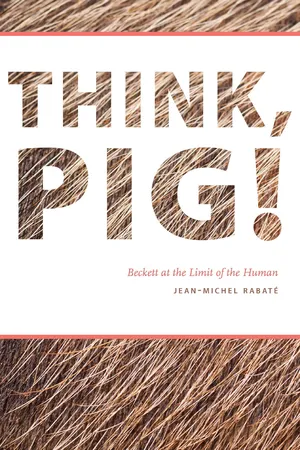
This book examines Samuel Beckett's unique lesson in courage in the wake of humanism's postwar crisis—the courage to go on living even after experiencing life as a series of catastrophes.
Rabaté, a former president of the Samuel Beckett Society and a leading scholar of modernism, explores the whole range of Beckett's plays, novels, and essays. He places Beckett in a vital philosophical conversation that runs from Bataille to Adorno, from Kant and Sade to Badiou. At the same time, he stresses Beckett's inimitable sense of metaphysical comedy.
Foregrounding Beckett's decision to write in French, Rabaté inscribes him in a continental context marked by a "writing degree zero" while showing the prescience and ethical import of Beckett's tendency to subvert the "human" through the theme of the animal. Beckett's "declaration of inhuman rights," he argues, offers the funniest mode of expression available to us today.
- 248 pages
- English
- ePUB (mobile friendly)
- Available on iOS & Android
eBook - ePub
About this book
Information
Publisher
Fordham University PressYear
2016Print ISBN
9780823270866
9780823270859
eBook ISBN
9780823270873
Table of contents
- Cover
- Title Page
- Copyright
- Contents
- Introduction
- 1. How to Think Like a Pig
- 2. The Worth and Girth of an Italian Hoagie
- 3. The Posthuman, or the Humility of the Earth
- 4. Burned Toasts and Boiled Lobsters
- 5. “Porca Madonna!”: Moving Descartes toward Geulincx and Proust
- 6. From an Aesthetics of Nonrelation to an Ethics of Negation
- 7. Beckett’s Kantian Critiques
- 8. Dialectics of Enlittlement
- 9. Bathetic Jokes, Animal Slapstick, and Ethical Laughter
- 10. Strength to Deny: Beckett between Adorno and Badiou
- 11. Lessons in Pigsty Latin: The Duty to Speak
- 12. An Irish Paris Peasant
- 13. The Morality of Form—A French Story
- Coda: Minima Beckettiana
- Acknowledgments
- Notes
- Index
Trusted by 375,005 students
Access to over 1.5 million titles for a fair monthly price.
Study more efficiently using our study tools.
Frequently asked questions
Yes, you can cancel anytime from the Subscription tab in your account settings on the Perlego website. Your subscription will stay active until the end of your current billing period. Learn how to cancel your subscription
No, books cannot be downloaded as external files, such as PDFs, for use outside of Perlego. However, you can download books within the Perlego app for offline reading on mobile or tablet. Learn how to download books offline
Perlego offers two plans: Essential and Complete
- Essential is ideal for learners and professionals who enjoy exploring a wide range of subjects. Access the Essential Library with 800,000+ trusted titles and best-sellers across business, personal growth, and the humanities. Includes unlimited reading time and Standard Read Aloud voice.
- Complete: Perfect for advanced learners and researchers needing full, unrestricted access. Unlock 1.5M+ books across hundreds of subjects, including academic and specialized titles. The Complete Plan also includes advanced features like Premium Read Aloud and Research Assistant.
We are an online textbook subscription service, where you can get access to an entire online library for less than the price of a single book per month. With over 1.5 million books across 990+ topics, we’ve got you covered! Learn about our mission
Look out for the read-aloud symbol on your next book to see if you can listen to it. The read-aloud tool reads text aloud for you, highlighting the text as it is being read. You can pause it, speed it up and slow it down. Learn more about Read Aloud
Yes! You can use the Perlego app on both iOS and Android devices to read anytime, anywhere — even offline. Perfect for commutes or when you’re on the go.
Please note we cannot support devices running on iOS 13 and Android 7 or earlier. Learn more about using the app
Please note we cannot support devices running on iOS 13 and Android 7 or earlier. Learn more about using the app
Yes, you can access Think, Pig! by Jean-Michel Rabaté in PDF and/or ePUB format, as well as other popular books in Literature & Modern Literary Criticism. We have over 1.5 million books available in our catalogue for you to explore.