This book examines the affinity between "theory" and "deconstruction" that developed in the American academy in the 1970s by way of the "Yale Critics": Harold Bloom, Paul de Man, Geoffrey Hartman, and J. Hillis Miller, sometimes joined by the French philosopher Jacques Derrida.
With this semi-fictional collective, theory became a media event, first in the academy and then in the wider print media, in and through its phantasmatic link with deconstruction and with "Yale." The important role played by aesthetic humanism in American pedagogical discourse provides a context for understanding theory as an aesthetic scandal, and an examination of the ways in which de Man's work challenges aesthetic pieties helps us understand why, by the 1980s, he above all had come to personify "theory."
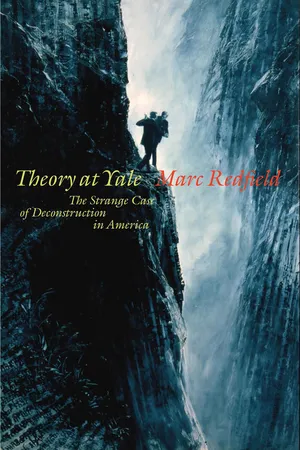
Combining a broad account of the "Yale Critics" phenomenon with a series of careful reexaminations of the event of theory, Redfield traces the threat posed by language's unreliability and inhumanity in chapters on lyric, on Hartman's representation of the Wordsworthian imagination, on Bloom's early theory of influence in the 1970s together with his later media reinvention as the genius of the Western Canon, and on John Guillory's influential attempt to interpret de Manian theory as a symptom of literature's increasing marginality. A final chapter examines Mark Tansey's paintings Derrida Queries de Man and Constructing the Grand Canyon, paintings that offer subtle, complex reflections on the peculiar event of theory-as-deconstruction in America.
- 272 pages
- English
- ePUB (mobile friendly)
- Available on iOS & Android
eBook - ePub
About this book
Information
Publisher
Fordham University PressYear
2015Print ISBN
9780823268672
9780823268665
eBook ISBN
9780823268689
Topic
PhilosophySubtopic
European Literary CriticismTable of contents
- Contents
- Introduction
- 1. Theory, Deconstruction, and the Yale Critics
- 2. Theory and Romantic Lyric
- 3. What Remains
- 4. Literature, Incorporated
- 5. Professing Theory
- 6. Querying, Quarrying
- Acknowledgments
- Notes
- Index
Trusted by 375,005 students
Access to over 1.5 million titles for a fair monthly price.
Study more efficiently using our study tools.
Frequently asked questions
Yes, you can cancel anytime from the Subscription tab in your account settings on the Perlego website. Your subscription will stay active until the end of your current billing period. Learn how to cancel your subscription
No, books cannot be downloaded as external files, such as PDFs, for use outside of Perlego. However, you can download books within the Perlego app for offline reading on mobile or tablet. Learn how to download books offline
Perlego offers two plans: Essential and Complete
- Essential is ideal for learners and professionals who enjoy exploring a wide range of subjects. Access the Essential Library with 800,000+ trusted titles and best-sellers across business, personal growth, and the humanities. Includes unlimited reading time and Standard Read Aloud voice.
- Complete: Perfect for advanced learners and researchers needing full, unrestricted access. Unlock 1.5M+ books across hundreds of subjects, including academic and specialized titles. The Complete Plan also includes advanced features like Premium Read Aloud and Research Assistant.
We are an online textbook subscription service, where you can get access to an entire online library for less than the price of a single book per month. With over 1.5 million books across 990+ topics, we’ve got you covered! Learn about our mission
Look out for the read-aloud symbol on your next book to see if you can listen to it. The read-aloud tool reads text aloud for you, highlighting the text as it is being read. You can pause it, speed it up and slow it down. Learn more about Read Aloud
Yes! You can use the Perlego app on both iOS and Android devices to read anytime, anywhere — even offline. Perfect for commutes or when you’re on the go.
Please note we cannot support devices running on iOS 13 and Android 7 or earlier. Learn more about using the app
Please note we cannot support devices running on iOS 13 and Android 7 or earlier. Learn more about using the app
Yes, you can access Theory at Yale by Marc Redfield in PDF and/or ePUB format, as well as other popular books in Philosophy & European Literary Criticism. We have over 1.5 million books available in our catalogue for you to explore.