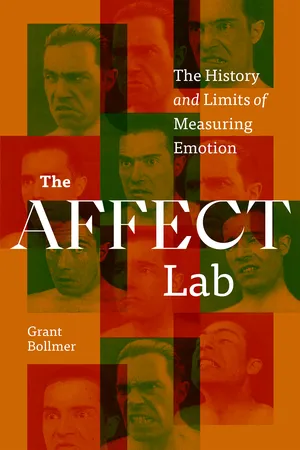
The Affect Lab
eBook - ePub

The Affect Lab

The History and Limits of Measuring Emotion

  1. English
  2. ePUB (mobile friendly)
  3. Available on iOS & Android
eBook - ePub

The Affect Lab

The History and Limits of Measuring Emotion

About this book

Examines how our understanding of emotion is shaped by the devices we use to measure it


Since the late nineteenth century, psychologists have used technological forms of media to measure and analyze emotion. In The Affect Lab, Grant Bollmer examines the use of measurement tools such as electrical shocks, photography, video, and the electroencephalograph to argue that research on emotions has confused the physiology of emotion with the tools that define its inscription. 


Bollmer shows that the psychological definitions of emotion have long been directly shaped by the physical qualities of the devices used in laboratory research. To investigate these devices, The Affect Lab examines four technologies related to the history of psychology in North America: spiritualist toys at Harvard University, serial photography in early American psychological laboratories, experiments on “psychopaths” performed with an instrument called an Offner Dynograph, and the development of the “electropsychometer,” or “E-Meter,” by Volney Mathison and L. Ron Hubbard. 


Challenging the large body of humanities research surrounding affect theory, The Affect Lab identifies an understudied problem in formulations of affect: how affect is a construction inseparable from the techniques and devices used to identify and measure it. Ultimately, Bollmer offers a new critique of affect and affect theory, demonstrating how deferrals to psychology and neuroscience in contemporary theory and philosophy neglect the material of experimental, scientific research.


Retail e-book files for this title are screen-reader friendly with images accompanied by short alt text and/or extended descriptions.

Frequently asked questions

Yes, you can cancel anytime from the Subscription tab in your account settings on the Perlego website. Your subscription will stay active until the end of your current billing period. Learn how to cancel your subscription.
No, books cannot be downloaded as external files, such as PDFs, for use outside of Perlego. However, you can download books within the Perlego app for offline reading on mobile or tablet. Learn more here.
Perlego offers two plans: Essential and Complete
  • Essential is ideal for learners and professionals who enjoy exploring a wide range of subjects. Access the Essential Library with 800,000+ trusted titles and best-sellers across business, personal growth, and the humanities. Includes unlimited reading time and Standard Read Aloud voice.
  • Complete: Perfect for advanced learners and researchers needing full, unrestricted access. Unlock 1.4M+ books across hundreds of subjects, including academic and specialized titles. The Complete Plan also includes advanced features like Premium Read Aloud and Research Assistant.
Both plans are available with monthly, semester, or annual billing cycles.
We are an online textbook subscription service, where you can get access to an entire online library for less than the price of a single book per month. With over 1 million books across 1000+ topics, we’ve got you covered! Learn more here.
Look out for the read-aloud symbol on your next book to see if you can listen to it. The read-aloud tool reads text aloud for you, highlighting the text as it is being read. You can pause it, speed it up and slow it down. Learn more here.
Yes! You can use the Perlego app on both iOS or Android devices to read anytime, anywhere — even offline. Perfect for commutes or when you’re on the go.
Please note we cannot support devices running on iOS 13 and Android 7 or earlier. Learn more about using the app.
Yes, you can access The Affect Lab by Grant Bollmer in PDF and/or ePUB format, as well as other popular books in Psychology & Emotions in Psychology. We have over one million books available in our catalogue for you to explore.

Table of contents

  1. Cover
  2. Title Page
  3. Copyright
  4. Contents
  5. Introduction: Techniques of the Affect Lab
  6. 1. William James’s Planchette
  7. 2. Books of Faces
  8. 3. The Prison Dynograph
  9. 4. E-Meter Metaphysics
  10. Conclusion: The Epistemology and Aesthetics of Empathy
  11. Acknowledgments
  12. Notes
  13. Bibliography
  14. Index
  15. Figure Descriptions
  16. About the Author