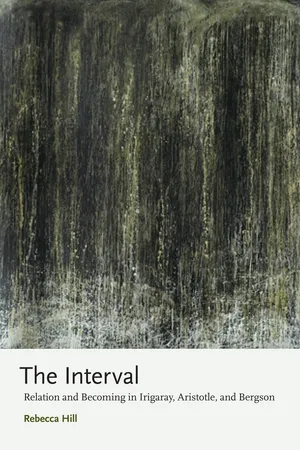
The Interval offers the first sustained analysis of the concept grounding Irigaray's thought: the constitutive yet incalculable interval of sexual difference. In an extension of Irigaray's project, Hill takes up her formulation of the interval as a way of rereading Aristotle's concept of topos and Bergson's concept of duration.
Hill diagnoses a sexed hierarchy at the heart of Aristotle's and Bergson's presentations. Yet beyond that phallocentrism, she points out how Aristotle's theory of topos as a sensible relation between two bodies that differ in being and Bergson's intuition of duration as an incalculable threshold of becoming are indispensable to the feminist effort to think about sexual difference.
Reading Irigaray with Aristotle and Bergson, Hill argues that the interval cannot be grasped as a space between two identities; it must be characterized as the sensible threshold of becoming, constitutive of the very identity of beings. The interval is the place of the possibility of sexed subjectivity and intersubjectivity; the interval is also a threshold of the becoming of sexed forces.
- 198 pages
- English
- ePUB (mobile friendly)
- Available on iOS & Android
eBook - ePub
About this book
Information
Publisher
Fordham University PressYear
2014Print ISBN
9780823262731
9780823237241
eBook ISBN
9780823263912
Topic
PhilosophySubtopic
Philosophy History & TheoryPART I
Relations
1. The Oblivion of the Interval
Whenever he [the Egyptian king, Sesostris] encountered a courageous enemy who fought valiantly for freedom, he erected pillars on the spot inscribed with his own name and country, and a sentence to indicate that by the might of his armed forces he had won the victory; if, however, a town fell easily into his hands without a struggle, he made an addition to the inscription on the pillar—for not only did he record on it the same facts as before, but added a picture of a woman’s genitals, meaning to show that the people of that town were no braver than women.
HERODOTUS 1972, 104
The ethics of sexual difference are persistent and to come. In all patriarchal cultures, all classes. . . .
SPIVAK 1993, 191
TO BEGIN A WORK ON THE INTERVAL—an interval that exceeds and precedes any designation of identity and would serve as the threshold of nonhierarchical sexual difference—with a close reading of Aristotle might be read as a pedestrian gesture. This would be the case if I presented him as a “straw man,” the predictable villain for poststructuralist feminisms and thinkers of difference. After all, he is widely credited with formalizing dichotomous logic, and his work is infamously explicit about woman’s servile relation to man (1254b13–4).1 While I do not dispute these assessments of Aristotle, I do not begin with his philosophy merely to condemn him. On the contrary, following Irigaray’s reading, I want to draw out a more interesting Aristotle. I want to consider what he has to offer to the theorization of the interval of sexual difference in excess of his misogyny.2 Aristotle’s metaphysics are understood here as an invaluable resource in the difficult task of articulating the place of the interval of sexual difference.
This chapter is concerned primarily with Aristotle’s formalization of the relationship between identity and difference. I argue that his philosophy is highly ambivalent toward the interval. On the one hand, difference is subordinate to the identities of his cherished categories of being. On the other hand, there are moments in his discourse in which the interval is affirmed in excess of any designation of being.
His theorization of the relationship between identity (to auto) and difference (diaphora) is figured in sexuate terms. More precisely, his valorization of the identities of the concepts of substance (ousia), physis, and form (eidos, morphē) are presented as masculine, and his devaluation of matter (hylē) and privation (sterēsis)—their supposed opposites—are aligned with the feminine. As we will see, this sexed hierarchy is undermined by the moments in his discourse in which difference erupts beyond the constraints of the identities of the categories.
Toward the end of this chapter, I read the contradictory figuration of difference in Aristotle in relation to Irigaray’s critical description of his metaphysics in her early work, “How to Conceive (of) a Girl?” (S, 160–67 / SA, 200–09). In this essay, Irigaray shows how the “highest” concepts of his ontology—substance, physis, and form—are obliquely dependent on their devalued “opposites.” I argue that “How to Conceive (of) a Girl?” is both a critique and a subversion of Aristotle. Irigaray makes explicit the phallocentrism enmeshed in his articulation of dichotomous logic and displaces the very functioning of that logic. Traces of the maternal-feminine overflow the limits of his ontology. This overflow, which cannot be presented as such, serves as the groundless ground of his project.
THE VIOLENCE OF BINARY LOGIC
As is well known, binary oppositions are logical contradictories symbolized by the relation of A and Not-A. The structure of this logic is formalized by Aristotle through the law of noncontradiction. He writes that “the same attribute cannot at the same time belong and not belong to the same subject in the same respect” (1005a20). This means that one side of a contradictory (A) is always true while the other side (Not-A) is necessarily false. For example, the following statements are mutually exclusive: “he is sitting” and “he is not sitting” (11b23; 13b2).
Binary oppositions are characterized by the law of excluded middle, which prohibits the existence of a middle position between opposed propositions or terms. The excluded middle is the necessary empty space that separates A from Not-A (Jay 1981, 45). Its role is to keep A as a discrete identity uncontaminated by the infinitation of the negative characteristic of Not-A. As John Dewey writes, “If, say, ‘virtue’ be assigned to A as its meaning, then Not-A includes not only vice, but triangles, horseraces, symphonies and the procession of the equinoxes.”3 Here “Not-virtue” is denied specificity, except as the absence of A.
The excluded middle is supposed to maintain A as a discrete identity uncontaminated by the infinitation of the negative that defines Not-A. Yet, as critics of binary thought point out, A depends on Not-A to have meaning. A would have no identity as A without the designation of Not-A as its excluded other. In this sense, Not-A is not external to A but constitutive of its very identity. Thus, despite Aristotle’s intentions, his cherished principle of excluded middle does not hold. I will analyze the implications of this unacknowledged dependence below, when I discuss Irigaray’s reading of the fundamental role of the maternal in secretly grounding his metaphysics.
Aristotle does present a number of modalities of opposition that do not conform to binary structure. For instance, correlative oppositions are not binaries. They express a quantitative relation between terms, such as the double of a sum (6a36–b1). Both the double and the original sum have specific identities, which are not obviously hierarchical. Perhaps one could argue that the double is subordinate to the figure from which it is posited because the original sum must be articulated first in order for the double to have meaning. Even so, a hierarchy of this kind cannot be reduced to a binary opposition, because in a binary the devalorized term is identified only as the negation of its privileged opposite. In contrast, a figure posited in relation to another sum has a particular identity: a double is two times a unit.
There is no question that Aristotle figures possessions and privations hierarchically. For instance, in the Categories, blindness is presented as the absence of sight (12a26–28). Here, privation designates a specific and circumscribable lack. We would not speak of moles as blind because “healthy” animals in this species do not have eyes. The privation of sight, then, is predicated only of animals that lack a capacity others in his or her species possess. If privation designates a specific absence it does not, strictly speaking, fit into the A / Not-A relation found in a binary opposition, because the devalorized side of a binary is characterized by the infinitation of the negative. While Aristotle’s formulation of possessions and privations in the Categories does not conform to a binary structure, his use of privation is looser elsewhere in his oeuvre. Aristotle acknowledges that his use of privation is broad. As he says in the Metaphysics, “There are just as many kinds of privations as there are words with negative prefixes” (1022b33–4).
In the Categories oppositions of contrariety take two forms. First, there are contrarieties that allow middle terms between them, such as white and black. For instance, all of the colors on the spectrum between white and black are “intermediates” (metaxu or ana meson) (12a17–20). Second, there are oppositions of contrariety such as health and sickness that admit no intermediates (12a1–10). In both cases, the opposed terms are conferred with specific identities that can be symbolized as an A/B relation. Yet Aristotle regularly renders all contrarieties as binary oppositions. Why? Intermediates tend to dissolve into a dualism, because a middle term is readily assimilated to one side or other of an opposition (Derrida 1981, 43). And Aristotle regards all dichotomies as hierarchical. One side is positive, while its other is a mere negative (G. E. R. Lloyd 1966, 65; Jay 1981, 46). For example, in the oppositions of white/black and man/woman, the first term is privileged over its “opposite.” Significantly, both of the devalued terms named here—“black” and “woman”—become entangled with one another in Aristotle’s discourse. The confusion of these terms occurs because they are thought only in relation to their privileged “opposites” and denied specific contours. Paradoxically, by neglecting to circumscribe these terms in his philosophy, Aristotle grants them an omnipotent status. For example, Irigaray argues that woman is not situated, which means, ironically, that she is more or less everywhere (Irigaray IR, 169–71 / E, 17–8).
Jacques Derrida argues that the very nature of an opposition between two terms is tied to binary structure. This is why Derrida is wary of acknowledging “two” sexes. In his view, the figuration of two sexes tends to be structured according to the violent subordinating logic of (binary) dualism. For Derrida, man/woman is a hierarchical relation as long as it remains bound to the number “two.”4 Irigaray contends that binary oppositions do not involve two terms but one term (man) and its negated other (woman), and this second term, as I have said, has no identity specific to itself. This is one of the senses implied by her famous designation of woman as the sex that is Not-One (TS/CS).5 But first, how does Aristotle conceive of difference?
THE SUBORDINATION OF DIFFERENCE TO IDENTITY
In a move that many twentieth-century philosophers decry, Aristotle defines difference in subordination to the concept of identity. Indeed, as Martin Heidegger, Derrida, Gilles Deleuze, Bergson, and Irigaray have argued, the act of defining difference in these terms obscures the very possibility of thinking difference.6 For Irigaray, privileging identity over difference is the phallomorphic gesture par excellence. According to her argument, Aristotle’s figuration of identity is established in unconscious homage to the erect penis. This maneuver jettisons feminine sexuality, along with the thinking of difference, to theoretical oblivion.7
And yet, Aristotle’s position on the relation of difference and identity is by no means straightforward. In fact, there are tensions in his argument. There are in his discourse loci where difference emerges as nothing other than identity’s enabling condition. Aristotle’s project does not assimilate these moments of tension inhabiting his philosophy. But whether or not his system acknowledges these tensions is less important than their inscription in his oeuvre. Their legibility in his discourse is one of the reasons why Aristotle’s texts are so fascinating, not only to scholars interested in the history of difference in metaphysics but to the future of thought and to the future of thinking sexual difference.
In Metaphysics 5,8 Aristotle defines difference (diaphora) in the following terms:
(1) those things which though other [hetera] are the same [to auto] in some respect, only not in number but either in species [eidei] or in genus [genei] or by analogy; (2) those whose genus is other [heteron], and contraries, and all things that have their otherness [heterotēta] in their substance [ousia]. (Metaphysics 5.1018a12–14)
In the first instance, he specifies that difference must be understood on the basis of a more primordial sameness (to auto). Thus, man and woman are both of the same species-form (eidei) but different in respect of their sex, black and white are contraries and yet both are predicated of the genus of color, and a trumpet blast and the color scarlet are different, while they are both analogously “loud.” Second, Aristotle outlines an order of difference where there is generic otherness between two things. So, for example, Agamemnon’s act of sacrificing Iphigenia is different to a clock.9
While Aristotle does not entirely abandon the formulation of difference presented in Metaphysics 5, he circumscribes a more specific conception of difference by distinguishing it from otherness (allo) in Metaphysics 10. In this treatise, he declares that all existent things are either other or the same, and otherness does not depend on identity. In contrast, difference is properly spoken of on the basis of a primordial sameness.
But difference is not the same as otherness [allo]. For the other [heteron] and that from which it is other [heteron] than need not be other [heteron] in some definite respect [for everything that exists is either other or the same), but that which is different [diaphora] from anything is different in some respect, so that there must be something identical [to auto] whereby they differ. [My emphases] (Metaphysics 5:1054b23–26)
Here, Aristotle insists that difference properly so called presupposes a relation of identity or sameness (to auto). As I said a moment ago, identity can be spoken of in three ways: in terms of species, genus, or analogy. While in Metaphysics 5 Aristotle includes otherness in genus as a modality of difference, in this passage otherness in genus is excluded as a form of difference. For Aristotle, things that are merely other cannot be described as different, because they are too far distant from one another and have no point of comparison (1055a6–7). Thus, in Metaphysics 10, difference necessarily implies measurability and comparability, which can occur only if different things share a primary relation of sameness.10
Once Aristotle has established the primacy of identity (to auto) in defining difference in Metaphysics 10, he is able to specify what kind of difference is the “greatest” (megistē). He contends that contrariety is the greatest difference. This difference is greatest because it distinguishes the extremes from which the generation of species (eidos) take place (1055a5–15). While he does not deny that differences arise within species (for example, the distinction between a black and a white cat is a kind of difference), contrariety is a more important form of difference because it enables the emergence of distinct species.11 Things that differ in genus are not comparable, and this means that they fall outside the limits of greatest difference.12
The privilege that Aristotle grants to contrariety, as the greatest difference in Metaphysics 10, must be understood in relation to his preoccupation with establishing the definition of his highest category of being, substance (ousia), in Metaphysics 7, which, as Jonathon Lear’s helpful analysis makes clear, is the species-form (eidos) (286–87).13 Differentia and genus do not exist as independent elements apart from the species-form. In other words, they have actuality only through the ...
Table of contents
- Cover Page
- Title Page
- Copyright Page
- Contents
- List of Abbreviations
- Acknowledgments
- Introduction
- PART I. Relations
- PART II. Becoming
- Conclusion: Interval as Relation, Interval as Becoming
- Notes
- Bibliography
- Index
Trusted by 375,005 students
Access to over 1.5 million titles for a fair monthly price.
Study more efficiently using our study tools.
Frequently asked questions
Yes, you can cancel anytime from the Subscription tab in your account settings on the Perlego website. Your subscription will stay active until the end of your current billing period. Learn how to cancel your subscription
No, books cannot be downloaded as external files, such as PDFs, for use outside of Perlego. However, you can download books within the Perlego app for offline reading on mobile or tablet. Learn how to download books offline
Perlego offers two plans: Essential and Complete
- Essential is ideal for learners and professionals who enjoy exploring a wide range of subjects. Access the Essential Library with 800,000+ trusted titles and best-sellers across business, personal growth, and the humanities. Includes unlimited reading time and Standard Read Aloud voice.
- Complete: Perfect for advanced learners and researchers needing full, unrestricted access. Unlock 1.5M+ books across hundreds of subjects, including academic and specialized titles. The Complete Plan also includes advanced features like Premium Read Aloud and Research Assistant.
We are an online textbook subscription service, where you can get access to an entire online library for less than the price of a single book per month. With over 1.5 million books across 990+ topics, we’ve got you covered! Learn about our mission
Look out for the read-aloud symbol on your next book to see if you can listen to it. The read-aloud tool reads text aloud for you, highlighting the text as it is being read. You can pause it, speed it up and slow it down. Learn more about Read Aloud
Yes! You can use the Perlego app on both iOS and Android devices to read anytime, anywhere — even offline. Perfect for commutes or when you’re on the go.
Please note we cannot support devices running on iOS 13 and Android 7 or earlier. Learn more about using the app
Please note we cannot support devices running on iOS 13 and Android 7 or earlier. Learn more about using the app
Yes, you can access The Interval by Rebecca Hill in PDF and/or ePUB format, as well as other popular books in Philosophy & Philosophy History & Theory. We have over 1.5 million books available in our catalogue for you to explore.