At the start of the twenty-first century, 1 percent of the U.S. population is behind bars. An additional 3 percent is on parole or probation. In all but two states, incarcerated felons cannot vote, and in three states felon disenfranchisement is for life. More than 5 million adult Americans cannot vote because of a felony-class criminal conviction, meaning that more than 2 percent of otherwise eligible voters are stripped of their political rights. Nationally, fully a third of the disenfranchised are African American, effectively disenfranchising 8 percent of all African Americans in the United States. In Alabama, Kentucky, and Florida, one in every five adult African Americans cannot vote.
Punishment and Inclusion gives a theoretical and historical account of this pernicious practice of felon disenfranchisement, drawing widely on early modern political philosophy, continental and postcolonial political thought, critical race theory, feminist philosophy, disability theory, critical legal studies, and archival research into state constitutional conventions. It demonstrates that the history of felon disenfranchisement, rooted in postslavery restrictions on suffrage and the contemporaneous emergence of the modern "American" penal system, reveals the deep connections between two political institutions often thought to be separate, showing the work of membership done by the criminal punishment system and the work of punishment done by the electoral franchise.
Felon disenfranchisement is a symptom of the tension that persists in democratic politics between membership and punishment. This book shows how this tension is managed via the persistence of white supremacy in contemporary regimes of punishment and governance.
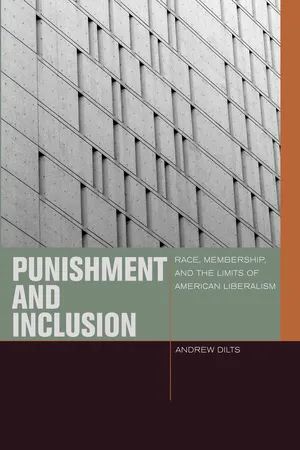
eBook - ePub
Punishment and Inclusion
Race, Membership, and the Limits of American Liberalism
- 352 pages
- English
- ePUB (mobile friendly)
- Available on iOS & Android
eBook - ePub
About this book
Information
Publisher
Fordham University PressYear
2014Print ISBN
9780823262427
9780823262410
eBook ISBN
9780823262434
1
A Productive Injustice
It might be helpful to start with some numbers. At the start of the twenty-first century, roughly 1 percent of the population of the United States is in jail or prison.1 Roughly 3 percent of the population of the United States is “on paper,” that is, on parole or probation.2 In forty-eight states and the District of Columbia, incarcerated felons cannot cast a vote; in thirty-five states, parolees cannot vote; in thirty of these, felons on probation cannot vote. In nine states, disenfranchisement may be permanent for certain offenses. And in three states—Kentucky, Virginia, and Iowa—disenfranchisement is for life. There are an estimated 5.3 million adult Americans who cannot vote because of a felony-class criminal conviction. Of these, over 2 million have completed their sentences in their entirety, while only about 1.3 million are actually incarcerated.3 In total, this is a little more than 2 percent of the voting-age population.4 A full third of the disenfranchised are African American, effectively disenfranchising nearly 8 percent of all adult African Americans in the United States. In Alabama, Kentucky, and Florida, one in every five adult African Americans cannot vote.5
The constitutionality of these restrictions on the right to vote is largely a settled question. On October 7, 2010, the full Ninth Circuit Court of Appeals ruled that the Voting Rights Act of 1965 does not prohibit criminal disenfranchisement, absent a showing of discriminatory intent in the adoption of disenfranchisement provisions.6 Should this case be appealed and heard by the Supreme Court, there is little reason to expect it to disagree. The 1974 standard set by the Court in Richardson v. Ramirez expressly rejected a similar Voting Rights Act claim, noting that Section 2 of the Fourteenth Amendment to the U.S. Constitution allows the abridgment of voting rights for “participation in rebellion, or other crime.” Provided that a disenfranchisement provision was not drawn up with explicit discriminatory intent, the courts have routinely insisted that a technically “color-blind” provision is entirely constitutional.
It is difficult to speak in generalities about felon disenfranchisement in the United States, as each state sets its own voting qualifications, governed only by a few federal mandates.7 As such, there is great variation among states as to which classes of persons (ex-felons, probationers, parolees) are allowed to vote. To an important degree, it is misleading to refer to this form of exclusion as specifically “felon disenfranchisement” as if it were a unified form of criminal disenfranchisement.8 This has led Department of Justice officials to characterize the mix of state laws as a “crazy-quilt” of policies.9 Nevertheless, a recent series of policy changes in Iowa is illustrative of how precarious the right to vote is for persons with felony convictions.
In 2005, former governor Thomas Vilsack of Iowa made national headlines when he issued Executive Order 42 on the Fourth of July that year. The order restored the voting rights of nearly eighty thousand Iowans who had completed criminal sentences. Prior to this moment, Iowa was one of only five states that permanently disenfranchised felons. The state’s first constitution, enacted in 1846, barred any person convicted of a felony or an “infamous crime” from holding office or casting a ballot. Vilsack’s order was heralded by voting rights activists and, in particular, was seen as a major advancement of African American voting rights. Iowa has one of the most racially disproportionate incarceration rates in the country. While constituting less than 3 percent of the state population, African Americans represent a full quarter of the state’s prison population. Prior to Vilsack’s order, the disenfranchisement rate for African Americans in the state was above 30 percent, the highest in the nation. What was perhaps more important was that Order 42 effectively ended ex-felon disenfranchisement in Iowa. The Iowa Department of Corrections was ordered to submit monthly lists of persons completing their sentences to the governor’s office for automatic and immediate voting rights restoration. As a result, an additional twenty thousand Iowans have regained their right to vote since then.
Yet within hours of Governor Terry Branstad’s inauguration on January 14, 2011, he fulfilled a campaign promise by rescinding Order 42, effectively ending automatic rights restoration. The estimated one hundred thousand Iowans who had been reenfranchised will not be affected, and so-called ex-felons are still eligible to apply to have their rights restored on a case-by-case basis. Such applications, however, can only be filed after an individual has fully paid all court costs, fines, and fees owed to the state. Such debt can easily reach tens of thousands of dollars, leading the Iowa-Nebraska State Conference of the NAACP to liken the process to a “modern day poll tax.”10 It is not alone in making such a comparison. Civil rights lawyer and author Michelle Alexander recently pointed to felon disenfranchisement as a key component of the “New Jim Crow” in the United States. “We have not ended racial caste in America,” she writes; “we have merely redesigned it.”11
The central question motivating this book is deceptively simple: what is the meaning of all this? What does it mean that Americans have, largely since the colonial period and most expansively during the later half of the nineteenth century, insisted again and again that the right to participation in collective self-government should be limited to people without criminal convictions? What does it mean to cast a vote under such conditions? What, to borrow a turn of phrase from Frederick Douglass, does it mean to be an American under the terms of felon disenfranchisement?
When I ask, “what does all this mean?” it is necessary to be clear what I do not mean. I do not mean, first of all, that this is about whether felon disenfranchisement is just or unjust under some specific terms of normative evaluation, although this is necessarily a question with which we will have to grapple. I do not mean to ask what social, economic, or political variables predict which states are most likely to disenfranchise felons.12 Nor do I mean to discover the estimated electoral effects of disenfranchisement provisions.13 And while there is a great deal to be said about the recent developments in Iowa and Florida and at various levels of the U.S. appellate court system, I do not mean narrowly to explain why various governors have issued the orders that they have or why various courts have issued the opinions that they have.14
I mean something else, something that intentionally steps back from the expressly normative and empirical questions about felon disenfranchisement and asks what this practice tells us about American liberalism as an organizing public ideology and, in particular, what it reveals about the relationship between punishment and citizenship under the terms of American liberalism.15 To ask the question in this way, focusing on the social and political meaning of felon disenfranchisement, is to ask about the work of felon disenfranchisement, for those whom it directly affects and also for the subterranean but no less important work it does for those who remain identified as free and upstanding citizens. In the end, it is necessarily a way of asking what the practice tells us about the American political condition generally and about the productive limits of American liberalism’s reliance on specific understandings of justice, inclusion, punishment, and membership.
I argue that felon disenfranchisement does not tell us very good things about living in the United States in the early years of the twenty-first century. This kind of academic focus tells us (if we limit “us” to those persons who have not been barred from the ballot box) that we continue to live in a racial caste system, that we fail to live up to our liberal ideals, that we trip over our commitments to civic republicanism, that we criminalize others who are different, that we treat each other as means toward our own ends of social and political equality, and most troubling of all, that we do so through one of our most cherished and sacred institutions: the franchise. Yet the deeper paradox of disenfranchisement is that it is a productive failure, in that it is symptomatic of liberalism’s typical refusal to address the foundational tension between state punishment and political membership. Both the standard normative and empirical approaches to disenfranchisement reflect this symptomatic blindness as well, as they are caught up in justificatory frameworks that inhibit a consideration of how disenfranchisement produces and maintains the same subjects that are excluded from the franchise. For all of our failings, we continue to restrict access to the ballot box not simply because we have fallen short of our ideals (which we may surely have) but also because such failings are productive of those ideals, offering a sense of identity, security, and meaning.
To this end, Punishment and Inclusion tells a peculiar story about felon disenfranchisement. This practice, rooted in the history of political thought, contemporary social theory, postslavery restrictions on suffrage, and the contemporaneous emergence of the modern American penal system, reveals the deep connections between two American political institutions often thought to be separate: the boundaries of membership and the terms of criminal justice. I treat disenfranchisement first and foremost as a symptom, rather than as the disease itself. In this case, it points us to a deep tension and interdependence that persists in democratic politics between who is considered a member of the polity and how that polity punishes persons who violate its laws. The account given here reveals the work of membership done quietly by our criminal justice system and, conversely, the work of punishment done by the electoral franchise.
The story of criminal disenfranchisement told in this book is also particular to the United States and, as such, grapples with the broader structure of white supremacy as a political system. I follow the philosopher Charles Mills’s account of white supremacy as “itself a political system, a particular power structure of formal or informal rule, socioeconomic privilege, and norms for the differential distribution of material wealth and opportunities, benefits and burdens, rights and duties.”16 As Mills argues, white supremacy is the “unnamed political system” that has produced the world we live in and the United States in particular. Criminal disenfranchisement plays an important role as a productive technique of race-making in the United States. From at least the nineteenth century until today, criminal disenfranchisement has worked to establish and maintain the color line as a marker of domination and control. As historical and empirical studies have already documented, the adoption of criminal disenfranchisement provisions and their continued popular support cannot be explained without reference to the racial history of the United States.17 But my claim goes further: at the core of the American liberal project, a system of racial subordination and domination is continually reestablished and maintained through the current electoral system that operates under the terms of felon disenfranchisement.
Ultimately, I want to tell a story about how legal techniques, punitive practices, and political discourses have been routinely deployed to manage this internal tension between punishment and membership by displacing it onto the bodies of criminalized others. Disenfranchisement helps to produce the figures of the innocent citizen and the dangerous felon that it is supposed to manage or constrain. In doing so, it attempts to alleviate a set of broader anxieties of living in a social world where harm may come from our own hands and our own failings, rather than simply from others. If liberal theories of justice rely on such displacements, we must rethink the meaning of justice itself, refiguring it in a way that is sensitive to the contingency of one’s political and legal standing, the production and fabrication of criminal kinds, and the social, political, and epistemological work done by the very practices we seek to adjudicate.
I absolutely think the practice of felon disenfranchisement must end in this country. Yet it is also my worry that this will not be sufficient if we continue to miss the connections between punishment and political membership as they define the American polity. The quest for inclusion will necessarily be incomplete if we fail to acknowledge the mutual constitution of punishment and citizenship. To end the practice of felon disenfranchisement without attending to its roots may simply displace the problem, producing a new symptom at a different border. This process is arguably already under way in the expansion of new techniques of punitive control that mange real and imagined American borders, such as the expansion of criminal background checks for employment, sex-offender registration requirements, and the massive proliferation of immigration detention centers—that is, prisons. It is better for us to confront the overlap between punishment and citizenship than to disavow the work that “criminals” do for us.
This book takes it title, in part, from Iris Young’s Inclusion and Democracy.18 As will become clear throughout my argument, her work greatly influences my thinking about disenfranchisement in particular. More generally, Young’s work shapes my thinking about the meaning of justice, inclusion, deep democracy, and the importance of critical theory for understanding our situation. Part of our collective difficulty, Young notes, is that when we think about the boundaries of civil society and its political associations, we tend to assume in advance who members are and what kinds of activities and actions are acceptable. When such assumptions take the form of exclusion—blocking or preventing persons from the self-determination of their social and political lives—we are usually right to call this injustice and turn to inclusion as an obvious remedy. But as Young reminds us, we must be very careful to think about the terms on which inclusion operates, such that it does not produce what she calls “internal exclusions.” Young’s analysis reminds us that it is necessary to account for forms of exclusion and domination that have become built into our political environment, our language, and our theories of justice. This is difficult work, but it is important if we want to do more than simply end an unjust practice but also address the underlying reasons that make it so difficult to end.
Ending disenfranchisement—and the conditions that allow it to be so productive—requires us to first frankly diagnose the work it does for us and to take seriously “radical” proposals such as prison abolition, an investment in politics far beyond the ballot box, or the complete political inclusion of all stakeholders in democratic processes.19 It also calls for a reorientation of our everyday practices as political and ethical ones, as practices necessarily ca...
Table of contents
- Cover
- Series Page
- Frontispiece
- Title Page
- Copyright
- Dedication
- Contents
- Preface
- Acknowledgments
- A Note About the Cover
- 1. A Productive Injustice
- 2. Fabricating Figures
- 3. Neoliberal Penality and the Biopolitics of Homo Œconomicus
- 4. To Kill a Thief
- 5. Innocent Citizens, Guilty Subjects
- 6. Punishing at the Ballot Box
- 7. Civic Disabilities
- 8. (Re)figuring Justice
- Coda
- Notes
- Bibliography
- Index
- Series List
Trusted by 375,005 students
Access to over 1.5 million titles for a fair monthly price.
Study more efficiently using our study tools.
Frequently asked questions
Yes, you can cancel anytime from the Subscription tab in your account settings on the Perlego website. Your subscription will stay active until the end of your current billing period. Learn how to cancel your subscription
No, books cannot be downloaded as external files, such as PDFs, for use outside of Perlego. However, you can download books within the Perlego app for offline reading on mobile or tablet. Learn how to download books offline
Perlego offers two plans: Essential and Complete
- Essential is ideal for learners and professionals who enjoy exploring a wide range of subjects. Access the Essential Library with 800,000+ trusted titles and best-sellers across business, personal growth, and the humanities. Includes unlimited reading time and Standard Read Aloud voice.
- Complete: Perfect for advanced learners and researchers needing full, unrestricted access. Unlock 1.5M+ books across hundreds of subjects, including academic and specialized titles. The Complete Plan also includes advanced features like Premium Read Aloud and Research Assistant.
We are an online textbook subscription service, where you can get access to an entire online library for less than the price of a single book per month. With over 1.5 million books across 990+ topics, we’ve got you covered! Learn about our mission
Look out for the read-aloud symbol on your next book to see if you can listen to it. The read-aloud tool reads text aloud for you, highlighting the text as it is being read. You can pause it, speed it up and slow it down. Learn more about Read Aloud
Yes! You can use the Perlego app on both iOS and Android devices to read anytime, anywhere — even offline. Perfect for commutes or when you’re on the go.
Please note we cannot support devices running on iOS 13 and Android 7 or earlier. Learn more about using the app
Please note we cannot support devices running on iOS 13 and Android 7 or earlier. Learn more about using the app
Yes, you can access Punishment and Inclusion by Andrew Dilts in PDF and/or ePUB format, as well as other popular books in Politics & International Relations & Criminal Law. We have over 1.5 million books available in our catalogue for you to explore.