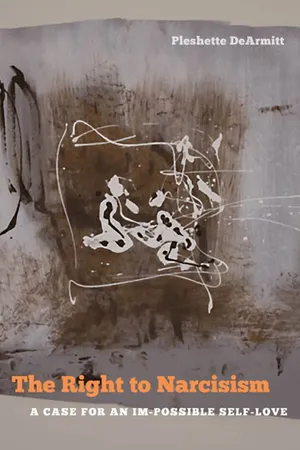
This book aims to wrest the concept of narcissism from its common and pejorative meanings— egoism and vanity—by revealing its complexity and importance. DeArmitt undertakes the work of rehabilitating "narcissism" by patiently reexamining the terms and figures that have been associated with it, especially in the writings of Rousseau, Kristeva, and Derrida.
These thinkers are known for incisively exposing a certain (traditional) narcissism that has been operative in Western thought and culture and for revealing the violence it has wrought— from the dangers of amour-propre and the pathology of a collective "one's own" to the phantasm of the sovereign One. Nonetheless, each of these thinkers denounces the naive denunciation of "narcissism," as the dangers of a non-negotiation with narcissism are more perilous. By rethinking "narcissism" as a complex structure of self-relation through the Other, the book reveals the necessity of an im-possible self-love.
- 208 pages
- English
- ePUB (mobile friendly)
- Available on iOS & Android
eBook - ePub
About this book
Information
Publisher
Fordham University PressYear
2013Print ISBN
9780823254446
9780823254439
eBook ISBN
9780823254453
Topic
PhilosophySubtopic
Literary CriticismPART I
Rousseau: The Passions of Narcissus
INTRODUCTION: ANOTHER MORALITY TALE?
L’amour-propre est plus habile que le plus habile homme du monde.
—La Rochefoucauld, Réflexions ou sentences et maximes morales
In the hands of the French moralists of the seventeenth century, Ovid’s Narcissus does not appear as a hubristic and deluded figure but rather as a cunning and perverse passion that can outwit the most reasonable of men.1 From Madame de Sablé’s Maximes to Pascal’s Pensées, the mot du jour of the moralists was most certainly amour-propre, which translated the Latin amor sui. As inheritors of the texts of the Church Fathers, the moralists appropriated the Augustinian opposition between amor sui (amour-propre) and amor Dei (charité).2 In the reflections of the moralists, especially in the writings of its most famous spokesman, La Rochefoucauld, amour-propre appears as an unequivocally maleficent passion that must be constantly guarded against. Amour-propre, in La Rochefoucauld’s Réflexions ou sentences et maximes morales, was so pervasively discussed and denounced that Voltaire in Le Siècle de Louis XIV wrote: “Quoiqu’il n’y ait presque qu’une vérité dans ce livre, qui est que l’amour-propre est le mobile de tout.”3
As a child of the eighteenth century, Rousseau was the recipient of a rich and heavy-handed moralist tradition in which the nature and effects of self-love as amour-propre had been well established. Thus, it is not surprising that the young Rousseau, in one of his earliest literary ventures, authored a play, essentially a morality tale, entitled Narcissus, or the Lover of Himself.4 The only play of Rousseau’s to be performed publicly—for a mere two nights—has never been described as a sophisticated or significant work of theatrical literature. Even Paul de Man, one of the play’s most subtle and generous readers, describes the drama thus: “To a large extent, Narcisse exploits the hackneyed comical resources of vanity.”5 This early work in which amour-propre is lightheartedly shown to make a mockery of man, a theme that is continued more critically and forcefully in Rousseau’s major theoretical writings, appears to confirm that he remains faithful to the French moral tradition’s condemnation of self-love as vain deceit.
Yet, as his readers are well aware, the mature Rousseau deviates from this tradition by refusing to unambiguously condemn self-love as unnatural and harmful to man.6 Rather Rousseau, who becomes the most renowned defender of the passions, resists the moral and theoretical simplicity of his predecessors and makes an unconventional case, like that of Aristotle in the Nicomachean Ethics, by arguing that self-love can and should serve man’s well-being.7 In Part I, “Rousseau: The Passions of Narcissus,” we undertake to show that Rousseau’s deep and careful consideration of self-love—at two levels—moves away from, although never wholly breaks with, the moralists. In the first chapter, “Man’s Double Birth,” we examine how Rousseau, in a first move, overtly and quite polemically argues for a natural and, hence, healthy notion of self-love that he opposes to a social and malignant form. In Chapter 2, “Regarding Self-Love Anew,” we make the case that Rousseau, perhaps in a less explicit yet no less powerful fashion, undermines the rigorous opposition between a purely good and an entirely evil expression of self-love that he himself had set up. It will be our contention that at this second level of analysis Rousseau, turning even further away from the intellectual naïveté of his predecessors, offers his readers a very complex and historically unprecedented version of self-love, or narcissism.
With the publication, in 1775, of the Discourse on the Origin of Inequality, perhaps his most famous morality tale, Rousseau introduces not one but two distinct types of self-love: amour-propre and amour de soi.8 In apparent agreement with the tradition, he continues to relegate amour-propre to the place that it had held in French letters by aligning it with “errors of the imagination,” in particular, with vanity or pride.9 Nonetheless, in a radical departure from the universal condemnation of self-love, Rousseau makes the case that man’s true self-love, which he terms amour de soi, has become, like the statue of Glaucus, disfigured and nearly unrecognizable because of the pernicious influences of society. In a return to a hypothetical state of nature, Rousseau attempts “to disentangle what is original from what is artificial in man’s present Nature” and, in so doing, discovers that the human animal is animated by an instinctual self-love that makes him intensely interested in his own preservation and well-being (SD 130/OC III:123). In fact, amour de soi is, on Rousseau’s account, the earliest operation of the human soul and, as such, is the well-spring for all others. He elaborates:
The source of our passions, the origin and the principle of all the others, the only one born with man and which never leaves him so long as he lives is amour de soi—a primitive, innate passion, which is anterior to every other and of which all others are in a sense only modifications.10
In order to defend man’s natural right to self-love, Rousseau, especially in the Second Discourse, engages in a polemic against the corrupting effects of civilization on man’s natural condition. In this schema, amour-propre appears as a relative, rather than an essential, passion that perverts and supplants man’s original love of himself. When depicting amour-propre, Rousseau often describes man’s condition in pathological terms, his passions are characterized as inflamed and feverish. As opposed to amour de soi, which allows man to remain within himself, amour-propre causes man to be perpetually ill at ease, since he is continually comparing himself with others and, thus, is forever outside himself. Due to a lifetime of fomented amour-propre, Rousseau believes, that social man, like Glaucus’s statue, is transformed and has become alien and unrecognizable, even to himself. Therefore, in this first elaboration of the conception of self-love, Rousseau establishes a stark opposition in which these “two very different passions in their nature and their effects, must not be confused” (SD 226/OC III:219).
In what we believe to be a remarkable re-elaboration of his original schema of self-love (which largely takes place in Book IV of Emile), Rousseau no longer exclusively champions the place and value of a natural form of self-love but now stresses the necessity for man’s self-love to take shape in the social sphere and even to be transformed into a public virtue, which benefits one’s self and one’s species alike. In order to bring about such a shift in his own philosophy of self-love, Rousseau must undo the rigorous opposition he had established between amour de soi and amour-propre. In the second chapter, the reader is asked to take a long detour through the notion of pitié, as we believe it occupies an essential place in Rousseau’s rethinking of the two types of self-love.
As we take this detour through pitié, we will discover that pitié is itself a detour through which self-love must travel. Self-love—both as amour de soi and amour-propre—is simultaneously deferred and expressed, restrained and unleashed in the complex process that Rousseau calls pitié. Therefore, we will follow the movements of pitié in order to trace the transformation of self-love both at the micro-level, in terms of the structures of the self, and the macro-level, in terms of the evolution of Rousseau’s thinking on the subject of self-love. In so doing, we will discover that in detailing the operations of pitié Rousseau re-marks the notion of the imagination, which has been so often devalued in his philosophy. While continuing to maintain that the powers of the human imagination, by taking man outside of himself, are potentially hazardous to his self-regard, Rousseau recognizes that the imagination—as the threshold between the self and other—must be reckoned with. And, perhaps, in spite of his own anxieties, Rousseau, we would like to show, provides a version of pitié that allows the thinker not only to rework the amour de soi/amour-propre opposition but also to reconcile the long-standing “conflict” between love of self and love of the other.
CHAPTER 1
Man’s Double Birth
We are, so to speak, born twice: once to exist and once to live; once for our species and once for our sex.
—Emile
The preceding epigraph, drawn from the second paragraph of Book IV of Emile, marks a dramatic split and shift between two epochs of human existence—childhood and adulthood—which are so vastly distinct for Rousseau that they each require their own birth, maturation, and education.1 One finds this double birth, to one’s species and sex, doubly inscribed in Rousseau’s work: first, in the Discourse on the Origin of Inequality, where the development of the human race is charted from its inception (state of nature) to its demise (society), and, second, in Emile, where a more or less parallel map is drawn of the birth of the individual. Each text, following a developmental or genetic schema, sketches out two separate states of being that correspond to two types of dependencies. Unequivocally, Rousseau declares that “[t]here are two sorts of [human] dependence: dependence on things, which is from nature; dependence on men, which is from society” (E 85/OC IV:311). We will see that each epoch of man’s existence, with its particular type of dependence, will be guided by a particular form of self-love—amour de soi in the case of the former and amour-propre in that of the latter.
THE FIRST BIRTH
Since the savage and the child are, for Rousseau, in their “natural state,” their experiences are dominated by the physical, consisting of little more than sensation and need. Need, an inescapable condition of human existence, brings man in relation to and makes him dependent upon “things.” In both the Second Discourse and Emile, things consist of products of nature, including the elements, plants, and animals. By emphasizing man’s dependence on things rather than persons, it would seem that Rousseau is suggesting that the savage and the child exist entirely alone, cut off from all human contact.
Although Rousseau generally portrays primitive men and children as solitary beings, he does not contend that they are not involved with and reliant upon other humans. For necessity leads the savage to mate and rear children, and necessity causes the child to depend upon his mother or nurse. Rousseau insists, however, that these attachments to others are driven and sustained by pure physical need.
For example, in the state of nature, the “Physical [sentiment of love] is the general desire which moves one sex to unite with the other” (SD 164/OC III:157). However, this link between the “erotic” couple in the state of nature dissolves as soon as the flame of sexual desire is extinguished. Even the mother-child bond in the state of nature obeys the law of necessity and thus ends with the satiation of their mutual needs. Without pathos, Rousseau writes:
The mother at first nursed her Children because of her own need; then habit made them dear to her, she nourished them because of theirs; as soon as they had the strength to forage on their own, they left even the Mother […], they soon were at the point of not even recognizing each other. (SD 153/OC III:147)
Likewise, there are many instances in Emile when Rousseau emphasizes that the child’s attachment to those who aid and care for him cannot properly be called “love” and must be understood...
Table of contents
- Cover
- Half Title
- Title Page
- Copyright
- Dedication
- Contents
- Acknowledgments
- Half Title
- Introduction: The Right to Narcissism?
- Part I. Rousseau: The Passions of Narcissus
- Part II. Kristeva: The Rebirth of Narcissus
- Part III. Derrida: The Mourning of Narcissus
- Afterword. Narcissism—By What Right?
- Notes
- Bibliography
- Index
Trusted by 375,005 students
Access to over 1.5 million titles for a fair monthly price.
Study more efficiently using our study tools.
Frequently asked questions
Yes, you can cancel anytime from the Subscription tab in your account settings on the Perlego website. Your subscription will stay active until the end of your current billing period. Learn how to cancel your subscription
No, books cannot be downloaded as external files, such as PDFs, for use outside of Perlego. However, you can download books within the Perlego app for offline reading on mobile or tablet. Learn how to download books offline
Perlego offers two plans: Essential and Complete
- Essential is ideal for learners and professionals who enjoy exploring a wide range of subjects. Access the Essential Library with 800,000+ trusted titles and best-sellers across business, personal growth, and the humanities. Includes unlimited reading time and Standard Read Aloud voice.
- Complete: Perfect for advanced learners and researchers needing full, unrestricted access. Unlock 1.5M+ books across hundreds of subjects, including academic and specialized titles. The Complete Plan also includes advanced features like Premium Read Aloud and Research Assistant.
We are an online textbook subscription service, where you can get access to an entire online library for less than the price of a single book per month. With over 1.5 million books across 990+ topics, we’ve got you covered! Learn about our mission
Look out for the read-aloud symbol on your next book to see if you can listen to it. The read-aloud tool reads text aloud for you, highlighting the text as it is being read. You can pause it, speed it up and slow it down. Learn more about Read Aloud
Yes! You can use the Perlego app on both iOS and Android devices to read anytime, anywhere — even offline. Perfect for commutes or when you’re on the go.
Please note we cannot support devices running on iOS 13 and Android 7 or earlier. Learn more about using the app
Please note we cannot support devices running on iOS 13 and Android 7 or earlier. Learn more about using the app
Yes, you can access The Right to Narcissism by Pleshette DeArmitt in PDF and/or ePUB format, as well as other popular books in Philosophy & Literary Criticism. We have over 1.5 million books available in our catalogue for you to explore.