Use your imagination! The demand is as important as it is confusing. What is the imagination? What is its value? Where does it come from? And where is it going in a time when even the obscene mseems overdone and passé?
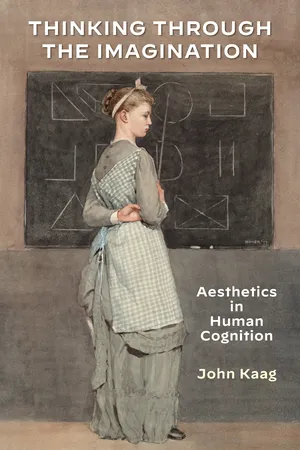
This book takes up these questions and argues for the centrality of imagination in humanmcognition. It traces the development of the imagination in Kant's critical philosophy (particularly the Critique of Aesthetic Judgment) and claims that the insights of Kantian aesthetic theory, especially concerning the nature of creativity, common sense, and genius, influenced the development of nineteenth-century American philosophy.
The book identifies the central role of the imagination in the philosophy of Peirce, a role often overlooked in analytic treatments of his thought. The final chapters pursue the observation made by Kant and Peirce that imaginative genius is a type of natural gift (ingenium) and must in some way be continuous with the creative force of nature. It makes this final turn by way of contemporary studies of metaphor, embodied cognition, and cognitive neuroscience.
- 272 pages
- English
- ePUB (mobile friendly)
- Available on iOS & Android
eBook - ePub
About this book
Information
Publisher
Fordham University PressYear
2014Print ISBN
9781531501846
9780823254934
eBook ISBN
9780823254941
Topic
PhilosophySubtopic
Aesthetics in PhilosophyONE
THE CULTIVATION OF THE IMAGINATION
It is not by dealing out cold justice to the circle of my ideas that I can make them grow, but by cherishing them and tending them as I would flowers in my garden.
—Charles Sanders Peirce (1893)
The Imaginative Imperative
For the two children, the season began as a wild dash—a race against the length of summer days.1 But by mid-August, the days proved too long and hot for their short attention spans. The unconstrained freedom of vacation exhausted itself or, more accurately and more ironically, exposed itself as a type of aimless discontent. Freedom from chores, school, and responsibility revealed itself as boredom to me and my brother on a humid afternoon. The toys and blocks that had once riveted our attention lay thrown and neglected about the playroom. Haphazardly discarded games no longer occupied our full attention. Surrounded by a chaos of playthings, my brother and I sat bickering in the middle of the room. At least bickering gave us something to do.
My mother had been listening to us for some time from the garden. The injunction that came to us through the back window was as simple as it was emphatic:
“Boys! Stop Squabbling! Be Imaginative!”
Being imaginative is no simple matter for two tired youngsters. More often than not, we needed a bit of encouragement. My brother and I had contented ourselves with our discontent, objecting to any force that might jostle us out of the odd comfort of bickering. Encouragement came in the form of an order. Get up off the ground, pick up our blocks and games, and come outside to help in the garden.
If being imaginative meant helping in the garden, my brother and I wanted no part in it. How could imagination play freely if it was forced to help with mundane chores? Gardening, however, if done properly, is an engaging activity, and our reluctance was short-lived. It is, after all, difficult to be reluctantly imaginative. Planting a bed is a type of play that rarely grows old. After a short tutorial in gardening etiquette, my mother set us free on a small plot. We were, however, not wholly free, at least not in the negative sense of being free from school or free from chores. This gardening may have been free play, but it was also serious business that deserved our full attention. In being imaginative, my brother and I came to understand the rules of play, the guidelines that determined the arrangement of shrubs and hosta, as they emerged unexpectedly in the interaction with a variety of plants and in a particular garden. This variety was not embodied in the random scattering of discarded toys or blocks but rather in the gathering together of various plants into the felt harmony of a well-planted garden. Even youngsters can learn that such a novel but harmonious gathering is the meaning of being imaginative. I had not yet read John Dewey’s Art as Experience, of course. But I did in a certain intuitive way understand that
the imagination is a way of seeing and feeling things as they compose an integral whole. It is the large and general blending of interests at the point where the mind comes in contact with the world. When old and familiar things are made new in experience there is imagination.2
The free play of growth and cultivation is a process that involves a child even against his will. Being imaginative means getting your hands dirty. Really dirty. After a stint in the yard, my mother would joke that it was difficult to see where the dirt ended and the skin began. In truth, such distinctions—between the human and the natural—are difficult to make in the midst of imaginative planting. It is here that we get at least a vague sense of the issues that will emerge over the course of this relatively thin book. In its everyday use, the imagination is understood as a creative power—perhaps the creative power—by which human beings get on with the meaningful business of living. It is the imagination that allows us to escape the mediocrity of our daily lives, to transcend the self-imposed boundaries—conceptual, personal, and social—that limit our growth. It is the imagination that generates a work of art, and it is the imagination that grants us the ability to interpret artworks. It is the imagination that keeps culture and science “on the move.” In short, it is the imagination that makes us fully human.
The American philosophical tradition, with its emphasis on growth, discovery, and human flourishing, has always been, at least indirectly, interested in this power of transcendence. Indeed, this philosophical tradition arguably more than any other has placed the imagination at the center of its account of being human. But here we encounter a problem, one that troubled American thinkers from Ralph Waldo Emerson to Susanne Langer. Where does the imagination, a creative power that has been regarded as distinctly human, come from? And where exactly does it take us? In one sense, these questions lead us into a phenomenological account of the experience of creativity. In another, it challenges us to locate the imagination in the workings of the natural world, in the physical natures that each of us possess. We should not be surprised that this has led to a variety of divergent treatments of the subject. Let us begin on the phenomenological side of things. Just as a youngster gets lost in the planting of a garden, in moments of imaginative play we often seem to lose ourselves in our play, our painting, or our experimentation. It seems that we are called out of our habitual ways of being in the world in order to engage with our surroundings in a new way. We are left unsettled, forever changed. We find ourselves anew, surprised to find that world that has been changed by our hands. For the ancients, these moments of ecstasy were attributed to the work of the muses, and it is in this attribution that they answered, or perhaps avoided, the question of the imagination’s origin. Perhaps we will find that the ancient Greeks were right in their avoidance of the question, but it seems that much can be said in regard to the way that the chance occurrences we experience in our natural surroundings give us the chance to exercise our creative powers.
Only recently have I looked back on the planting afternoons in my childhood garden and reflected on the meaning of being imaginative. The reflection is my point of departure for the following project. Dewey was right: the imagination brings individuals together and leads them to compose a unified whole. Our garden was living proof of this. After a successful afternoon of planting, the various shrubs and the various members of my family were, for the time being, arranged in a cooperative relation. As Dewey notes, imagination “weds man and nature” but also “renders men (and women) aware of their union with one another in origin and destiny.”3 This “union” could never have been prescribed beforehand, nor could it be repeated in the future. This union was brand-new—novelty at its finest. Old and familiar plots of ground, tamped down by the careless running of little feet, were carefully retilled and given new life on those days of imagination. The regeneration of the garden corresponded with a kind of personal renewal and growth. The communication and cooperation of two brothers were made anew. The boredom of old and familiar patterns of interaction was overcome in the injunction to be imaginative. There was no time for bickering—we were absorbed in the process of planting. In this process, imagination transformed the dispositions of two boys and the world at large, or at least a small corner of my mother’s back lawn. In spite of my efforts to verbalize the meaning of these imaginative days, something about this boyhood experience has been lost—and lost forever. The imagination is cultivated in the continuous flow and interaction of sense, emotion, and meaning. One experiences this flow as a pervasive quality of feeling that defies definitive explanation. Any real attempt to describe this pervasive quality results in an admixture of poetry and paradox that still misses the imaginative quality of gardening. As Proust understood, all of the senses are at play in imagination. The ground smells warm. The plants call to be planted in a certain fashion. The orange and gold of marigolds feel right next to the varied hues of zinnias. While such poetic descriptions hint at the holistic quality of the imagination, they do little to describe the process and situation in which being imaginative takes place. Without ignoring the phenomenological character of imaginative encounters, I hope to describe the limits and the movement of imagination. Without abandoning the lived experience of the imagination, I aim to theorize about its particular place in the history of thought and its unique outline as a way of thinking. This theorizing must, if it is to be at all successful, in a certain sense return us to the experience of the imagination.
The investigation of the imagination and its origins must remain accountable to the experience of human creativity. Let us return to our central question: Where does the imagination come from? In answering this, we cannot lose the experiential sense of the imagination. This is no easy task. I maintain that a proper answer will lead us not only into the depths of phenomenology but also, simultaneously, into the most recent findings of the empirical sciences.
This may seem to be a surprising claim. What could the empirical sciences have to say about the creative spirit of the imagination? Is there not a danger in reducing the imagination to a set of mechanical processes, reducing the one human power that is, almost by definition, not to be reduced? Yes, there is. I concede that there is a chance that the empirical sciences may have nothing to contribute to our understanding of the imagination, and there is the very real risk of reductionism. That being said, I think it is worth taking this chance and facing this risk. Since Aristotle and Kant, there has been a vague sense that human creativity—in its cultural and artistic splendor—could be traced to the creative processes of nature. With this project, I hope to show how this vague sense might now be articulated in a coherent theory. It currently remains a mere hope expressed as we look forward into an age of science that does respond, despite rumors to the contrary, to the longstanding and well-grounded accusations of material reductionism. What we find when we touch on the findings of today’s science—not the science of fifty or a hundred years ago—is an increasing interest in the indeterminacy, emergence, and spontaneity of natural processes. This interest allows us to investigate a continuity between the novelty of the human imagination and the workings of nature that appear to reflect a corresponding dynamism. The empirical sciences will not tell us how to be imaginative, but they may shed light on the origins and preconditions of this creative power that has long defined what it is to be human. Led by theoretical biology and cognitive neuroscience, the natural sciences are at the very least on their way to developing models that might give us perspectives on the complexity, novelty, and unity of the creative imagination. That is the hope.
This hope comes hand in hand with the belief that by attending to the experience and the origin of the imagination we can respond to the bickering that emanates from a corner of the philosophic playroom. Like all bickering, it stems as much from boredom as it does from any genuine conflict. Thus, the injunction to “be imaginative” is an appropriate one. Much of the squabbling in contemporary philosophy appears to concern the shape and definition of human thinking and human meaning making. An honest observer could see the disagreement as one that emerges as the toys and games of the history of philosophy lose their charm. More accurately, perhaps, the charm of these games has been forgotten. My project, therefore, is an injunction for philosophy to “be imaginative!”—to attend to the embodied, creative, and spontaneous aspects of human thought that the Western philosophical canon does occasionally highlight.
At these turns in our intellectual tradition, it is the imagination that seems to negotiate the disagreements in philosophy as it mediates the binary ways of thinking that have continually emerged as points of contention in the history of Western thought: the problem of mind and body, the disjunction between form and content, the conflict between sensibility and understanding, the tension between diversity and unity, the antagonism between growth and collectivity. These disagreements continue to define large swaths of the philosophical landscape. Some new planting seems to be in order: the imagination clears a middle ground between parties and conceptions that have remained in longstanding opposition, a fertile ground where new forms of human flourishing can grow and be conceptualized.
I harbor a worry that has, to this point, remained buried in footnotes and offhand comments, namely that professional philosophy has become intentionally boring. The push to publish in competitive academic departments has encouraged scholars to take up ever-narrower philosophical questions. As their questions have “thinned out,” the motivation behind their research has grown ever more questionable. The focus on the minutiae of certain fields of philosophy causes us to lose sight of the fact that philosophy, at its best, concerns the creative and imaginative business of living. I believe that a “focus” on the concept of the imagination has the opposite effect of this type of intellectual myopia. I hope that such a focus on the imagination might open up the possibilities of philosophy. I mean to encourage philosophy to take up human creativity not only as its topic of study but also as its guiding telos. Dewey suggested that philosophical disagreements—the bickering that results from comfortable boredom—reflects analogous conflicts that exist in the field of contemporary culture. Once again—and this time unfortunately—he seems to be on target. Squabbling in the fields of epistemology and metaphysics echoes the general dis-ease of a people who have grown weary with their playthings. Indeed, modernity’s tendency to produce more distractions, both conceptual and social, has done little to relieve the symptoms of summer afternoon boredom. Have we reached the weary point where even the exciting and the obscene is overdone and passé? Do we live anesthetically—asleep to one another and to the potentialities that quietly underpin our lives? Has the gap between private impulse and public concern widened to a disturbing degree? Has our sense of a creative future been trumped by cynicism?
In the wake of these questions, which must be asked, the encouragement to “be imaginative” seems not just appropriate but frighteningly necessary. The encouragement does not supply new toys but a new way of engaging with them, a new way of feeling, a new way of combining ideas and things to compose a satisfying and unifying situation. My project begins to explain what it might mean to “be imaginative” and to highlight the role and significance of the imagination in the history of philosophy.
Attempts to situate the concept of the imagination in the history of philosophy have proved difficult. I will argue that they have been largely unsuccessful. Dewey recognizes this lack of success, commenting:
“Imagination” shares with “beauty” the doubtful honor of being the chief theme in esthetic writings of enthusiastic ignorance. More perhaps than any other phrase of the human contribution, it has been treated as a special and self-contained faculty, differing from others in possession of mysterious potencies.4
Dewey makes several important points here regarding the traditional treatment of the imagination. First, the imagination is traditionally addressed by work in aesthetics and narrowly framed in aesthetic practice. According to this view, the imagination is associated almost exclusively with the creative arts rather than with epistemic processes. Imaginative work is the exclusive province of painters and children. The imagination is framed—like the canvases of Cezanne and Vermeer—on an easel, in a museum. Rational adults are expected to outgrow their imaginative bodies after a short and indulgent period of whimsical play.
As the discipline of aesthetics has become more of a self-contained field, a trend that began in the eighteenth century and continues to this day, the marginalization of the imagination has become more pronounced. Many scholars note, however, that an understanding of the imagination as a mere play of images distinct from the serious work of reason predates the rise of the discipline of aesthetics. Indeed, the understanding can be traced back to the Platonic dialogues or, more accurately, to the Platonism that arose from these works. The prejudice against the imagination and imitative arts more generally is typified by Socrates’ insistence in the Republ...
Table of contents
- Cover
- Half Title
- Series Announcement Page
- Title Page
- Copyright
- Contents
- Acknowledgments
- Half Title
- 1. The Cultivation of the Imagination
- 2. Enlightening Thought: Kant and the Imagination
- 3. C. S. Peirce and the Growth of the Imagination
- 4. Abduction: Inference and Instinct
- 5. Imagining Nature
- 6. Ontology and Imagination: Peirce on Necessity and Agency
- 7. The Evolution of the Imagination
- 8. Emergence, Complexity, and Creativity
- 9. Be Imaginative! Suggestion and Imperative
- Notes
- Bibliography
- Index
- Series Page
Trusted by 375,005 students
Access to over 1.5 million titles for a fair monthly price.
Study more efficiently using our study tools.
Frequently asked questions
Yes, you can cancel anytime from the Subscription tab in your account settings on the Perlego website. Your subscription will stay active until the end of your current billing period. Learn how to cancel your subscription
No, books cannot be downloaded as external files, such as PDFs, for use outside of Perlego. However, you can download books within the Perlego app for offline reading on mobile or tablet. Learn how to download books offline
Perlego offers two plans: Essential and Complete
- Essential is ideal for learners and professionals who enjoy exploring a wide range of subjects. Access the Essential Library with 800,000+ trusted titles and best-sellers across business, personal growth, and the humanities. Includes unlimited reading time and Standard Read Aloud voice.
- Complete: Perfect for advanced learners and researchers needing full, unrestricted access. Unlock 1.5M+ books across hundreds of subjects, including academic and specialized titles. The Complete Plan also includes advanced features like Premium Read Aloud and Research Assistant.
We are an online textbook subscription service, where you can get access to an entire online library for less than the price of a single book per month. With over 1.5 million books across 990+ topics, we’ve got you covered! Learn about our mission
Look out for the read-aloud symbol on your next book to see if you can listen to it. The read-aloud tool reads text aloud for you, highlighting the text as it is being read. You can pause it, speed it up and slow it down. Learn more about Read Aloud
Yes! You can use the Perlego app on both iOS and Android devices to read anytime, anywhere — even offline. Perfect for commutes or when you’re on the go.
Please note we cannot support devices running on iOS 13 and Android 7 or earlier. Learn more about using the app
Please note we cannot support devices running on iOS 13 and Android 7 or earlier. Learn more about using the app
Yes, you can access Thinking Through the Imagination by John Kaag in PDF and/or ePUB format, as well as other popular books in Philosophy & Aesthetics in Philosophy. We have over 1.5 million books available in our catalogue for you to explore.