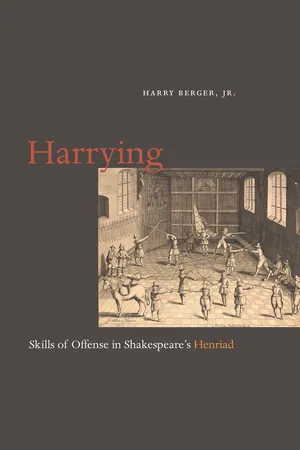
Harrying considers Richard III and the four plays of Shakespeare's Henriad—Richard II, Henry IV Part 1, Henry IV Part 2, and Henry V. Berger combines close reading with cultural analysis to show how the language characters speak always says more than the speakers mean to say.
Shakespeare's speakers try to say one thing. Their language says other things that often question the speakers' motives or intentions. Harrying explores the effect of this linguistic mischief on the representation of all the Henriad's major figures.
It centers attention on the portrayal of Falstaff and on the bad faith that darkens the language and performance of Harry, the Prince of Wales who becomes King Henry V.
- 232 pages
- English
- ePUB (mobile friendly)
- Available on iOS & Android
eBook - ePub
About this book
Information
Publisher
Fordham University PressYear
2015Print ISBN
9780823256631
9780823256624
eBook ISBN
9780823256655
1. Misanthropology in Richard III
Shakespeare’s Richard III is a play about a “real” historical person, a dead tyrant whose wickedness is guaranteed by textual authority. Throughout the play he moves downstage and “addresses” an audience that he assumes is familiar with him and his story. He performs frequently enough “before” that audience to make him seem aware of their scrutiny even when he’s bustling about upstage in the midst of his plots and perversions. It’s obviously important to him to maintain contact with, and also to maintain rhetorical control over, an audience to whom his present doings are (as we say nowadays) history. But what kind of history are they, and what’s his particular problem with that history?
During the first thirty-one lines of Richard’s opening soliloquy his references are vague enough to suggest that his audience possesses general if not detailed familiarity with the sources in Thomas More, Edward Hall, and Raphael Holinshed, as well as with the history covered by the three Henry VI plays that precede Richard III. The most specific references, “this sun of York” and “Grim-visaged war” (1.1.2, 9), still presume familiarity with the story.1 At the end of the soliloquy, the sudden drop into the details of his “plots” and “inductions” against “Clarence and the King” produces the same effect, although the details will be explained as soon as the soliloquy is over and the action begins. Finally, his “descant on mine own deformity” (1.1.27) is a strong allusion to the sources I mentioned.
So it is that from the opening lines of the play, Shakespeare presents us with a protagonist who seems aware of an audience that knows who he is and where he comes from. Furthermore, he seems eager to explore and test and possibly challenge a prefabricated image of himself floating around in the public domain. Richard’s performance may be straightforward in that he wears his villainy on his sleeve, but it is complicated by two possibilities. First, the play represents him as a camp version of the Tudor scapegoat. Second, the play represents him presenting himself as a camp version of the Tudor scapegoat.
This view of Richard is not my invention. It has been advanced and explored with variations in a large body of critical work during the past five decades or so. My own sense of the play responds to a particular version of the view, one that can be traced back to A. P. Rossiter (1961) and Nicholas Brooke (1968), and then forward to more recent studies by Patricia Parker and Linda Charnes.
Rossiter argues that since Richard is “in effect God’s agent,” an “angel with horns,” the play reveals justice to be the work of a divine will “as pitiless as the Devil’s.” As a result, “the naive, optimistic, ‘Christian’ principle of history, consoling and comfortable, modulates into its opposite.” Nevertheless, the play is more than “a ‘debunking’ of Tudor myth.” Rather it interrogates the “absolutes” and “certainties” that myth offers, and it “leaves us with relatives, ambiguities, irony.”2
Brooke concedes that since the play celebrates the Tudor victory over the tyrant, it ratifies the working of the “gigantic machine” of “Christian order behind the seeming chaos of human affairs.” But he argues persuasively that this Christian-Tudor theme gets challenged by the play’s attention to Richard’s merry melodrama of misanthropy, by its delight in his self-delight, and by its focus on his high-spirited villainy—theater effects produced primarily through the medium of soliloquy. The cost of the oppressive and deterministic Christian plot that underwrites “the whole Tudor theory of history” is thus measured in theatrical terms. In other words, the necessities of the killjoy plot curtail our pleasure in Richard’s histrionic and irrational exuberance.3
Brooke’s accomplishment is to have shown how Shakespeare uses the villain’s role to parody Tudor ideology and its appropriation of the gigantic Christian machine. This theme was subsequently developed by Parker and Charnes. Parker argues that the play depicts its protagonist as the product of the bad faith with which Tudor historiography demonized Richard and sanctified Henry VII: Richard’s “unnatural” deformity and fiendishness are the creation of the official Tudor histories. Shakespeare’s character is presented as the scapegoat that “a particular official construction of history might retroactively require.”4
This construction is what Charnes calls notorious identity. She carries Parker’s idea a little further by suggesting that Shakespeare’s character presents himself as the Tudor scapegoat. Her argument is that the Richard who performs the villain’s discourse tries but ultimately fails to dissociate himself from the notorious identity the Tudors saddled him with. As she and others point out, when he says, “I am determinéd to prove a villain,” he probably means that he is resolved, committed, to proving himself a villain in a way that will put his sources to shame. But the phrase also means that he is preordained to be a villain and can’t do anything about it, can only replay the role imposed on him by Tudor ideology. Charnes argues that by the end of the play Richard realizes that “he has determined nothing for himself.”5 But I think a slightly different view of the matter opens up if we follow Brooke’s lead and focus on Richard’s theatrical high jinks.
What makes him a vital and compelling villain is that he fully actualizes a vital and compelling duplicity built into the rhetorical structure of the villain’s discourse: The speaker tells himself one thing and tells everyone else onstage another, and among the things he tells himself is that he tells himself one thing and tells everyone else another. He all but flaunts his villainy in his victims’ faces as if daring them to find him out. He would clearly like to invert the victim’s slogan, which, in the form King Lear gives it, is “I am more sinned against than sinning.” But the inversion is troubled by an ambiguity.
The obverse of Lear’s complaint is “I am more sinning than sinned against.” This is the formula for the villain’s discourse. It also happens to be the confessional theme of the sinner’s discourse. Until very late in the play, Richard labors successfully to keep the villain’s boast from being contaminated by its formulaic double and moral opposite. From the start he looks for chances to sharpen up his villain talk. This is why he soliloquizes so much. It’s also why Lady Anne offers him a world-class target. At the end of the first scene, the murderer of Anne’s husband and father-in-law struts his nasty plan to make amends by marrying “the wench.” The trouble is that in the ensuing scene her complicity challenges his claim to autonomous malfeasance.
During their stimulating discussion of Richard III, Jean Howard and Phyllis Rackin claim that the women in the play “are deprived of theatrical power and agency”—deprived, that is, by Shakespeare. Borrowing an idea from Susan Jeffords, they argue that Richard monopolizes the stage with his “performative masculinity.”6 But I’m not sure that this claim holds for Anne, who seems to know something about performative femininity and who enthusiastically competes with Richard in histrionic flummery. I prefer an argument that was advanced in different forms by Marguerite Waller and John Jowett: Anne deprives herself of agency and does so through her enjoyment of theatrical power. “Susceptible to the . . . erotic charm of theater,” she revels in her declamatory performance of the victim’s discourse.7
It is she, Waller notes, who “sets the terms for scene 2” by defining herself as “poor Anne” and flaunting her new independence as a mourning widow:8
Set down, set down your honorable load,
If honor may be shrouded in a hearse,
Whiles I a while obsequiously lament
Th’untimely fall of virtuous Lancaster. (1.2.1–4)
She works the pathos of repetition and then pauses archly for a categorial check on her choice of adjectives. But the real damage is done by the indefinite quantifier, “a while.” It warns us to settle down, settle down, because we know she aims the “lamentations of poor Anne” at an audience more substantial than the lowly attendants in her cortège. She’s waiting for Richard.
Though she titles her little act “Th’untimely fall of virtuous Lancaster,” her passion is more vengeful than elegiac. It quickly veers toward vilification of the villain. Then, as if that swerve profanes the ground beneath the dead king, she tells her servants to pick up the hearse and move on, but immediately orders them to put it down again so she may properly “lament King Henry’s corpse.” She still waits for Richard.
At this moment the object of her fury appears on cue and offers a helping hand. He repeats her order, bullies the servants, and, in the guise of shoring up her authority, he begins to reduce it. Thus it isn’t only Shakespeare who deprives Anne of agency. Richard joins in. But it isn’t only Richard. Anne joins in. As Waller and Jowett convincingly show, the seduction scene that follows is partly driven by her exercise of the power of self-disempowerment. She gets herself seduced.
After his gratuitous offer of help spurs her to take her execration to its climax, Richard blithely catches Anne’s curses and bounces them back as literary hyperboles. She calls him a devil, and he calls her a saint, “adopting” and adapting “her constellation of terms.”9 She chooses to accept his adaptation, to join his Petrarchan dance, to follow his lead. He in turn offers her—and she assumes—the illusory autonomy of the Cruel Fair whose expiring victims implore her to murder them, but only by metaphor.
It takes two to play that game. Jowett notes that when she calls Richard “dissembler,” her “chiding is that of the resentful though forgiving lover,” empowered to “exercise mercy.”10 Finally she accepts his ring, and, with the very phrase intended to deny she’s surrendering, she surrenders herself: “To take is not to give.” “Poor [widow] Anne” the victim has discovered a new role. Enough of grieving and cursing. She’ll become a tease. Her words herald the onset of excitement and lawlessness, the throb of an impulse that joins the sinner to the villain in the discordant harmony of “more sinning than sinned against.”
“Was ever woman in this humor wooed? / Was ever woman in this humor won?” These lines introduce a soliloquy characterized by Waller as a “self-serving, long-winded, but unfounded assessment” of what just happened. Richard describes it admiringly as a conquest “carried out in the face of every improbability.”11 But he has to persuade his audience as well as himself that he took what the audience just saw Anne give. He needs someone, some disinterested connoisseur of good villainy, with whom he can share the secrets he can’t divulge to his potential victims without jeopardizing his ability to victimize. He seems (perhaps unbeknown to himself) to have found such a connoisseur in Anne.
The effect of sandwiching the seduction between soliloquies is to increase our sense that Richard performs the entire seduction scene with one eye on the audience those soliloquies evoke. He aims his performances downstage toward an audience whose voyeuristic relation to the onstage community of victims reinforces his, an audience of superior wit and judgment capable of rewarding him with the appreciation, the applause, the respect, and the loathing he deserves.
This is an audience presumably aware of the fact that the first tetralogy blandly dishes out such “staples of early Tudor propaganda” as “the pious role-playing” of Henry VII along with his campaign to get Richard demonized and Henry VI sanctified.12 In the play’s most hilarious episode, act 3, scene 7, Shakespeare has Richard perform a wicked parody not only of Henry VI but also of the religious myth of legitimacy that was instituted at Richard’s expense by his Tudor successor.
The objective of that scene is to get the Mayor and citizens of London to support his claim to the throne. He and his hatchet man, the Duke of Buckingham, cook up a plan in which, with the commons present, Richard appears aloft in all his sanctity—standing between two bishops, clutching his prayer book, full of Christian blather. He can’t imagine why his devotions are being disturbed by such worldly fluff as kingship. He spends a long time proclaiming his unfitness to rule and keeping his future subjects on the hook.
This little charade makes fun of the saintly king, Henry VI, who, in the preceding play, had been equally reluctant to rule and who was captured with prayer book in hand before Richard killed him. In addition, Richard’s prominent display of a devotional text as a dramatic prop caricatures the more general—and Machiavellian—use of such texts in the theater of propaganda. As he camps up his villain’s role, Shakespeare’s audience is entitled to wonder whether Shakespeare’s Richard is getting his revenge on the Tudors for their slander of his prototype—whether he isn’t belatedly mocking the chronicle myth that empowers Richard, and that lets him get away with murder just long enough to establish the new order on the cornerstone of his deformed body.
Act 3, scene 7 is high comedy, but Richard’s performance becomes puzzling as soon as we ask at whom it’s aimed and what it seems intended to accomplish. Is it protracted because his onstage auditors are hard to convince? Anne Righter Barton calls it “a little comedy, drawn out at some length,” and notes that here, as elsewhere, “ingenuous souls are deceived” by “the brilliance of Richard’s performance.”13 Barton finds it odd that Shakespeare’s concentration on its brilliance leads him to diverge on this point from the source of the scene in Thomas More’s life of Richard. The citizens in More’s “account . . . are all perfectly well aware of the deception involved,” whereas Shakespeare “gives no indication whatsoever that the Mayor’s cry, ‘God bless your Grace’ . . . , or the citizens’ ‘Amen’ is insincere.”14 But this isn’t quite right, because at the beginning of the scene there are indications that qualify the onstage spectators’ show of sincerity.
Act 3, scene 7 begins with Richard asking Buckingham how the citizens reacted when he enumerated the reasons why Richard should be king. Buckingham delivers the following report: They responded with speechless fear and diffidence, and when he asked what “this wilful silence” meant, the Mayor explained that the people were not accustomed to being addressed by anyone but a civic official called the Recorder. On being urged to repeat the message, the Mayor nervously attributed it to Buckingham: “Thus saith the Duke, thus hath the Duke inferred, / But nothing spoke in warrant from himself” (3.7.27–28).
At this point, Buckingham continues, some of his goons planted in the citizen audience shouted, “God save King Richard!” and he, taking “vantage of those few,” thanked the citizens for the “love to Richard” evinced by “this general applause and cheerful shout” (3.7.31–35). Having thus been royally conned, the Mayor and his deputation appear before Richard. During the long stretch of pious palaver that follows, the Mayor manages to interject four one-line comments, three of which are smarmy endorsements, and the last of which is followed by Buckingham’s “Long live King Richard” and the ratifying choric “Amen,” the only sound uttered by the Mayor’s taciturn townspeople.
This meager evidence can’t be used to determine whether Richard’s civic auditors are taken in by his performance—whether the auditors are ingenuous and deceived or simply cowed by fear into compliance. But several other passages in the play throw light on this question and even contextualize the citizen response within the boundaries of a well-defined pattern. The strange goings-on in act 3, scene 7 are sharply ...
Table of contents
- Cover
- Title Page
- Copyright
- Dedication
- Contents
- Preface
- 1. Misanthropology in Richard III
- 2. “Here, Cousin, Seize the Crown”: The Triumphant Fall of Richard, the Self-Harrier
- 3. Richard’s Soliloquy: Richard II, Act 5, Scene 5, Lines 1–166
- 4. On the Continuity of the Henriad
- 5. Falstaff and Harry
- 6. A Horse Named Cut: 1 Henry IV, Act 2, Scene 1
- 7. Hydra and Rhizome
- 8. Falstaff, Carnival, and the Perils of Speech-Prefixity
- 9. Interlude: The Clown as Dog
- 10. The King’s Names
- 11. Rabbits, Ducks, Lions, Foxes: A Henrician Bestiary
- 12. Harrying the Stage: Henry V as Tetralogical Echo Chamber
- 13. Harry’s Question
- Notes
Trusted by 375,005 students
Access to over 1.5 million titles for a fair monthly price.
Study more efficiently using our study tools.
Frequently asked questions
Yes, you can cancel anytime from the Subscription tab in your account settings on the Perlego website. Your subscription will stay active until the end of your current billing period. Learn how to cancel your subscription
No, books cannot be downloaded as external files, such as PDFs, for use outside of Perlego. However, you can download books within the Perlego app for offline reading on mobile or tablet. Learn how to download books offline
Perlego offers two plans: Essential and Complete
- Essential is ideal for learners and professionals who enjoy exploring a wide range of subjects. Access the Essential Library with 800,000+ trusted titles and best-sellers across business, personal growth, and the humanities. Includes unlimited reading time and Standard Read Aloud voice.
- Complete: Perfect for advanced learners and researchers needing full, unrestricted access. Unlock 1.5M+ books across hundreds of subjects, including academic and specialized titles. The Complete Plan also includes advanced features like Premium Read Aloud and Research Assistant.
We are an online textbook subscription service, where you can get access to an entire online library for less than the price of a single book per month. With over 1.5 million books across 990+ topics, we’ve got you covered! Learn about our mission
Look out for the read-aloud symbol on your next book to see if you can listen to it. The read-aloud tool reads text aloud for you, highlighting the text as it is being read. You can pause it, speed it up and slow it down. Learn more about Read Aloud
Yes! You can use the Perlego app on both iOS and Android devices to read anytime, anywhere — even offline. Perfect for commutes or when you’re on the go.
Please note we cannot support devices running on iOS 13 and Android 7 or earlier. Learn more about using the app
Please note we cannot support devices running on iOS 13 and Android 7 or earlier. Learn more about using the app
Yes, you can access Harrying by Harry Berger in PDF and/or ePUB format, as well as other popular books in Literature & English Literary Criticism. We have over 1.5 million books available in our catalogue for you to explore.