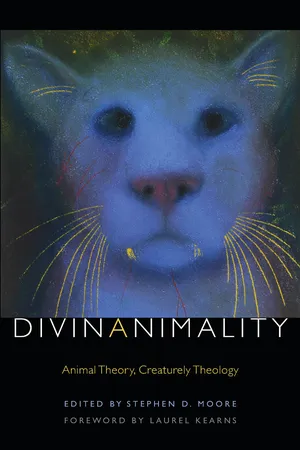
A turn to the animal is underway in the humanities, most obviously in such fields as philosophy, literary studies, cultural studies, and religious studies. One important catalyst for this development has been the remarkable body of animal theory issuing from such thinkers as Jacques Derrida and Donna Haraway. What might the resulting interdisciplinary field, commonly termed animality studies, mean for theology, biblical studies, and other cognate disciplines? Is it possible to move from animal theory to creaturely theology?
This volume is the first full-length attempt to grapple centrally with these questions. It attempts to triangulate philosophical and theoretical reflections on animality and humanity with theological reflections on divinity. If the animal–human distinction is being rethought and retheorized as never before, then the animal–human–divine distinctions need to be rethought, retheorized, and retheologized along with it. This is the task that the multidisciplinary team of theologians, biblical scholars, philosophers, and historians assembled in this volume collectively undertakes. They do so frequently with recourse to Derrida's animal philosophy and also with recourse to an eclectic range of other relevant thinkers, such as Haraway, Giorgio Agamben, Emmanuel Levinas, Gloria Anzaldua, Helene Cixous, A. N. Whitehead, and Lynn White Jr.
The result is a volume that will be essential reading for religious studies audiences interested in ecological issues, animality studies, and posthumanism, as well as for animality studies audiences interested in how constructions of the divine have informed constructions of the nonhuman animal through history.
- 392 pages
- English
- ePUB (mobile friendly)
- Available on iOS & Android
eBook - ePub
About this book
Information
Publisher
Fordham University PressYear
2014Print ISBN
9780823263202
9780823263196
eBook ISBN
9780823263219
Topic
Theology & ReligionSubtopic
Christian TheologyNOTES
FOREWORD | LAUREL KEARNS
1. Laurel Kearns and Catherine Keller, eds., Ecospirit: Religions and Philosophies for the Earth, Transdisciplinary Theological Colloquia (New York: Fordham University Press, 2007).
2. Jacques Derrida, Animal That Therefore I Am, ed. Marie-Louise Mallet, trans. David Wood, Perspectives in Continental Philosophy (New York: Fordham University Press, 2008).
3. Ibid., 90.
4. Donna Haraway, When Species Meet, Posthumanities (Minneapolis: University of Minnesota Press, 2008), 20.
5. Derrida, Animal That Therefore I Am, 32.
6. James Cone, “Whose Earth Is It Anyway?” in Earth Habitat: Eco-Injustice and the Church’s Response, ed. Dieter Hessel and Larry Rasmussen (Minneapolis: Fortress Press, 2001), 23.
7. John Wesley, Sermon 23, “Upon Our Lord’s Sermon on the Mount, III,” in Works of John Wesley (London: Wesleyan Methodist Book Room, 1872), vol. 5, I.11.
8. Martin Luther, as quoted in Paul Santmire, Nature Reborn: The Ecological and Cosmic Promise of Christian Theology (Minneapolis: Fortress Press, 2000), 82.
9. Aldo Leopold, A Sand County Almanac, and Sketches Here and There (1948; New York: Oxford University Press, 1987), 129–32.
INTRODUCTION: FROM ANIMAL THEORY TO CREATURELY THEOLOGY | STEPHEN D. MOORE
1. Kari Weil, Thinking Animals: Why Animal Studies Now? (New York: Columbia University Press, 2012), 4. Further on the complex relations between animal advocacy and advocacy for oppressed human groups, see Marianne DeKoven and Michael Lundblad, eds., Species Matters: Humane Advocacy and Cultural Theory (New York: Columbia University Press, 2012).
2. Marianne DeKoven, “Guest Column: Why Animals Now?” PMLA 124, no. 2 (2009): 368n3. See further Michael Lundblad, “From Animal to Animality Studies,” PMLA 124, no. 2 (2009): 496–502). For the “zoocriticism” moniker, see Graham Huggan and Helen Tiffin, Postcolonial Ecocriticism: Literature, Animals, Environment (New York: Routledge, 2010), 18. Zoocriticism “is concerned not just with animal representation but also with animal rights.”
3. See Dian Fossey, Gorillas in the Mist (Boston: Houghton Mifflin, 1983); Jane Goodall, The Chimpanzees of Gombe: Patterns of Behavior (Cambridge, Mass.: Belknap Press of Harvard University Press, 1986); Peter Singer, Animal Liberation (New York: Avon, 1975); Tom Regan, The Case for Animal Rights (Berkeley: University of California Press, 1983); J. M. Coetzee, The Lives of Animals, ed. Amy Gutmann (Princeton: Princeton University Press, 1999).
4. Lynn White Jr., “The Historical Roots of Our Ecologic Crisis,” Science 155, no. 3767 (1967): 1203–7, reprinted in The Ecocriticism Reader: Landmarks in Literary Ecology, ed. Cheryll Glotfelty and Harold Fromm (Athens: University of Georgia Press, 1996), 3–14. Although White’s native field was medieval history, his article is the opening selection in this anthology, which was the first full-length introduction to ecocriticism in the field of literary studies—testimony to White’s cross-disciplinary reach.
5. Ibid., 9. Page references to White’s article are from The Ecocriticism Reader.
6. Ibid., 13.
7. It is appropriate, then, that the last main essay in the volume, that of Matthew Riley, should engage explicitly with White’s seminal article, while also radically reframing it.
8. Fossey, Gorillas in the Mist, 141.
9. Ibid., 141–42.
10. Jacques Derrida, “L’animal que donc je suis (à suivre),” in L’animal autobiographique, ed. Marie-Louise Mallet (Paris: Galilée, 1999), 251–303
11. Jacques Derrida, “The Animal That Therefore I Am (More to Follow),” trans. David Wills, Critical Inquiry 28, no. 2 (2002): 369–418.
12. Jacques Derrida, The Animal That Therefore I Am, ed. Marie-Louise Mallet; trans. David Wills, Perspectives in Continental Philosophy (New York: Fordham University Press, 2008).
13. Jacques Derrida, The Beast and the Sovereign, ed. Michel Lisse et al.; trans. Geoffrey Bennington, 2 vols., Seminars of Jacques Derrida (Chicago: University of Chicago Press, 2009–11), 1:1–2. Originally published as Séminaire: La bête et le souverain, Volume I (2001–2002); Volume II (2002–2003), ed. Michel Lisse et al. (Paris: Galilée, 2008–10).
14. The quotation is from The Animal That Therefore I Am, 37–38, where Derrida provides a list of his texts in which mammals, birds, reptiles, fish, insects, and other “critters” range freely. The list, although lengthy, is cursory and incomplete. Generally speaking, however, it is mainly in relation to Heideggerian thought that Derrida engages in sustained fashion with “the question of the animal” prior to “The Animal That Therefore I Am.” Two other Derridean engagements with animality are also worth noting: “‘Eating Well’; or, The Calculation of the Subject,” in Who Comes after the Subject? ed. Eduardo Cadava, Peter Connor, and Jean-Luc Nancy (New York: Routledge, 1991), 96–119; and “Violence against Animals,” in For What Tomorrow . . . : A Dialogue, by Jacques Derrida and Elisabeth Roudinesco, trans. Jeff Fort, Cultural Memory in the Present (Stanford, Calif.: Stanford University Press, 2004), 62–76.
15. Cary Wolfe, “Human, All Too Human: ‘Animal Studies’ and the Humanities,” PMLA 124, no. 2 (2009): 570. Wolfe’s article is perhaps the best brief overview of animality studies to date. For book-length overviews (each rather differently focused), see Weil, Thinking Animals; Margo DeMello, Animals and Society: An Introduction to Human-Animal Studies (New York: Columbia University Press, 2012); and Dawne McCance, Critical Animal Studies: An Introduction (Albany: State University of New York Press, 2013). For the intersection of animality studies and postcolonial studies, see Huggan and Tiffin, Postcolonial Ecocriticism, which includes a biblically oriented chapter titled “Christianity, Cannibalism and Carnivory” (162–84). For the relationship of animality studies to posthumanism, see Cary Wolfe, What Is Posthumanism? Posthumanities (Minneapolis: University of Minnesota Press, 2009), 99–142.
16. The precise relationship of “theory” to poststructuralism is a contested issue, prompting Jonathan Culler to venture a more cautious (but perhaps overly expansive) definition of it as an umbrella term for “discourses that come to exercise influence outside their apparent disciplinary realm because they offer new and persuasive characterizations of problems or phenomena of general interest: language, consciousness, meaning, nature and culture . . . , and so on” (The Literary in Theory, Cultural Memory in the Present [Stanford, Calif.: Stanford University Press, 2007], 4.)
17. See Gilles Deleuze and Félix Guattari’s A Thousand Plateaus: Capitalism and Schizophrenia, trans. Brian Massumi (1980; Minneapolis: University of Minnesota Press, 1987), 256–341.
18. See Julia Kristeva, Powers of Horror: An Essay on Abjection, trans. Leon S. Roudiez, European Perspectives (1980; New York: Columbia University Press, 1982); Kelly Oliver, Animal Lessons: How They Teach Us to Be Human (New York: Columbia University Press, 2009), 277–302.
19. See Emmanuel Levinas, “The Name of a Dog, or Natural Rights,” in Difficult Freedom: Essays on Judaism, trans. Sean Hand (Baltimore: Johns Hopkins University Press, 1990), 151–53.
20. See Matthew Calarco and Peter Atterton, eds., Animal Philosophy: Essential Readings in Continental Thought (New York: Continuum, 2004), 31–36, 63–71, 193–201.
21. Even “animal theory,” however capacious, is still a relatively bounded universe of discourse. When critical reflection on animality is loosed from “theory,” it flies still farther afield—as far as Whitehead even, a crucial r...
Table of contents
- Cover
- Series Page
- Title Page
- Copyright
- Dedication
- Contents
- Foreword
- Acknowledgments
- Introduction: From Animal Theory to Creaturely Theology
- Animals, before Me, with Whom I Live, by Whom I Am Addressed: Writing after Derrida
- The Dogs of Exodus and the Question of the Animal
- Devouring the Human: Digestion of a Corporeal Soteriology
- The Microbes and Pneuma That Therefore I Am
- The Apophatic Animal: Toward a Negative Zootheological Imago Dei
- The Divinanimality of Lord Sequoia
- Animal Calls
- Little Bird in My Praying Hands: Rainer Maria Rilke and God’s Animal Body
- The Logos of God and the End of Humanity: Giorgio Agamben and the Gospel of John on Animality as Light and Life
- Anzaldúa’s Animal Abyss: Mestizaje and the Late Ancient Imagination
- Daniel’s Animal Apocalypse
- Ecotherology
- And Say the Animal Really Responded: Speaking Animals in the History of Christianity
- So Many Faces: God, Humans, and Animals
- A Spiritual Democracy of All God’s Creatures: Ecotheology and the Animals of Lynn White Jr.
- Epilogue. Animals and Animality: Reflections on the Art of Jan Harrison
- Notes
- List of Contributors
- Index
- Series List
Trusted by 375,005 students
Access to over 1.5 million titles for a fair monthly price.
Study more efficiently using our study tools.
Frequently asked questions
Yes, you can cancel anytime from the Subscription tab in your account settings on the Perlego website. Your subscription will stay active until the end of your current billing period. Learn how to cancel your subscription
No, books cannot be downloaded as external files, such as PDFs, for use outside of Perlego. However, you can download books within the Perlego app for offline reading on mobile or tablet. Learn how to download books offline
Perlego offers two plans: Essential and Complete
- Essential is ideal for learners and professionals who enjoy exploring a wide range of subjects. Access the Essential Library with 800,000+ trusted titles and best-sellers across business, personal growth, and the humanities. Includes unlimited reading time and Standard Read Aloud voice.
- Complete: Perfect for advanced learners and researchers needing full, unrestricted access. Unlock 1.5M+ books across hundreds of subjects, including academic and specialized titles. The Complete Plan also includes advanced features like Premium Read Aloud and Research Assistant.
We are an online textbook subscription service, where you can get access to an entire online library for less than the price of a single book per month. With over 1.5 million books across 990+ topics, we’ve got you covered! Learn about our mission
Look out for the read-aloud symbol on your next book to see if you can listen to it. The read-aloud tool reads text aloud for you, highlighting the text as it is being read. You can pause it, speed it up and slow it down. Learn more about Read Aloud
Yes! You can use the Perlego app on both iOS and Android devices to read anytime, anywhere — even offline. Perfect for commutes or when you’re on the go.
Please note we cannot support devices running on iOS 13 and Android 7 or earlier. Learn more about using the app
Please note we cannot support devices running on iOS 13 and Android 7 or earlier. Learn more about using the app
Yes, you can access Divinanimality by Stephen D. Moore in PDF and/or ePUB format, as well as other popular books in Theology & Religion & Christian Theology. We have over 1.5 million books available in our catalogue for you to explore.