What is flirtation, and how does it differ from seduction?
In historical terms, the particular question of flirtation has tended to be obscured by that of seduction, which has understandably been a major preoccupation for twentieth-century thought and critical theory. Both the discourse and the critique of seduction are unified by their shared obsession with a very determinate end: power. In contrast, flirtation is the game in which no one seems to gain the upper hand and no one seems to surrender. The counter-concept of flirtation has thus stood quietly to the side, never quite achieving the same prominence as that of seduction. It is this elusive (and largely ignored) territory of playing for play's sake that is the subject of this anthology.
The essays in this volume address the under-theorized terrain of flirtation not as a subgenre of seduction but rather as a phenomenon in its own right. Drawing on the interdisciplinary history of scholarship on flirtation even as it re-approaches the question from a distinctly aesthetic and literary-theoretical point of view, the contributors to Flirtations thus give an account of the practice of flirtation and of the figure of the flirt, taking up the act's relationship to issues of mimesis, poetic ambiguity, and aesthetic pleasure. The art of this poetic playfulness—often read or misread as flirtation's "empty gesture"—becomes suddenly legible as the wielding of a particular and subtle form of nonteleological power.
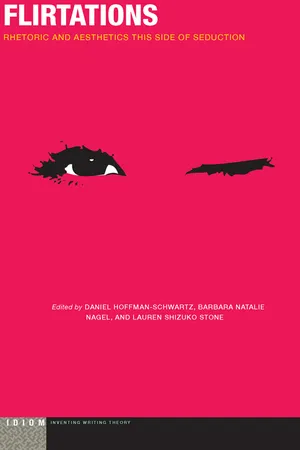
eBook - ePub
Flirtations
Rhetoric and Aesthetics This Side of Seduction
- 192 pages
- English
- ePUB (mobile friendly)
- Available on iOS & Android
eBook - ePub
Flirtations
Rhetoric and Aesthetics This Side of Seduction
About this book
Information
Publisher
Fordham University PressYear
2015Print ISBN
9780823264902
9780823264896
eBook ISBN
9780823264919
NOTES
“ALMOST NOTHING; ALMOST EVERYTHING”
1. The “dialogical” Platonic trajectory of flirtation, which finds its privileged descendants in Enlightenment Romantic salon culture, seems distinct from the modern, urban figuration of flirtation as fleeting encounter.
2. For a rigorous account of the tradition of the thought-image (Denkbild), including the question of the place of Simmel’s writing within the constellation of Benjamin, Bloch, Kracauer, and Adorno, see Gerhard Richter, Thought-Images: Frankfurt School Writers’ Reflections from Damaged Life (Stanford: Stanford University Press, 2007).
3. Georg Simmel, “Flirtation,” in On Women, Sexuality, and Love, translated and introduction by Guy Oakes (New Haven: Yale University Press, 1984), 133–52.
4. Ibid., 144. For “purposiveness without purpose,” see Immanuel Kant, Critique of the Power of Judgement, 1790, translated by Paul Guyer and Eric Matthews (Cambridge, U.K.: Cambridge University Press, 2000).
5. Ernst Bloch, “Pippa Passes,” 1969, in Traces, translated by Anthony A. Nassar (Stanford: Stanford University Press, 2006), 59–61.
6. Ibid., 59.
7. Ibid., 60.
8. Ibid.
9. Ibid., 61.
10. Adam Phillips, On Flirtation: Psychoanalytic Essays on the Uncommitted Life (Cambridge, Mass.: Harvard University Press, 1994), 12.
11. In the field of literary studies itself, the most significant work is Richard Kaye’s The Flirt’s Tragedy: Desire Without End in Victorian and Edwardian Fiction (Charlottesville: Virginia University Press, 2002), which offers a comprehensive analysis of flirtation in the nineteenth- and early twentieth-century novel. Kaye reads flirtation as a formal feature—concentrating on the temporal aspect of deferral for the novel—as well as a political moment, “a dissident gesture.” Though we have learned much from Kaye’s work, our project is broader in scope, covering a wider range of periods, genres, and national literary traditions. Perhaps more important and especially in distinction from Kaye’s, our project is unabashedly speculative, taking flirtation as an object of general theoretical interest rather than as a period artifact or an object of strictly genealogical investigation.
12. Phillips, On Flirtation, xii.
13. Ibid., xxiii.
14. Ibid., xvii.
15. Roland Barthes, A Lover’s Discourse: Fragments, 1977, translated by Richard Howard (New York: Hill and Wang, 1996), 4.
16. Ibid., 3.
17. Stanley Cavell, Pursuits of Happiness (Cambridge, Mass.: Harvard University Press, 1981), 7.
18. Ibid., 86.
19. It should be noted in passing that Cavell tends to read the analogy between the conversations in the films and philosophical conversation in only one direction. His intervention is to demonstrate the philosophical significance of the comedy of remarriage, but the amorous conversations of his films seem to be treated as a special case of philosophical-critical conversation rather than its paradigm, thus shielding the philosopher from a full engagement with the affective (libidinal, gendered) dimensions of the philosophical enunciation. In this regard the Symposium remains more radical; in Cavell no Alcibiades bursts upon the scene.
20. Cavell, Pursuits of Happiness, 88.
21. In this regard it is telling that Cavell, like Simmel, cites the Kantian formula of “purposefulness without purpose” but, unlike Simmel, imagines this as the “achievement” of the constituted couple; for Cavell “purposefulness without purpose” seems to presuppose the teleology of the couple (ibid., 89).
22. Niklas Luhmann, Liebe als Passion: Zur Codierung von Intimität (Frankfurt: Suhrkamp, 1982); Niklas Luhmann, Love as Passion: The Codification of Intimacy, translated by Jeremy Gaines and Doris L. Jones (Cambridge, U.K.: Polity Press, 1986).
23. Ibid., 18–33.
24. Ibid., 28.
25. Ibid., 18.
26. Luhmann’s analysis of the paradoxical “communication of the incommunicable” (ibid., 128) only underscores the degree to which communication forms the ultimate horizon of his thinking on love and literature alike.
INTERLUDE. BARELY COVERED BANTER
1. Double Indemnity, directed by Billy Wilder, 1944. There is an abundance of writing on the film; see, for instance, Joan Copjec, “The Phenomenal Nonphenomenal: Private Space in Film Noir,” in Shades of Noir (London: Verso, 1993), 167–98; James Naremore, “Straight-Down-the-Line: Making and Remaking Double Indemnity,” Film Comment 32.1 (1996): 22–31; Elisabeth Bronfen, “Femme Fatale: Negotiations of Tragic Desire,” New Literary History 35.1 (2004): 103–16; Hugh S. Manon, “Some Like It Cold: Fetishism in Billy Wilder’s Double Indemnity,” Cinema Journal 44.4 (2005): 18–43.
2. James Cain, Double Indemnity (New York: Knopf, 1943).
3. Stanley Cavell, Pursuits of Happiness (Cambridge, Mass.: Harvard University Press, 1981). The films discussed by Cavell were produced between 1934 and 1949; Double Indemnity, in other words, is very much the contemporary of the comedy of remarriage.
4. Ibid., 88.
5. Ibid., 86.
6. For a philosophical account of indemnification, see Jacques Derrida, “Faith and Knowledge,” translated by Samuel Weber, in Acts of Religion, edited by Gil Anidjar (New York: Routledge 2002), 40–101.
7. Georg Simmel, “Flirtation,” in Georg Simmel: On Women, Sexuality, and Love, translated by Guy Oakes (New Haven: Yale University Press, 1984), 143; Georg Simmel, “Die Koketterie,” in Philosophische Kultur (Leipzig: Klinkhardt, 1911), 90.
8. Simmel, “Flirtation,” 145; Simmel, “Die Koketterie,” 92.
9. In his extremely insightful 1998 review of the film, Roger Ebert touches indirectly on this question: “On their third meeting, after a lot of aggressive wordplay, they agree to kill the husband and collect the money. I guess they also make love; in 1944 movies you can’t be sure, but if they do, it’s only the once.” See Roger Ebert, “Double Indemnity Movie Review,” Chicago Sun Times, December 20, 1998, archived at http://www.rogerebert.com/reviews/great-movie-double-indemnity-1944, accessed March 11, 2014.
10. As an editor I was able to profit from the other contributions to the volume. On flirtation and death, see Hamilton’s essay and Anderson’s.
11. On the relation of the Kantian formula of “purposiveness without purpose” to flirtation, see Simmel, as...
Table of contents
- Cover
- Half Title
- Series Announcement Page
- Title Page
- Copyright
- Contents
- Acknowledgments
- Half Title
- “Almost Nothing; Almost Everything”: An Introduction to the Discourse of Flirtation
- Meta-Flirtations
- Flirtation with the World
- Flirtation and Transgression
- Notes
- List of Contributors
- Index
- Series Page
Trusted by 375,005 students
Access to over 1.5 million titles for a fair monthly price.
Study more efficiently using our study tools.
Frequently asked questions
Yes, you can cancel anytime from the Subscription tab in your account settings on the Perlego website. Your subscription will stay active until the end of your current billing period. Learn how to cancel your subscription
No, books cannot be downloaded as external files, such as PDFs, for use outside of Perlego. However, you can download books within the Perlego app for offline reading on mobile or tablet. Learn how to download books offline
Perlego offers two plans: Essential and Complete
- Essential is ideal for learners and professionals who enjoy exploring a wide range of subjects. Access the Essential Library with 800,000+ trusted titles and best-sellers across business, personal growth, and the humanities. Includes unlimited reading time and Standard Read Aloud voice.
- Complete: Perfect for advanced learners and researchers needing full, unrestricted access. Unlock 1.5M+ books across hundreds of subjects, including academic and specialized titles. The Complete Plan also includes advanced features like Premium Read Aloud and Research Assistant.
We are an online textbook subscription service, where you can get access to an entire online library for less than the price of a single book per month. With over 1.5 million books across 990+ topics, we’ve got you covered! Learn about our mission
Look out for the read-aloud symbol on your next book to see if you can listen to it. The read-aloud tool reads text aloud for you, highlighting the text as it is being read. You can pause it, speed it up and slow it down. Learn more about Read Aloud
Yes! You can use the Perlego app on both iOS and Android devices to read anytime, anywhere — even offline. Perfect for commutes or when you’re on the go.
Please note we cannot support devices running on iOS 13 and Android 7 or earlier. Learn more about using the app
Please note we cannot support devices running on iOS 13 and Android 7 or earlier. Learn more about using the app
Yes, you can access Flirtations by Barbara Natalie Nagel,Lauren Shizuko Stone, Daniel Hoffman-Schwartz in PDF and/or ePUB format, as well as other popular books in Social Sciences & Literary Criticism for Comparative Literature. We have over 1.5 million books available in our catalogue for you to explore.